Department of Psychology, New York University, New York, NY, USA.
Cognition and Brain Plasticity Unit, IDIBELL, L'Hospitalet de Llobregat, Barcelona, Spain.
Nat Neurosci. 2019 Apr;22(4):627-632. doi: 10.1038/s41593-019-0353-z. Epub 2019 Mar 4.
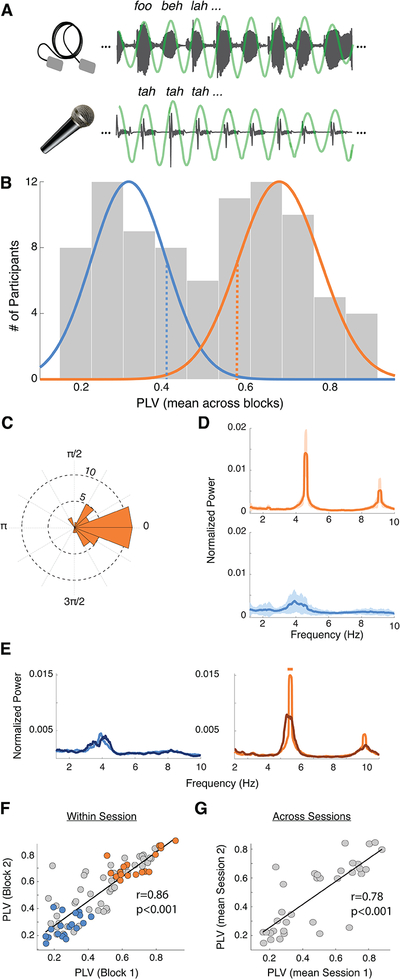
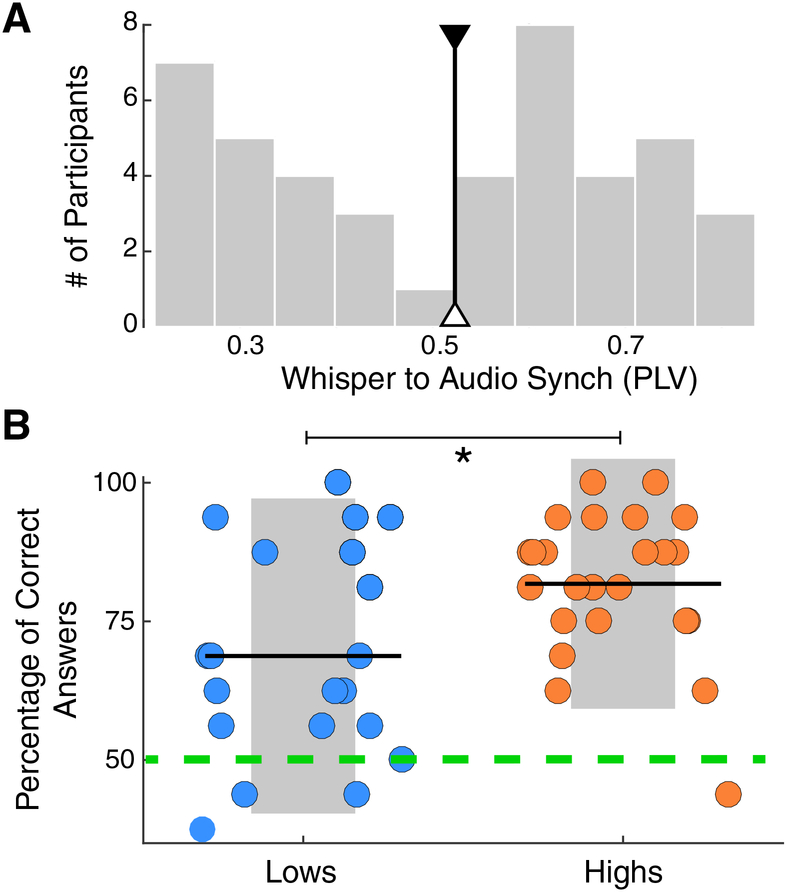
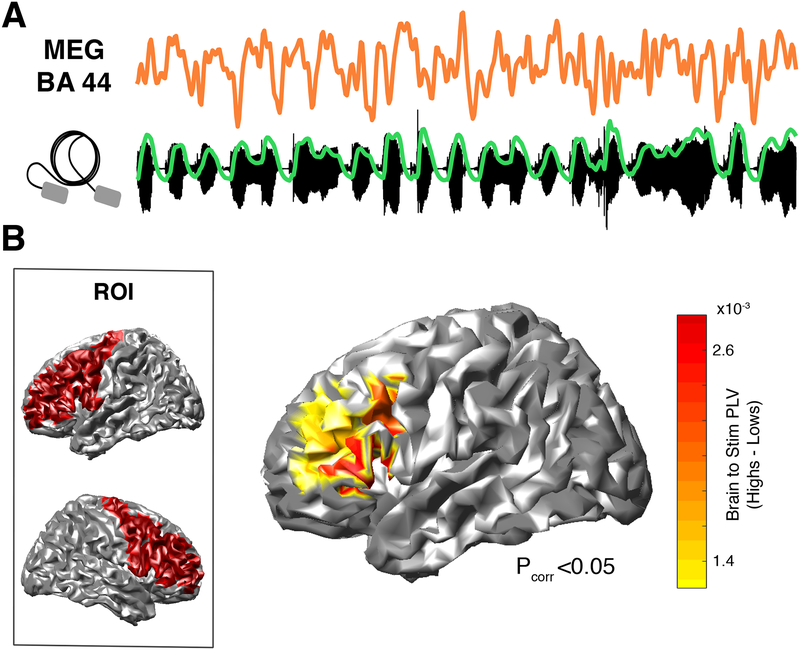
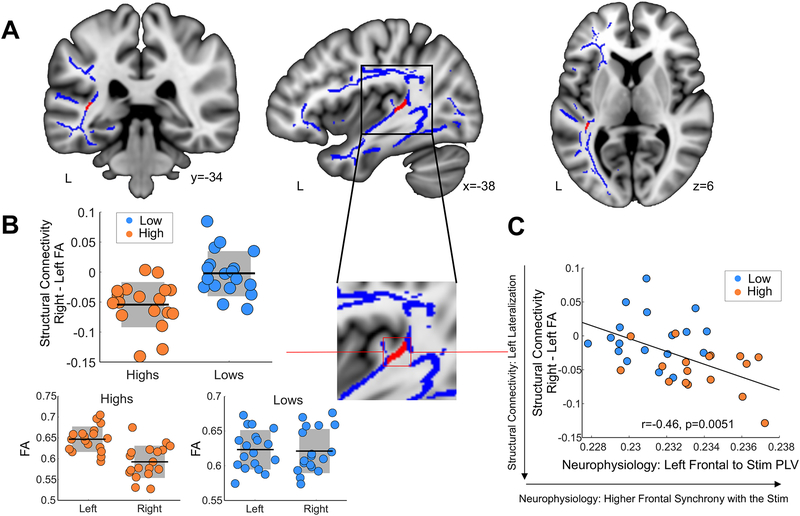
We introduce a deceptively simple behavioral task that robustly identifies two qualitatively different groups within the general population. When presented with an isochronous train of random syllables, some listeners are compelled to align their own concurrent syllable production with the perceived rate, whereas others remain impervious to the external rhythm. Using both neurophysiological and structural imaging approaches, we show group differences with clear consequences for speech processing and language learning. When listening passively to speech, high synchronizers show increased brain-to-stimulus synchronization over frontal areas, and this localized pattern correlates with precise microstructural differences in the white matter pathways connecting frontal to auditory regions. Finally, the data expose a mechanism that underpins performance on an ecologically relevant word-learning task. We suggest that this task will help to better understand and characterize individual performance in speech processing and language learning.
我们介绍了一个看似简单的行为任务,它可以在普通人群中可靠地识别出两种截然不同的群体。当呈现一系列随机音节的等时序列时,一些听众会不由自主地使自己发出的音节与感知到的节奏保持一致,而另一些听众则对外部节奏无动于衷。我们使用神经生理学和结构成像方法,展示了具有明显言语处理和语言学习后果的群体差异。当被动听语音时,高同步者在前额区域表现出与刺激同步性增加,这种局部模式与连接额叶和听觉区域的白质通路的微观结构差异精确相关。最后,数据揭示了一种支撑在生态相关的单词学习任务中表现的机制。我们认为,这个任务将有助于更好地理解和描述言语处理和语言学习中的个体表现。