Han Susu, Huang Tao, Wu Xing, Wang Xiyu, Li Wen, Liu Shanshan, Yang Wei, Shi Qi, Li Hongjia, Shi Kunhe, Hou Fenggang
Shanghai Municipal Hospital of Traditional Chinese Medicine, Shanghai University of Traditional Chinese Medicine, 274 Zhijiang Road, Shanghai 200071, People's Republic of China
The Affiliated Hospital of Ningbo University, Ningbo, Zhejiang, 315020, People's Republic of China.
Ther Adv Med Oncol. 2019 Feb 25;11:1758835919830831. doi: 10.1177/1758835919830831. eCollection 2019.
Novel prognostic markers and therapeutic targets for advanced cancer are urgently needed. This report with trial sequential analysis (TSA) was first conducted to provide robust estimates of the correlation between aldehyde dehydrogenase 1 (ALDH1) and Nestin and clinical outcomes of advanced cancer patients.
Hazard ratios (HRs) with 95% confidence intervals (CIs) were summarized for overall survival (OS), disease-free survival (DFS), progression-free survival (PFS), cancer-specific survival (CSS), relapse/recurrence-free survival (RFS), and metastasis-free survival (MFS) from multivariable analysis. TSA was performed to control for random errors.
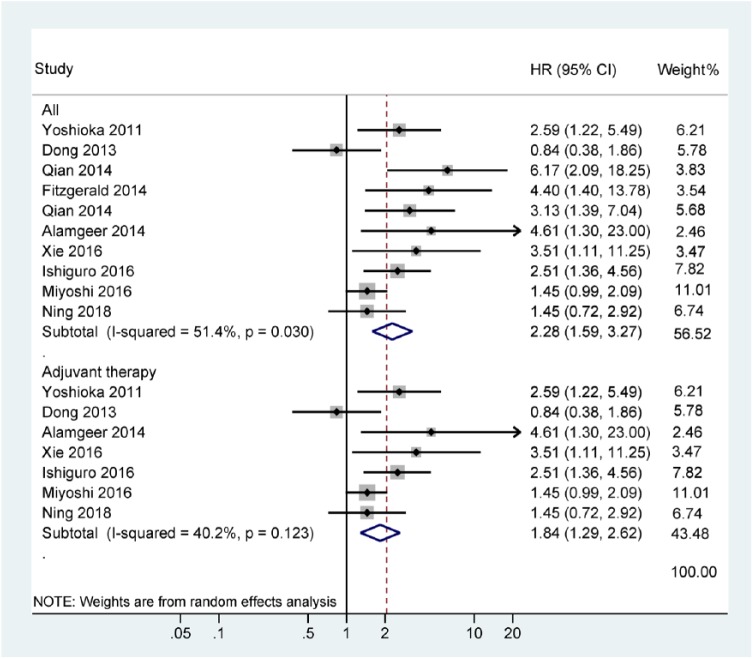
A total of 20 studies with 2050 patients (ALDH1: 15 studies with 1557 patients and Nestin: 5 studies with 493 patients) were identified. ALDH1 (HR = 2.28, < 0.001) and Nestin (HR = 2.39, < 0.001) were associated with a worse OS, as confirmed by TSA. Nestin positivity was linked to a poor PFS (HR = 2.08, < 0.001), but ALDH1 was not linked to DFS, RFS, MFS, or PFS, and TSA showed that more studies were needed. Subgroup analysis by tumor type indicated that ALDH1 positivity may be associated with shorter OS in breast, head and neck cancers, but there was no association with colorectal cancer. Subgroup analysis by study source showed that ALDH1 positivity was correlated with a worse OS for Japanese (HR = 1.94, = 0.002) and European patients (HR = 4.15, < 0.001), but there was no association for Chinese patients. Subgroup analysis by survival rate showed that ALDH1 positivity correlated with poor OS at ⩾ 5 years (HR = 2.33, < 0.001) or 10 years (HR = 1.76, = 0.038).
ALDH1 may be more valuable as an effective therapeutic target than Nestin for improving the long-term survival rate of advanced cancer. Additional prospective clinical trials are needed across different cancer types.
晚期癌症急需新的预后标志物和治疗靶点。本报告首次采用试验序贯分析(TSA),以可靠评估醛脱氢酶1(ALDH1)和巢蛋白与晚期癌症患者临床结局之间的相关性。
通过多变量分析总结总生存期(OS)、无病生存期(DFS)、无进展生存期(PFS)、癌症特异性生存期(CSS)、无复发/无复发生存期(RFS)和无转移生存期(MFS)的风险比(HR)及95%置信区间(CI)。进行TSA以控制随机误差。
共纳入20项研究,涉及2050例患者(ALDH1:15项研究,1557例患者;巢蛋白:5项研究,493例患者)。TSA证实,ALDH1(HR = 2.28,<0.001)和巢蛋白(HR = 2.39,<0.001)与较差的OS相关。巢蛋白阳性与较差的PFS相关(HR = 2.08,<0.001),但ALDH1与DFS、RFS、MFS或PFS无关,TSA表明需要更多研究。按肿瘤类型进行的亚组分析表明,ALDH1阳性可能与乳腺癌、头颈癌患者较短的OS相关,但与结直肠癌无关。按研究来源进行的亚组分析表明,ALDH1阳性与日本患者(HR = 1.94,=0.002)和欧洲患者较差的OS相关(HR = 4.15,<0.001),但与中国患者无关。按生存率进行的亚组分析表明,ALDH1阳性与5年及以上(HR = 2.33,<0.001)或10年(HR = 1.76,=0.038)较差的OS相关。
对于提高晚期癌症患者的长期生存率,ALDH1作为有效治疗靶点可能比巢蛋白更具价值。需要针对不同癌症类型开展更多前瞻性临床试验。