Minami Seigo, Ihara Shouichi, Komuta Kiyoshi
Department of Respiratory Medicine, Osaka Police Hospital, Osaka 543-0035, Japan.
World J Oncol. 2019 Feb;10(1):55-61. doi: 10.14740/wjon1184. Epub 2019 Feb 26.
The Gustave Roussy Immune Score (GRIm-Score) was developed based on the Royal Marsden Hospital (RMH) prognostic score for the purpose of a better patient selection for immunotherapy phase I trials. This scoring system is simply calculated by neutrophil-to-lymphocyte ratio, lactate dehydrogenase (LDH), and serum albumin concentration. The aim of our study was to determine whether GRIm-Score is a practically useful prognostic biomarker for advanced non-small cell lung cancer (NSCLC) patients treated with cytotoxic chemotherapy or epidermal growth factor receptor-tyrosine kinase inhibitor (EGFR-TKI).
This retrospective and single institutional study collected 185 adenocarcinomas without active EGFR mutation, 115 squamous cell carcinomas treated with first-line cytotoxic chemotherapy, and 140 NSCLCs with mutant EGFR treated with first- or second-generation EGFR-TKI monotherapy. These treatments were initiated between July 2007 and March 2018 at our hospital. We compared overall survival (OS) and progression-free survival (PFS) between high and low GRIm-Score groups. Using multivariate Cox proportional hazard analyses, we also found prognostic factors of survival times.
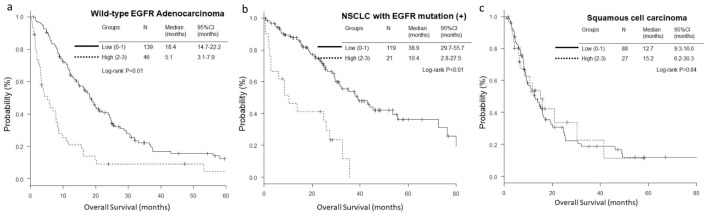
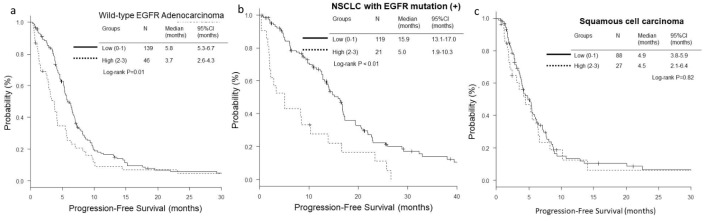
The OS and PFS of low GRIm-Score group were significantly longer than those of high-score group in wild-type EGFR adenocarcinoma (low vs. high; median OS, 18.4 vs. 5.1 months, P < 0.01, and median PFS, 5.8 vs. 3.7 months, P = 0.01) and EGFR-mutant NSCLC (median OS, 38.9 vs. 10.4 months, P < 0.01, and median PFS, 15.9 vs. 5.0 months, P < 0.01). Subsequent multivariate analyses detected high GRIm-Score in wild-type EGFR adenocarcinoma as a poor prognostic factor of OS (hazard ratio (HR) 2.20, 95% CI 1.47 - 3.31, P < 0.01), and in the EGFR-mutant NSCLC as a poor prognostic factor of PFS (HR 1.89, 95% CI 1.00 - 3.55, P = 0.049).
High GRIm-Score was an independent prognostic biomarker of OS of first-line cytotoxic chemotherapy for wild-type EGFR adenocarcinoma and of PFS of first- or second-generation EGFR-TKI for EGFR-mutant NSCLC. Therefore, GRIm-Score is not only a specific selection marker for experimental immunotherapy trials, but may also be a promising and useful pretreatment prognostic maker for specific NSCLC subsets in the real-world practice.
古斯塔夫·鲁西免疫评分(GRIm-Score)是基于皇家马斯登医院(RMH)预后评分开发的,目的是为免疫治疗I期试验更好地选择患者。该评分系统通过中性粒细胞与淋巴细胞比值、乳酸脱氢酶(LDH)和血清白蛋白浓度简单计算得出。我们研究的目的是确定GRIm-Score对于接受细胞毒性化疗或表皮生长因子受体酪氨酸激酶抑制剂(EGFR-TKI)治疗的晚期非小细胞肺癌(NSCLC)患者是否是一种实用的预后生物标志物。
这项回顾性单机构研究收集了185例无活性EGFR突变的腺癌、115例接受一线细胞毒性化疗的鳞状细胞癌以及140例接受第一代或第二代EGFR-TKI单药治疗的EGFR突变NSCLC。这些治疗于2007年7月至2018年3月在我院开始。我们比较了高GRIm-Score组和低GRIm-Score组之间的总生存期(OS)和无进展生存期(PFS)。使用多变量Cox比例风险分析,我们还发现了生存时间的预后因素。
在野生型EGFR腺癌中,低GRIm-Score组的OS和PFS显著长于高评分组(低vs.高;中位OS,18.4个月vs.5.1个月,P<0.01;中位PFS,5.8个月vs.3.7个月,P=0.01),在EGFR突变NSCLC中也是如此(中位OS,38.9个月vs.10.4个月,P<0.01;中位PFS,15.9个月vs.5.0个月,P<0.01)。随后的多变量分析发现,野生型EGFR腺癌中高GRIm-Score是OS的不良预后因素(风险比(HR)2.20,95%CI 1.47 - 3.31,P<0.01),在EGFR突变NSCLC中是PFS的不良预后因素(HR 1.89,95%CI 1.00 - 3.55,P=0.049)。
高GRIm-Score是野生型EGFR腺癌一线细胞毒性化疗OS以及EGFR突变NSCLC第一代或第二代EGFR-TKI PFS的独立预后生物标志物。因此,GRIm-Score不仅是实验性免疫治疗试验的特异性选择标志物,在现实世界实践中对于特定NSCLC亚组也可能是一种有前景且有用的治疗前预后标志物。