Bishop Chris, Read Paul, Chavda Shyam, Jarvis Paul, Turner Anthony
Faculty of Science and Technology, London Sports Institute, Middlesex University, London NW1 4RL, UK.
Athlete Health and Research Performance Center, Aspetar Orthopaedic and Sports Medicine Hospital, Doha 29222, Qatar.
Sports (Basel). 2019 Mar 4;7(3):58. doi: 10.3390/sports7030058.
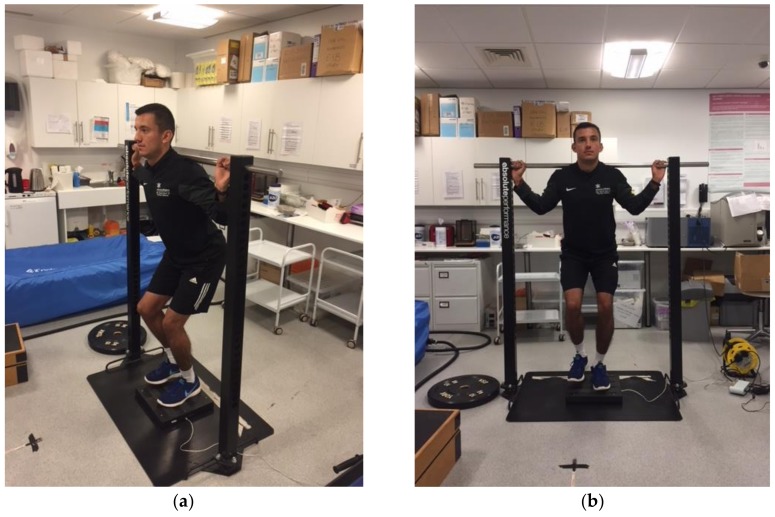
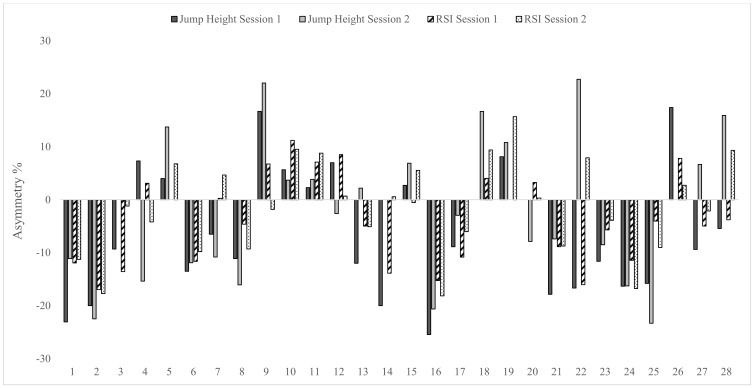
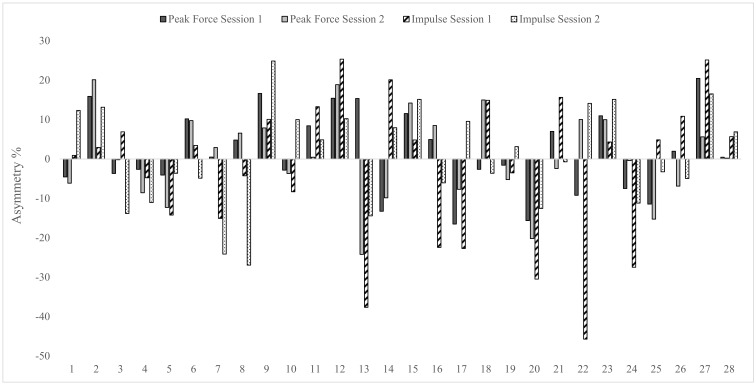
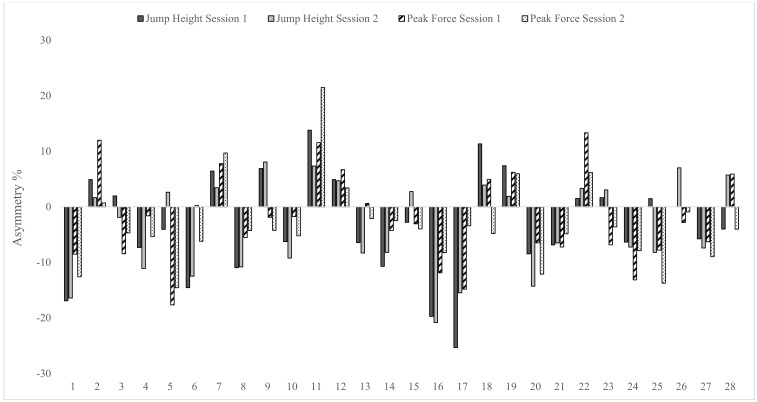
The aims of the present study were to determine test-retest reliability for unilateral strength and power tests used to quantify asymmetry and determine the consistency of both the magnitude and direction of asymmetry between test sessions. Twenty-eight recreational trained sport athletes performed unilateral isometric squat, countermovement jump (CMJ) and drop jump (DJ) tests over two test sessions. Inter-limb asymmetry was calculated from both the best trial and as an average of three trials for each test. Test reliability was computed using the intraclass correlation coefficient (ICC), coefficient of variation (CV) and standard error of measurement (SEM). In addition, paired samples -tests were used to determine systematic bias between test sessions and Kappa coefficients to report how consistently asymmetry favoured the same side. Within and between-session reliability ranged from moderate to excellent (ICC range = 0.70⁻0.96) and CV values ranged from 3.7⁻13.7% across tests. Significant differences in asymmetry between test sessions were seen for impulse during the isometric squat ( = 0.04; effect size = ⁻0.60) but only when calculating from the best trial. When computing the direction of asymmetry across test sessions, levels of agreement were fair to substantial for the isometric squat (Kappa = 0.29⁻0.64), substantial for the CMJ (Kappa = 0.64⁻0.66) and fair to moderate for the DJ (Kappa = 0.36⁻0.56). These results show that when asymmetry is computed between test sessions, the group mean is generally devoid of systematic bias; however, the direction of asymmetry shows greater variability and is often inter-changeable. Thus, practitioners should consider both the direction and magnitude of asymmetry when monitoring inter-limb differences in healthy athlete populations.
本研究的目的是确定用于量化不对称性的单侧力量和功率测试的重测信度,并确定测试阶段之间不对称性的大小和方向的一致性。28名受过休闲训练的运动员在两个测试阶段进行了单侧等长深蹲、反向移动跳(CMJ)和下落跳(DJ)测试。通过每个测试的最佳试验以及三次试验的平均值来计算肢体间不对称性。使用组内相关系数(ICC)、变异系数(CV)和测量标准误差(SEM)计算测试信度。此外,使用配对样本t检验来确定测试阶段之间的系统偏差,并使用卡帕系数来报告不对称性在多大程度上始终有利于同一侧。组内和组间信度从中度到优秀(ICC范围=0.70⁻0.96),各测试的CV值范围为3.7⁻13.7%。等长深蹲过程中的冲量在测试阶段之间的不对称性存在显著差异(P = 0.04;效应大小=⁻0.60),但仅在根据最佳试验计算时出现。在计算测试阶段之间的不对称性方向时,等长深蹲的一致性水平为中等至高度(卡帕=0.29⁻0.64),CMJ为高度(卡帕=0.64⁻0.66),DJ为中等至低度(卡帕=0.36⁻0.56)。这些结果表明,当计算测试阶段之间的不对称性时,组均值通常没有系统偏差;然而,不对称性的方向显示出更大的变异性,并且经常是可互换的。因此,从业者在监测健康运动员群体的肢体间差异时应同时考虑不对称性的方向和大小。