Sabisz Agnieszka, Naumczyk Patrycja, Marcinkowska Anna, Graff Beata, Gąsecki Dariusz, Glińska Anna, Witkowska Marta, Jankowska Anna, Konarzewska Aleksandra, Kwela Jerzy, Jodzio Krzysztof, Szurowska Edyta, Narkiewicz Krzysztof
Second Department of Radiology, Medical University of Gdańsk, Gdańsk, Poland.
Institute of Psychology, University of Gdańsk, Gdańsk, Poland.
Front Aging Neurosci. 2019 Feb 19;11:35. doi: 10.3389/fnagi.2019.00035. eCollection 2019.
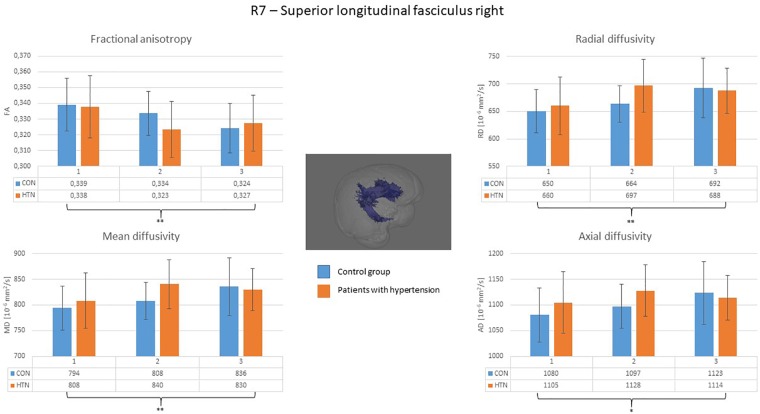
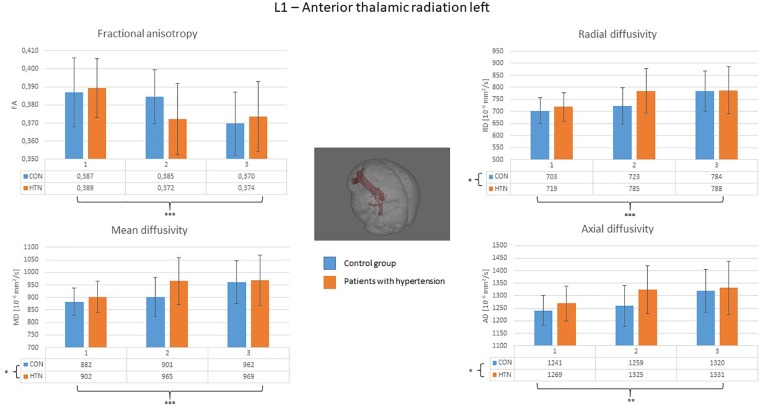
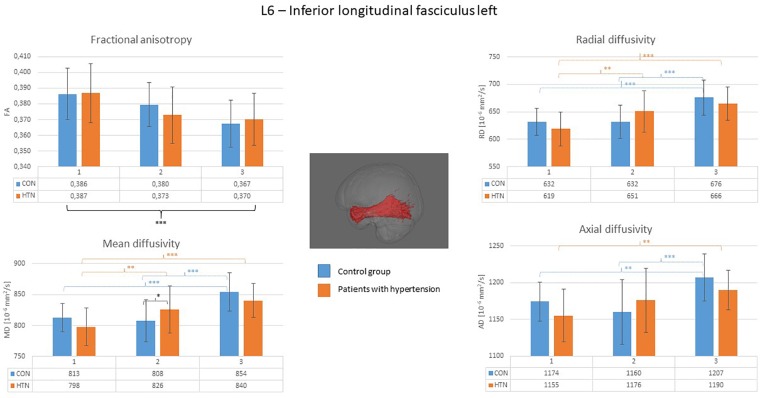
Aging disrupts white matter integrity, and so does continuous elevated blood pressure that accompanies hypertension (HTN). Yet, our understanding of the interrelationship between these factors is still limited. The study aimed at evaluating patterns of changes in diffusion parameters (as assessed by quantitative diffusion fiber tracking - qDTI) following both aging, and hypertension, as well as the nature of their linkage. 146 participants took part in the study: the control group ( = 61) and the patients with hypertension ( = 85), and were divided into three age subgroups (25-47, 48-56, 57-71 years). qDTI was used to calculate the values of fractional anisotropy, mean, radial and axial diffusivity in 20 main tracts of the brain. The effects of factors (aging and hypertension) on diffusion parameters of tracts were tested with a two-way ANOVA. In the right hemisphere there was no clear effect of the HTN, nor an interaction between the factors, though some age-related effects were observed. Contrary, in the left hemisphere both aging and hypertension contributed to the white matter decline, following a functional pattern. In the projection pathways and the fornix, HTN and aging played part independent of each other, whereas in association fibers and the corpus callosum if the hypertension effect was significant, an interaction was observed. HTN patients manifested faster decline of diffusion parameters but also reached a plateau earlier, with highest between-group differences noted in the middle-aged subgroup. Healthy and hypertensive participants have different brain aging patterns. The HTN is associated with acceleration of white matter integrity decline, observed mainly in association fibers of the left hemisphere.
衰老会破坏白质完整性,高血压(HTN)伴随的持续血压升高也会如此。然而,我们对这些因素之间相互关系的理解仍然有限。该研究旨在评估衰老和高血压后扩散参数(通过定量扩散纤维追踪 - qDTI评估)的变化模式及其联系的性质。146名参与者参与了该研究:对照组(n = 61)和高血压患者(n = 85),并被分为三个年龄亚组(25 - 47岁、48 - 56岁、57 - 71岁)。qDTI用于计算大脑20个主要神经束中的各向异性分数、平均扩散率、径向扩散率和轴向扩散率的值。用双向方差分析测试因素(衰老和高血压)对神经束扩散参数的影响。在右半球,高血压没有明显影响,因素之间也没有相互作用,尽管观察到了一些与年龄相关的影响。相反,在左半球,衰老和高血压都导致了白质衰退,呈现出一种功能模式。在投射通路和穹窿中,高血压和衰老相互独立起作用,而在联合纤维和胼胝体中,如果高血压效应显著,则观察到相互作用。高血压患者表现出扩散参数下降更快,但也更早达到平台期,中年亚组中组间差异最大。健康参与者和高血压参与者有不同的脑衰老模式。高血压与白质完整性衰退加速有关,主要在左半球的联合纤维中观察到。