Kayano Taishi, Lee Ki-Deok, Nishiura Hiroshi
Graduate School of Medicine, Hokkaido University, Kita 15 Jo Nishi 7 Chome, Kitaku, Sapporo 0608638, Japan.
Department of Infectious Diseases, School of Medicine, Eulji University, Seoul 01830, Republic of Korea.
Can J Infect Dis Med Microbiol. 2019 Jan 30;2019:1451490. doi: 10.1155/2019/1451490. eCollection 2019.
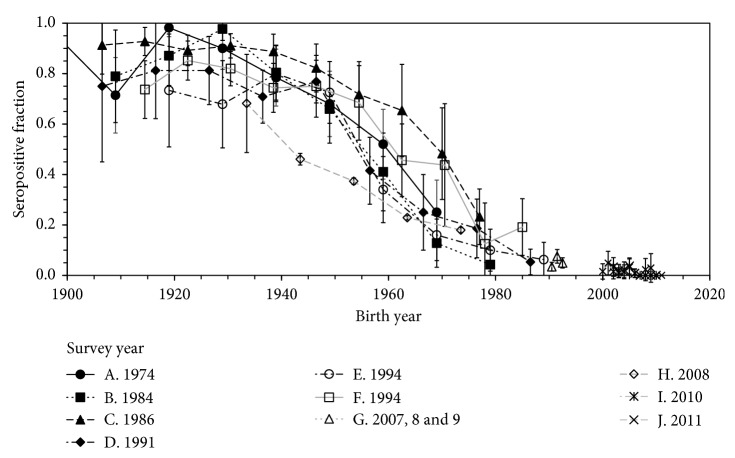
Although the seroprevalence against () in Japan has declined over the birth year, Japanese people have yet exhibited a relatively high risk of gastric cancer. The present study employed mathematical models to estimate the time- and age-dependent force of infection with in Japan, predicting the future seroprevalence by time and age.
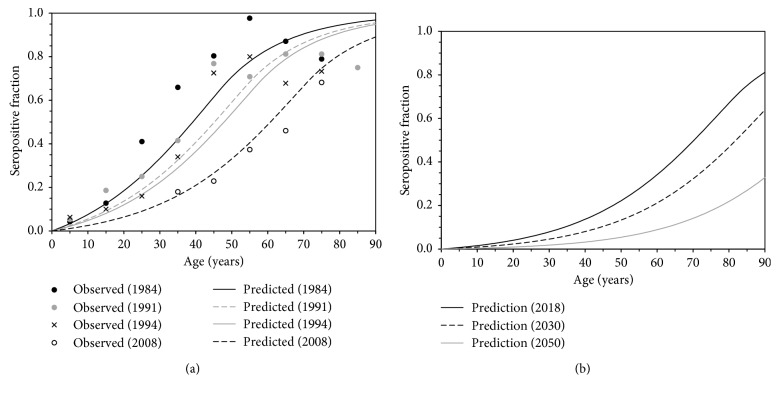
We investigated the published seroprevalence data against in Japan from 1980-2018. Solving the McKendrick partial differential equation model, the seroprevalence was modeled as a function of survey year and age. Maximum likelihood estimation was conducted to estimate parameters governing the time- and age-dependent force of infection.
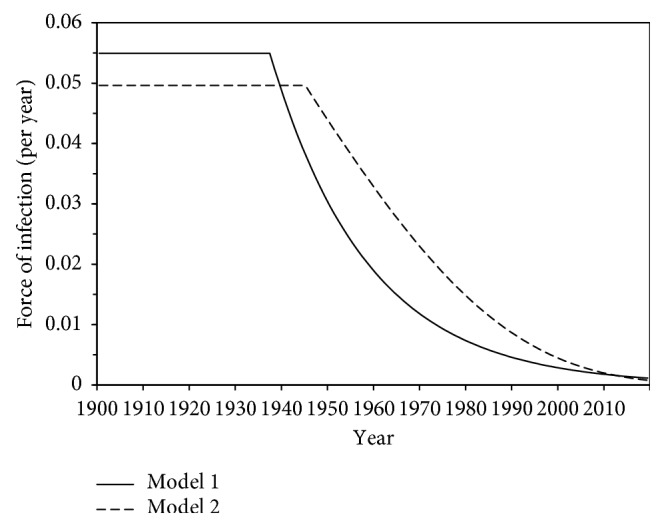
Among all fitted models, the time-dependent and age-independent model with an exponentially decaying force of infection over years was most favored. Fitted models indicated that the force of infection started to decrease during and/or shortly after the World War II. Using the parameterized model, the predicted fraction seropositive at the age of 40 years in 2018 was 0.22, but it is expected to decrease to 0.13 in 2030 and 0.05 in 2050, respectively.
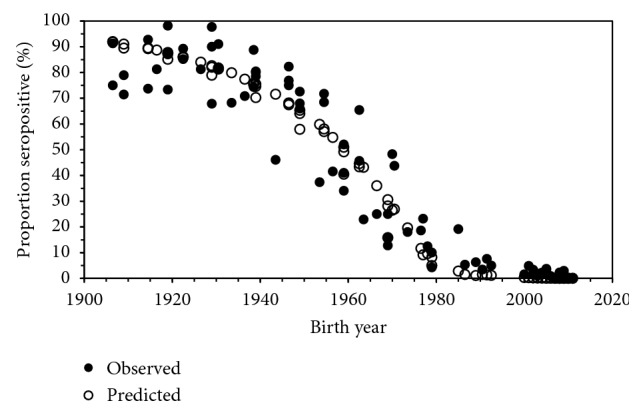
The time dependence was consistent with the decline in the force of infection as a function of the birth year. The force of infection has continuously and greatly declined over time, implying the diminished transmission of through the time course and small chance of persistence. These findings are critical to anticipate the future decline in gastric cancer incidence.
尽管日本针对()的血清阳性率随出生年份有所下降,但日本人患胃癌的风险仍然相对较高。本研究采用数学模型来估计日本随时间和年龄变化的感染()的感染力,预测未来不同时间和年龄的血清阳性率。
我们调查了1980 - 2018年日本已发表的针对()的血清阳性率数据。通过求解麦肯德里克偏微分方程模型,将血清阳性率建模为调查年份和年龄的函数。进行最大似然估计以估计控制随时间和年龄变化的感染力的参数。
在所有拟合模型中,感染力随年份呈指数衰减的时间依赖性且与年龄无关的模型最为合适。拟合模型表明,感染力在第二次世界大战期间和/或之后不久开始下降。使用参数化模型,2018年40岁时预测的血清阳性率为0.22,但预计到2030年将降至0.13,到2050年将降至0.05。
时间依赖性与感染力随出生年份下降一致。随着时间的推移,感染力持续大幅下降,这意味着()在整个时间过程中的传播减少,持续存在的可能性较小。这些发现对于预测未来胃癌发病率的下降至关重要。