Department of Orthopaedic Surgery, Eulji University Hospital, Daejeon, Korea.
Department of Orthopaedic Surgery, Gyeongsang National University Hospital, Jinju, Korea.
Clin Orthop Surg. 2019 Mar;11(1):1-14. doi: 10.4055/cios.2019.11.1.1. Epub 2019 Feb 18.
The purpose of this systematic review was to investigate various fixation methods or implants used in the treatment of Pauwels type III femoral neck fractures.
PubMed Central, OVID Medline, Cochrane Collaboration Library, Web of Science, Embase, and AHRQ databases were searched to identify relevant studies published until August 2017 with English language restriction. Studies were selected on the basis of the following inclusion criteria: biomechanical study of Pauwels type III femoral neck fractures and the use of dynamic hip screw (DHS) or multiple screw fixation or other devices for fixation of the fracture.
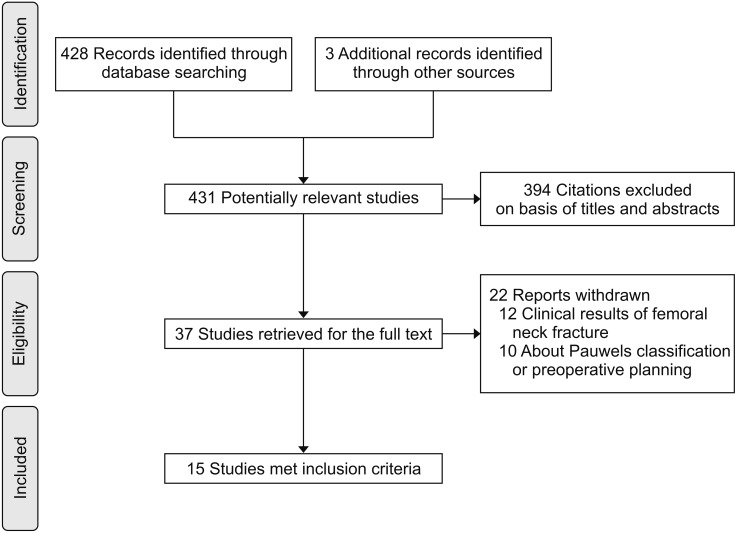
A total of 15 studies were included in the systematic review. Eight studies were conducted using cadavers, six studies using sawbones, and one using a finite element model. During the mechanical testing, each study measured mechanical stiffness, failure to cyclic loading, failure to vertical loading of each fixation device. DHS was included in 11 studies, multiple screw fixation in 10 studies, and other devices in six studies. Baitner et al. and Samsami et al. reported that the mechanical stiffness of DHS was superior to three inverted triangular screw fixation. Hawks et al. and Gumustas et al. reported that using a transverse calcar screw can withstand vertical loading better than three inverted triangular screw fixation. In addition, there were some studies where instruments such as Intertan nail, locking plate or other devices showed excellent biomechanical properties.
There are a variety of methods and instruments for fixation of the Pauwels type III fractures. However, it is difficult to conclude that any method is more desirable because there are advantages and disadvantages to each method. Therefore, we should pay attention to the implant choice and consider adequate weight bearing affecting the stiffness of the implant.
本系统评价的目的是调查治疗Ⅲ型 Pauwels 股骨颈骨折时使用的各种固定方法或植入物。
检索了 PubMed Central、OVID Medline、Cochrane 协作图书馆、Web of Science、Embase 和 AHRQ 数据库,以确定截至 2017 年 8 月发表的英文限制的相关研究。根据以下纳入标准选择研究:Ⅲ型 Pauwels 股骨颈骨折的生物力学研究以及使用动力髋螺钉(DHS)或多钉固定或其他装置固定骨折。
共有 15 项研究纳入系统评价。8 项研究使用尸体,6 项研究使用人造骨,1 项研究使用有限元模型。在力学测试过程中,每项研究均测量了每种固定装置的力学刚度、循环加载失败、垂直加载失败。DHS 纳入 11 项研究,多钉固定纳入 10 项研究,其他装置纳入 6 项研究。Baitner 等人和 Samsami 等人报告 DHS 的力学刚度优于三倒三角钉固定。Hawks 等人和 Gumustas 等人报告称,使用横向骺螺钉可以比三倒三角钉固定更好地承受垂直载荷。此外,还有一些研究表明 Intertan 钉、锁定板或其他器械具有出色的生物力学性能。
治疗Ⅲ型 Pauwels 骨折有多种方法和器械。然而,由于每种方法都有其优缺点,因此很难得出任何一种方法更可取的结论。因此,我们应该注意植入物的选择,并考虑到适当的负重对植入物刚度的影响。