BGPI, INRA Centre Occitanie-Montpellier, SupAgro, CIRAD, Montpellier, France.
SVQV, INRA Centre Grand Est-Colmar, Université de Strasbourg, Colmar, France.
PLoS One. 2019 Mar 6;14(3):e0213087. doi: 10.1371/journal.pone.0213087. eCollection 2019.
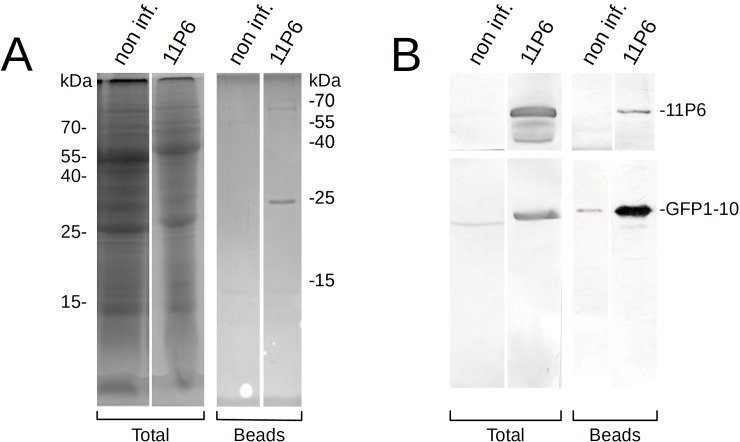
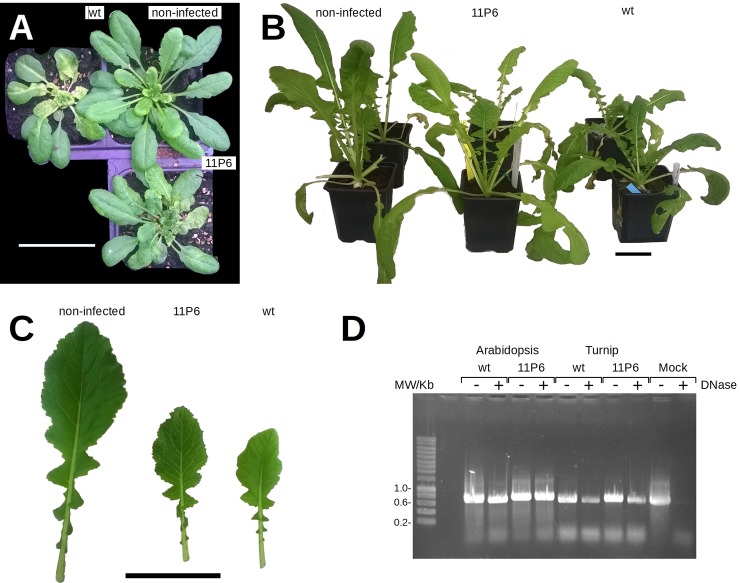
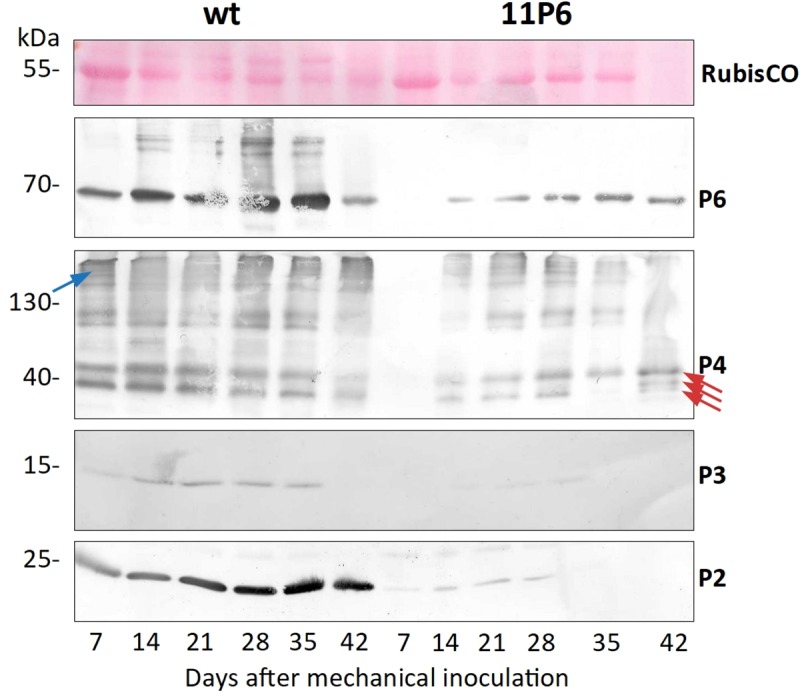
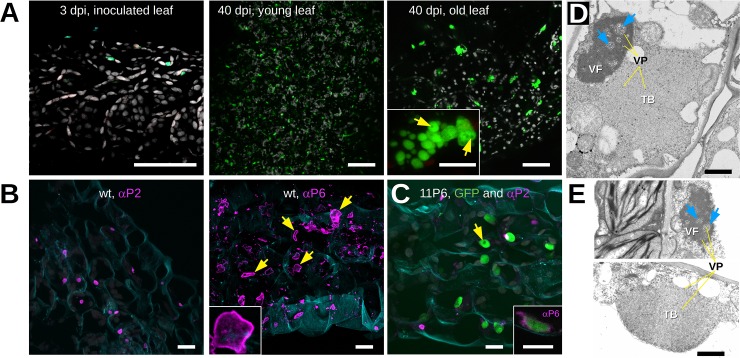
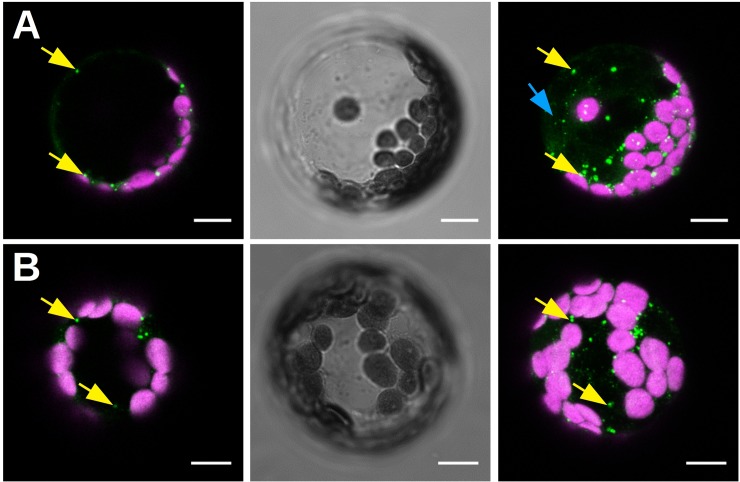
The split GFP technique is based on the auto-assembly of GFP when two polypeptides-GFP1-10 (residues 1-214; the detector) and GFP11 (residues 215-230; the tag)-both non-fluorescing on their own, associate spontaneously to form a fluorescent molecule. We evaluated this technique for its efficacy in contributing to the characterization of Cauliflower mosaic virus (CaMV) infection. A recombinant CaMV with GFP11 fused to the viral protein P6 (a key player in CaMV infection and major constituent of viral factory inclusions that arise during infection) was constructed and used to inoculate transgenic Arabidopsis thaliana expressing GFP1-10. The mutant virus (CaMV11P6) was infectious, aphid-transmissible and the insertion was stable over many passages. Symptoms on infected plants were delayed and milder. Viral protein accumulation, especially of recombinant 11P6, was greatly decreased, impeding its detection early in infection. Nonetheless, spread of infection from the inoculated leaf to other leaves was followed by whole plant imaging. Infected cells displayed in real time confocal laser scanning microscopy fluorescence in wild type-looking virus factories. Thus, it allowed for the first time to track a CaMV protein in vivo in the context of an authentic infection. 11P6 was immunoprecipitated with anti-GFP nanobodies, presenting a new application for the split GFP system in protein-protein interaction assays and proteomics. Taken together, split GFP can be an attractive alternative to using the entire GFP for protein tagging.
分裂 GFP 技术基于 GFP 自身在两种多肽(GFP1-10(残基 1-214;探测器)和 GFP11(残基 215-230;标签))自发组装形成荧光分子时的自动组装。我们评估了该技术在表征花椰菜花叶病毒(CaMV)感染中的功效。构建了一种 GFP11 融合到病毒蛋白 P6(CaMV 感染中的关键因子,也是感染过程中病毒工厂包涵体的主要成分)的重组 CaMV,并用于接种表达 GFP1-10 的转基因拟南芥。突变病毒(CaMV11P6)具有传染性、蚜虫可传播性,并且在多次传代中插入稳定。感染植物的症状延迟且较轻。病毒蛋白积累,特别是重组 11P6,大大减少,阻碍了其在感染早期的检测。尽管如此,从接种叶片到其他叶片的感染传播仍通过全株成像进行跟踪。受感染的细胞在实时共聚焦激光扫描显微镜下显示出野生型病毒工厂的荧光。因此,它首次允许在真实感染的情况下在体内追踪 CaMV 蛋白。11P6 与抗 GFP 纳米抗体免疫沉淀,为分裂 GFP 系统在蛋白质-蛋白质相互作用分析和蛋白质组学中的新应用提供了可能。总之,分裂 GFP 可以成为用于蛋白质标记的完整 GFP 的一种有吸引力的替代方法。