Wimmer Georg, Vécsei Andreas, Häfner Michael, Uhl Andreas
University of Salzburg, Department of Computer Sciences, Salzburg, Austria.
St. Anna Children's Hospital, Vienna, Austria.
J Med Imaging (Bellingham). 2018 Jul;5(3):034504. doi: 10.1117/1.JMI.5.3.034504. Epub 2018 Sep 24.
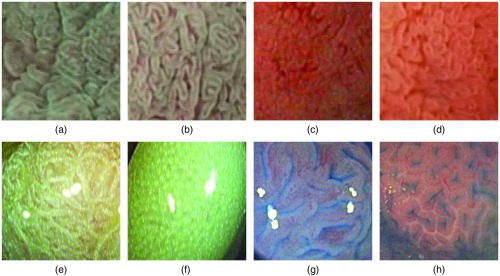
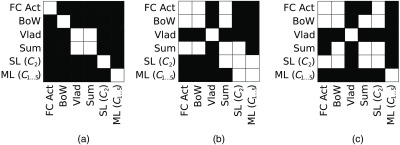
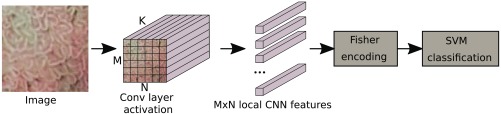
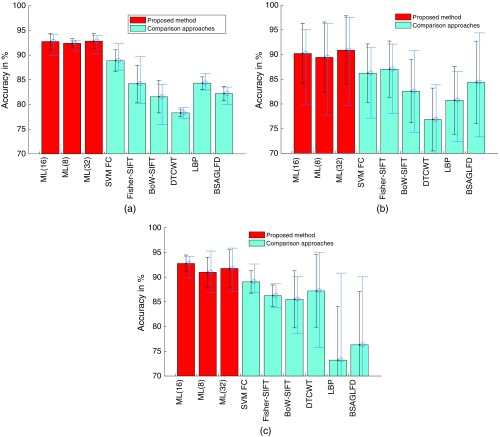
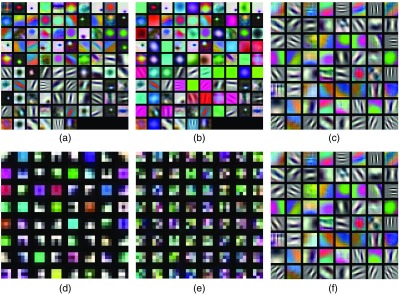
We propose an approach for the automated diagnosis of celiac disease (CD) and colonic polyps (CP) based on applying Fisher encoding to the activations of convolutional layers. In our experiments, three different convolutional neural network (CNN) architectures (AlexNet, VGG-f, and VGG-16) are applied to three endoscopic image databases (one CD database and two CP databases). For each network architecture, we perform experiments using a version of the net that is pretrained on the ImageNet database, as well as a version of the net that is trained on a specific endoscopic image database. The Fisher representations of convolutional layer activations are classified using support vector machines. Additionally, experiments are performed by concatenating the Fisher representations of several layers to combine the information of these layers. We will show that our proposed CNN-Fisher approach clearly outperforms other CNN- and non-CNN-based approaches and that our approach requires no training on the target dataset, which results in substantial time savings compared with other CNN-based approaches.
我们提出了一种基于将Fisher编码应用于卷积层激活的方法,用于自动诊断乳糜泻(CD)和结肠息肉(CP)。在我们的实验中,三种不同的卷积神经网络(CNN)架构(AlexNet、VGG-f和VGG-16)被应用于三个内镜图像数据库(一个CD数据库和两个CP数据库)。对于每种网络架构,我们使用在ImageNet数据库上预训练的网络版本以及在特定内镜图像数据库上训练的网络版本进行实验。卷积层激活的Fisher表示使用支持向量机进行分类。此外,通过连接几层的Fisher表示以合并这些层的信息来进行实验。我们将表明,我们提出的CNN-Fisher方法明显优于其他基于CNN和非CNN的方法,并且我们的方法不需要在目标数据集上进行训练,与其他基于CNN的方法相比,这大大节省了时间。