University of Southampton, Southampton, SO17 1BJ, United Kingdom.
Sci Rep. 2019 Mar 6;9(1):3717. doi: 10.1038/s41598-019-40170-z.
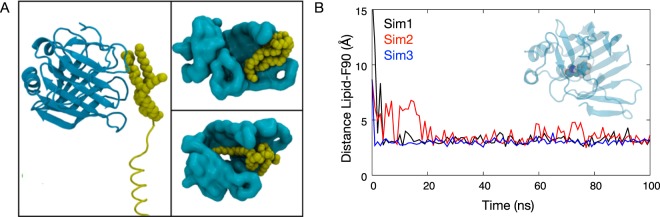
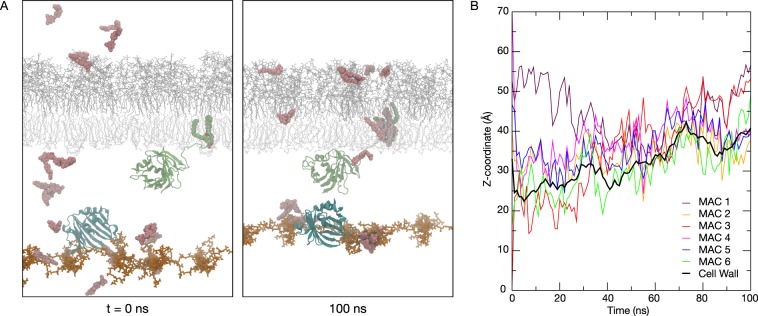
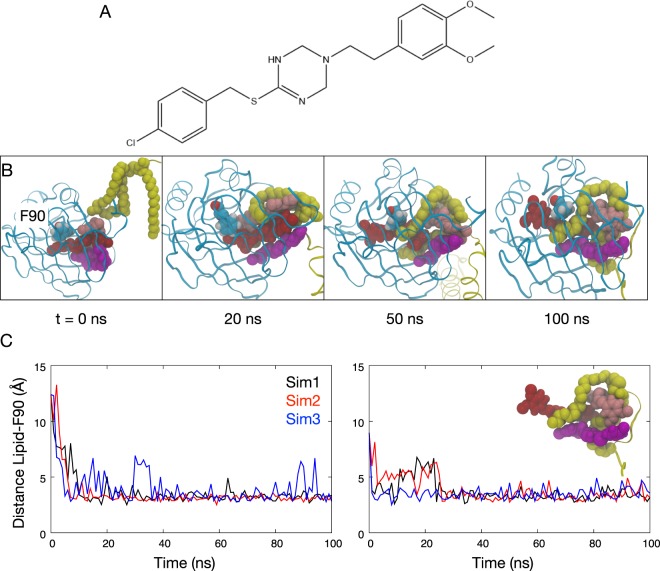
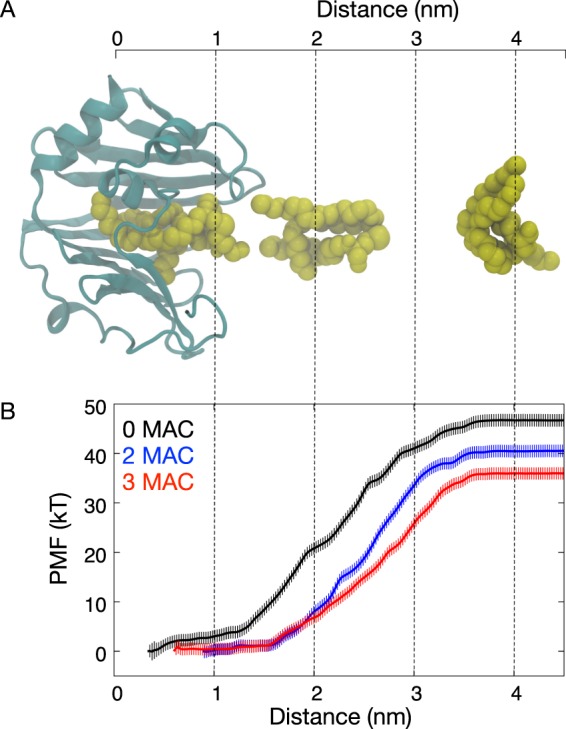
The cell envelope of Gram-negative bacteria is synthesized and maintained via mechanisms that are targets for development of novel antibiotics. Here we focus on the process of moving Braun's lipoprotein (BLP) from the periplasmic space to the outer membrane of E. coli, via the LolA protein. In contrast to current thinking, we show that binding of multiple inhibitor molecules inside the hydrophobic cavity of LolA does not prevent subsequent binding of BLP inside the same cavity. Rather, based on our atomistic simulations we propose the theory that once inhibitors and BLP are bound inside the cavity of LolA, driven by hydrophobic interactions, they become entangled with each other. Our umbrella sampling calculations show that on the basis of energetics, it is more difficult to dislodge BLP from the cavity of LolA when it is uncomplexed compared to complexed with inhibitor. Thus the inhibitor reduces the affinity of BLP for the LolA cavity.
革兰氏阴性菌的细胞包膜是通过合成和维持机制来合成和维持的,这些机制是开发新型抗生素的目标。在这里,我们专注于通过 LolA 蛋白将 Braun 的脂蛋白 (BLP) 从周质空间转移到大肠杆菌外膜的过程。与当前的观点相反,我们表明,在 LolA 的疏水性腔体内结合多个抑制剂分子并不会阻止随后在同一腔体内结合 BLP。相反,基于我们的原子模拟,我们提出了这样一种理论,即在疏水力的驱动下,一旦抑制剂和 BLP 结合到 LolA 的腔体内,它们就会相互缠绕。我们的伞状采样计算表明,从能量的角度来看,与与抑制剂结合相比,当 BLP 未与抑制剂结合时,从 LolA 腔体内驱除 BLP 更加困难。因此,抑制剂降低了 BLP 与 LolA 腔的亲和力。