Oertel Viola, Kraft Dominik, Alves Gilberto, Knöchel Christian, Ghinea Denisa, Storchak Helena, Matura Silke, Prvulovic David, Bittner Robert A, Linden David E J, Reif Andreas, Stäblein Michael
Laboratory for Neuroimaging, Department of Psychiatry, Psychosomatic Medicine and Psychotherapy, Goethe University, Frankfurt am Main, Germany.
Brain Imaging Centre, Goethe University, Frankfurt am Main, Germany.
Front Psychiatry. 2019 Feb 19;10:33. doi: 10.3389/fpsyt.2019.00033. eCollection 2019.
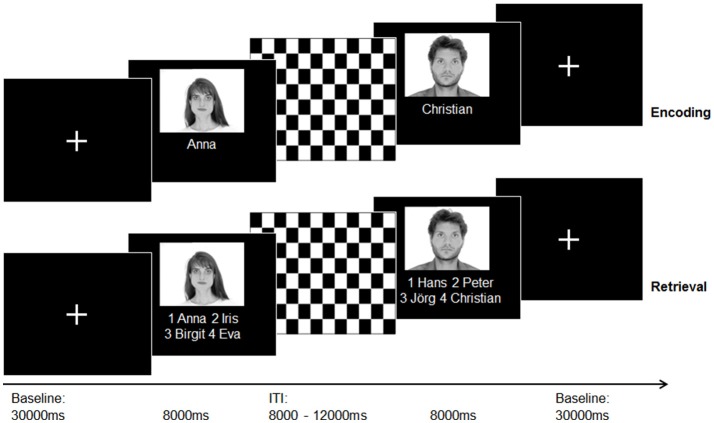
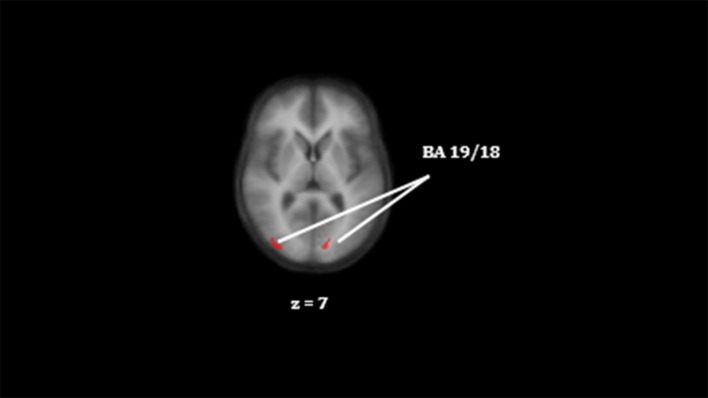
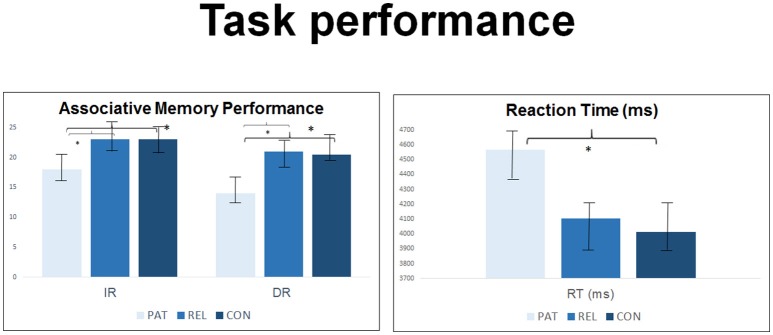
Memory impairments are a major characteristic of schizophrenia (SZ). In the current study, we used an associative memory task to test the hypothesis that SZ patients and first-degree relatives have altered functional patterns in comparison to healthy controls. We analyzed the fMRI activation pattern during the presentation of a face-name task in 27 SZ patients, 23 first-degree relatives, and 27 healthy controls. In addition, we performed correlation analyses between individual psychopathology, accuracy and reaction time of the task and the beta scores of the functional brain activations. We observed a lower response accuracy and increased reaction time during the retrieval of face-name pairs in SZ patients compared with controls. Deficient performance was accompanied by abnormal functional activation patterns predominantly in DMN regions during encoding and retrieval. No significant correlation between individual psychopathology and neuronal activation during encoding or retrieval of face-name pairs was observed. Findings of first-degree relatives indicated slightly different functional pattern within brain networks in contrast to controls without significant differences in the behavioral task. Both the accuracy of memory performance as well as the functional activation pattern during retrieval revealed alterations in SZ patients, and, to a lesser degree, in relatives. The results are of potential relevance for integration within a comprehensive model of memory function in SZ. The development of a neurophysiological model of cognition in psychosis may help to clarify and improve therapeutic options to improve memory and functioning in the illness.
记忆障碍是精神分裂症(SZ)的一个主要特征。在当前研究中,我们使用了一项联想记忆任务来检验以下假设:与健康对照相比,SZ患者及其一级亲属的功能模式发生了改变。我们分析了27名SZ患者、23名一级亲属和27名健康对照在进行面孔-名字任务时的功能磁共振成像(fMRI)激活模式。此外,我们还对个体精神病理学、任务的准确性和反应时间与功能性脑激活的β分数之间进行了相关性分析。我们观察到,与对照组相比,SZ患者在检索面孔-名字对时反应准确性较低,反应时间延长。表现不佳伴随着编码和检索过程中主要在默认模式网络(DMN)区域的异常功能激活模式。在面孔-名字对的编码或检索过程中,未观察到个体精神病理学与神经元激活之间存在显著相关性。一级亲属的研究结果表明,与对照组相比,大脑网络内的功能模式略有不同,但在行为任务中无显著差异。SZ患者在记忆表现的准确性以及检索过程中的功能激活模式均显示出改变,而亲属的改变程度较小。这些结果对于纳入SZ记忆功能综合模型具有潜在意义。建立精神病认知的神经生理模型可能有助于阐明和改善治疗方案,以改善该疾病中的记忆和功能。