Palabiyik Orkide, Tastekin Ebru, Doganlar Zeynep Banu, Tayfur Pinar, Dogan Ayten, Vardar Selma Arzu
Department of Medical Services and Techniques, Trakya University Health Services Vocational College, Edirne 22030, Turkey.
Department of Pathology, Trakya University Faculty of Medicine, Edirne 22030, Turkey.
Biomed Rep. 2019 Feb;0(0):1-10. doi: 10.3892/br.2018.1179. Epub 2018 Dec 13.
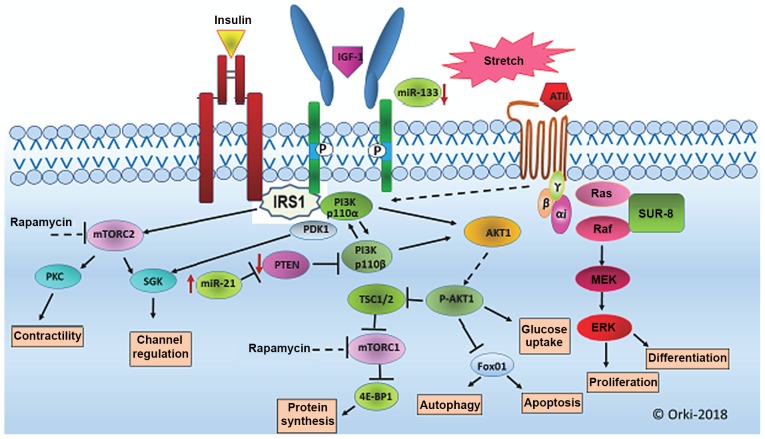
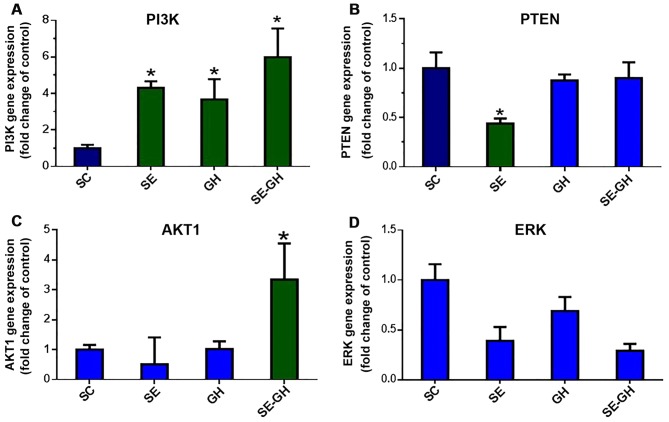
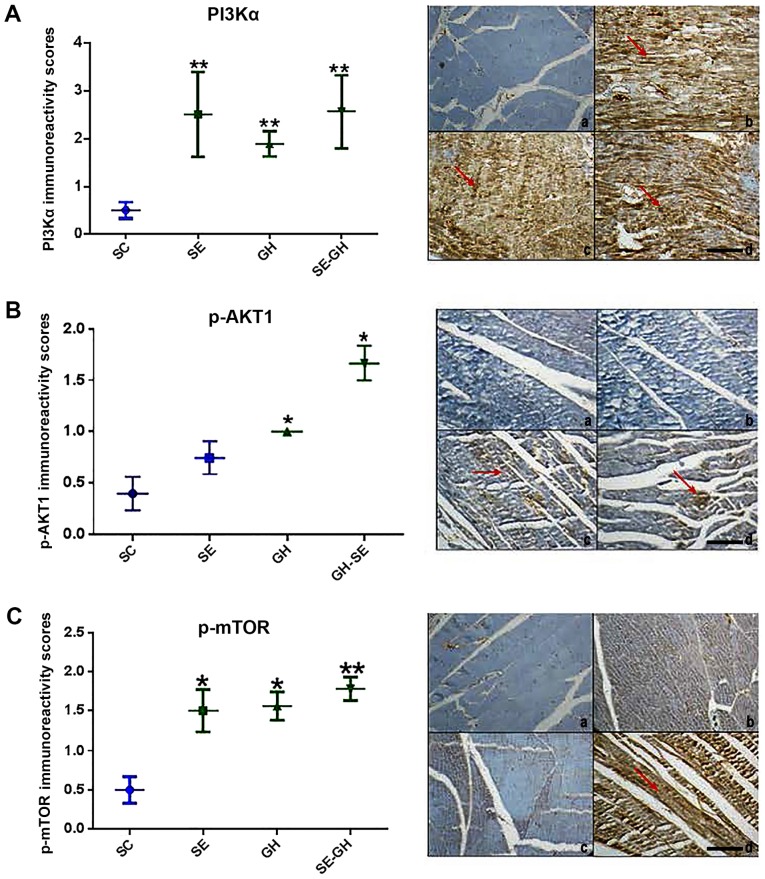
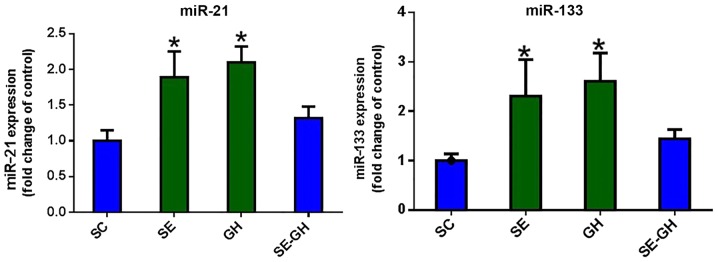
Athletes misuse recombinant human growth hormone (r-hGH) to enhance their performance. Although r-hGH is known to increase cardiac hypertrophy, the underlying molecular mechanism remains unclear. The aim of the present study was to investigate the role of r-hGH in cardiac intracellular signaling pathways and of miR-21 and miR-133 expression in rat hearts during exercise. A total of 36 adult male Sprague-Dawley rats were divided into sedentary control (SC, n=9), swimming exercise (SE, n=8), r-hGH (GH, n=10) and swimming exercise plus r-hGH (SE-GH, n=9) groups. The exercise groups completed a 1-h swimming exercise 5 times a week for 8 weeks. Subcutaneous r-hGH was administered as 0.3 mg/kg/day. Phosphoinositide-3-kinase (PI3K), serine/threonine protein kinase 1 (AKT1), extracellular signal-regulated kinase (ERK), microRNA (miR)-21 and miR-133 expression was evaluated in ventricular muscle by real-time quantitative polymerase chain reaction. Protein expression of PI3K, AKT1, ERK and mechanistic target of rapamycin (mTOR) was also assessed by immunohistochemistry. Statistical differences were analyzed by two-way ANOVA. PI3K and AKT1 expression and the gene and protein levels was notably increased in the SE-GH group compared with in SC ventricular tissues (P<0.05). mTOR protein expression was higher in the GH, SE and SE-GH groups compared with in the SC group (P<0.05, <0.05 and <0.001, respectively). ERK gene/protein expression was similar across all groups. miR-21 and miR-133 levels in ventricular muscle were higher in the SE and GH groups than those in the SC group. In summary, growth hormone application coupled with swimming exercise appeared to affect the PI3K/AKT/mTOR signaling pathway in the left ventricular tissue of rats; however, ERK signaling pathway appeared inactive in physiological left ventricular hypertrophy caused by swimming and GH administration over 8 weeks. Furthermore, GH treatment resulted in increased miR-21 and miR-133 expression. Future study by our group will aim to assess the effects of higher dose GH treatment.
运动员滥用重组人生长激素(r-hGH)以提高其运动表现。尽管已知r-hGH会增加心脏肥大,但其潜在的分子机制仍不清楚。本研究的目的是探讨r-hGH在心脏细胞内信号通路中的作用以及运动期间大鼠心脏中miR-21和miR-133表达的作用。总共36只成年雄性Sprague-Dawley大鼠被分为久坐对照组(SC,n = 9)、游泳运动组(SE,n = 8)、r-hGH组(GH,n = 10)和游泳运动加r-hGH组(SE-GH,n = 9)。运动组每周进行5次1小时的游泳运动,共8周。皮下注射r-hGH的剂量为0.3 mg/kg/天。通过实时定量聚合酶链反应评估心室肌中磷酸肌醇-3-激酶(PI3K)、丝氨酸/苏氨酸蛋白激酶1(AKT1)、细胞外信号调节激酶(ERK)、微小RNA(miR)-21和miR-133的表达。还通过免疫组织化学评估PI3K、AKT1、ERK和雷帕霉素靶蛋白(mTOR)的蛋白表达。采用双向方差分析分析统计差异。与SC心室组织相比,SE-GH组中PI3K和AKT1的表达以及基因和蛋白水平显著增加(P<0.05)。与SC组相比,GH组、SE组和SE-GH组中mTOR蛋白表达更高(分别为P<0.05、<0.05和<0.001)。所有组中ERK基因/蛋白表达相似。SE组和GH组心室肌中miR-21和miR-133水平高于SC组。总之,生长激素应用联合游泳运动似乎会影响大鼠左心室组织中的PI3K/AKT/mTOR信号通路;然而,在8周游泳和生长激素给药引起的生理性左心室肥大中,ERK信号通路似乎不活跃。此外,生长激素治疗导致miR-21和miR-133表达增加。我们小组未来的研究旨在评估更高剂量生长激素治疗的效果。