Aghaie Meybodi Mohamad, Qumseya Bashar J, Shakoor Delaram, Lobner Katie, Vosoughi Kia, Ichkhanian Yervant, Khashab Mouen A
Tehran University of Medical Sciences, Tehran, Iran.
Division of Gastroenterology and Hepatology, Archbold Medical Group/Florida State University, United States.
Endosc Int Open. 2019 Mar;7(3):E322-E329. doi: 10.1055/a-0812-1458. Epub 2019 Feb 28.
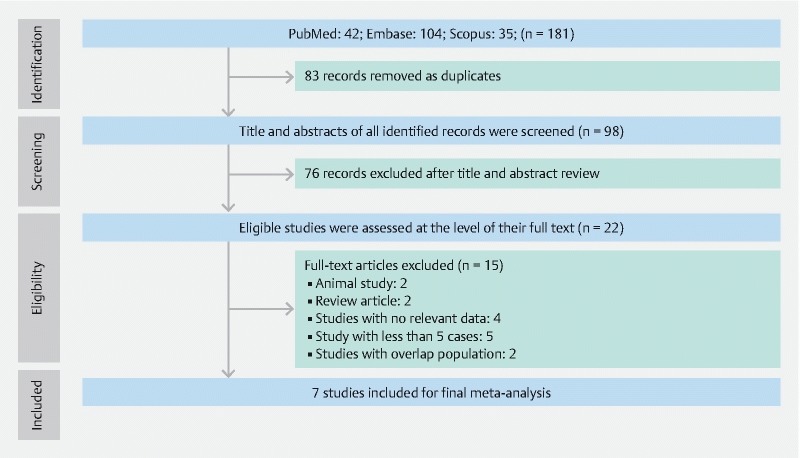
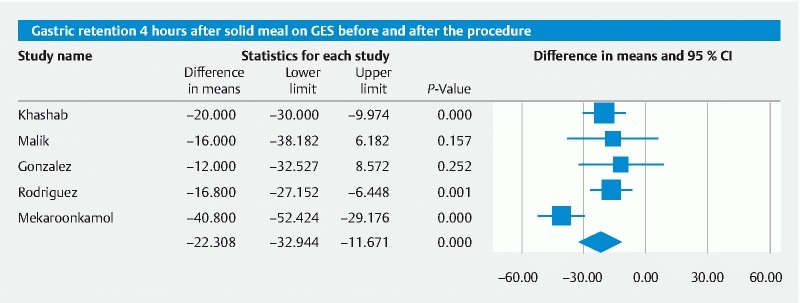
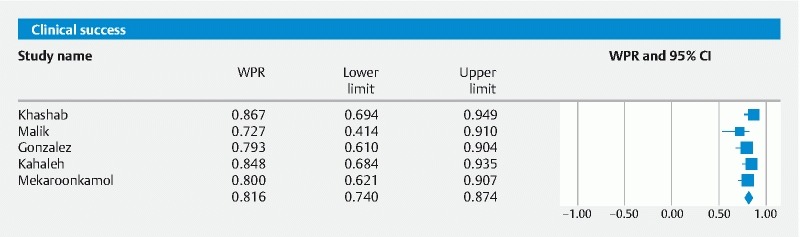
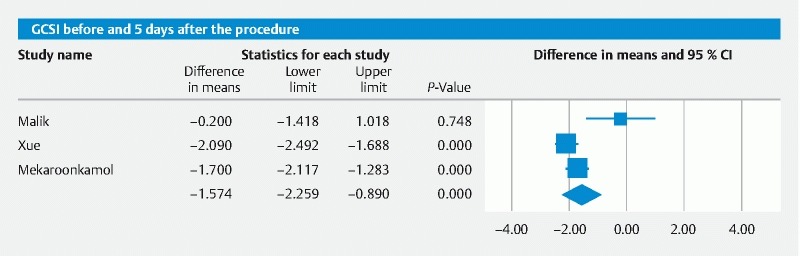
Clinical management of patients with gastroparesis is challenging. Prior pyloric targeted procedures are either invasive or have questionable long-term efficacy. Gastric per-oral endoscopic myotomy (G-POEM) has been recently introduced as a minimally invasive approach. In this review, we performed a meta-analysis to evaluate the feasibility and efficacy of this technique in the management of patients with refractory gastroparesis. PubMed, Embase, and Scopus databases were searched to identify relevant studies published through May 2018. Weighted pool rates (WPR) of the clinical resolution were calculated. Pooled values of Gastroparesis Cardinal Symptom Index (GCSI) before and after the procedure were compared. Pooled difference in means comparing gastric emptying before and after the procedure was calculated. Fixed or random effect model was used according to the level of heterogeneity. Seven studies with 196 patients were included in the meta-analysis. The mean value of procedure duration was 69.7 (95 % confidence interval [95 % CI]: 39 - 99 minutes) and average estimate of hospital stay was 1.96 (95 % CI: 1.22 - 2.95) days. The WPR for clinical success was 82 % (95 % CI: 74 % - 87 %, I = 0). Compared with pre-procedure GCSI values, mean values of GCSI were reduced significantly at 5 days (-1.57 (95 % CI:-2.2,-0.9), I = 80 %) ( < 0.001). Mean values of gastric emptying were significantly decreased 2 - 3 months after the procedure (-22.3 (95 %CI: -32.9, - 11.6), I = 67 %) ( < 0.05). Due to the high rate of clinical success and low rate of adverse events, G-POEM should be considered in management of refractory gastroparesis.
胃轻瘫患者的临床管理具有挑战性。先前针对幽门的手术要么具有侵入性,要么长期疗效存疑。胃经口内镜下肌切开术(G-POEM)最近作为一种微创方法被引入。在本综述中,我们进行了一项荟萃分析,以评估该技术在难治性胃轻瘫患者管理中的可行性和疗效。检索了PubMed、Embase和Scopus数据库,以识别截至2018年5月发表的相关研究。计算了临床缓解的加权合并率(WPR)。比较了手术前后胃轻瘫主要症状指数(GCSI)的合并值。计算了手术前后胃排空均值的合并差异。根据异质性水平使用固定或随机效应模型。荟萃分析纳入了7项研究中的196例患者。手术持续时间的平均值为69.7(95%置信区间[95%CI]:39-99分钟),平均住院时间估计为1.96(95%CI:1.22-2.95)天。临床成功的WPR为82%(95%CI:74%-87%,I²=0)。与术前GCSI值相比,术后5天GCSI的平均值显著降低(-1.57(95%CI:-2.2,-0.9),I²=80%)(P<0.001)。术后2-3个月胃排空的平均值显著降低(-22.3(95%CI:-32.9,-11.6),I²=67%)(P<0.05)。由于临床成功率高且不良事件发生率低,在难治性胃轻瘫的管理中应考虑G-POEM。