Centre for International Health, University of Otago, New Zealand.
Clin Infect Dis. 2019 Mar 7;68(Suppl 2):S105-S116. doi: 10.1093/cid/ciy1094.
Contemporary incidence estimates of typhoid fever are needed to guide policy decisions and control measures and to improve future epidemiological studies.
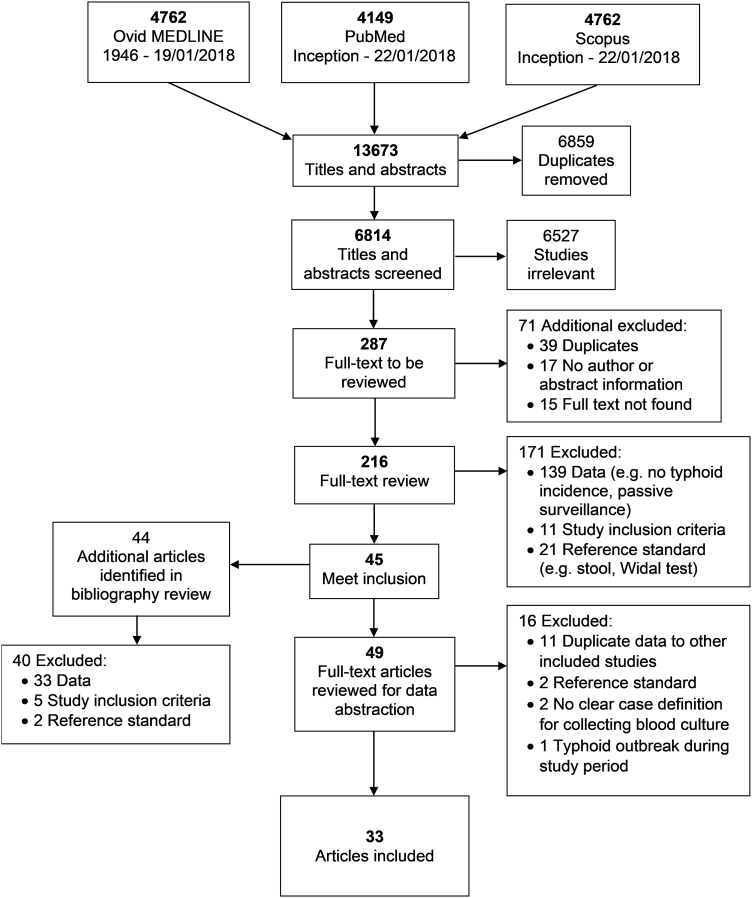
We systematically reviewed 3 databases (Ovid Medline, PubMed, and Scopus) without restriction on age, country, language, or time for studies reporting the incidence of blood culture-confirmed typhoid fever. Outbreak, travel-associated, and passive government surveillance reports were excluded. We performed a meta-analysis using a random-effects model to calculate estimates of pooled incidence, stratifying by studies that reported the incidence of typhoid fever and those that estimated incidence by using multipliers.
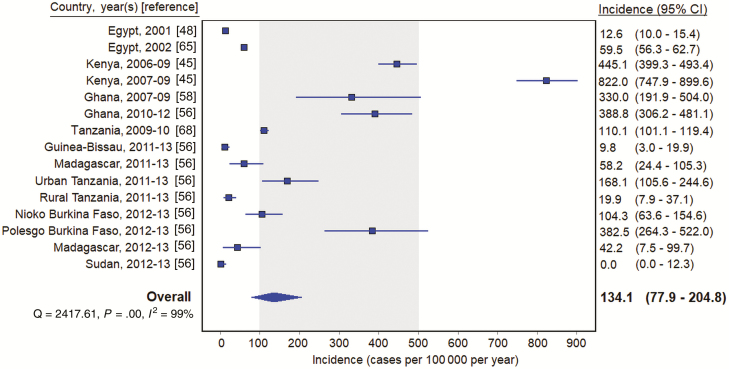
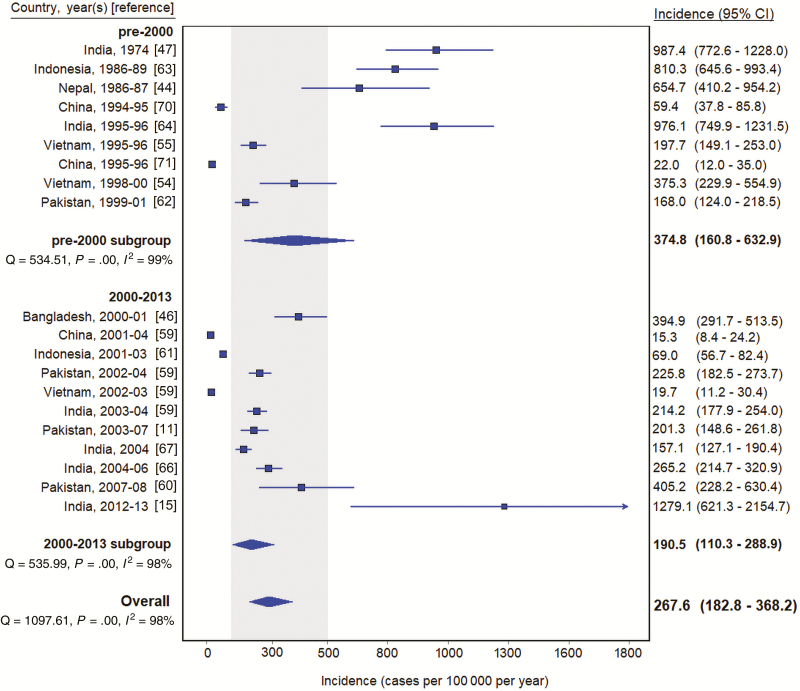
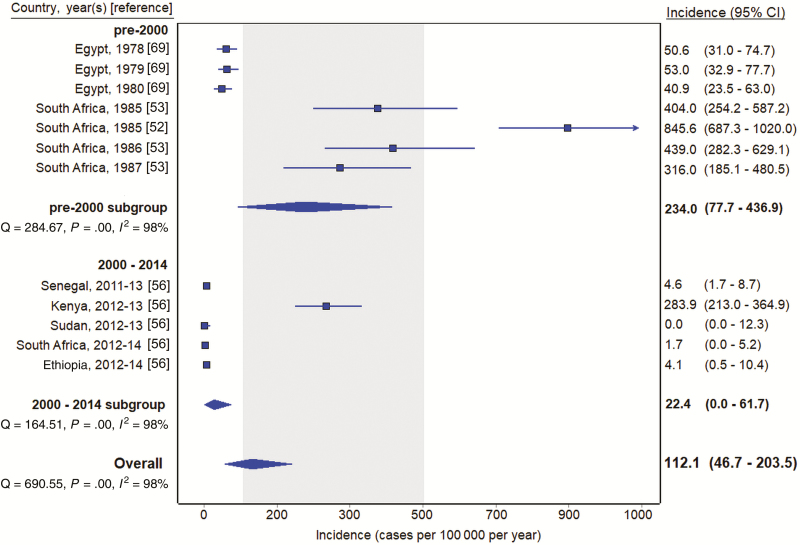
Thirty-three studies were included in the analysis. There were 26 study sites from 16 countries reporting typhoid cases from population-based incidence studies, and 17 sites in 9 countries used multipliers to account for underascertainment in sentinel surveillance data. We identified Africa and Asia as regions with studies showing high typhoid incidence while noting considerable variation of typhoid incidence in time and place, including in consecutive years at the same location. Overall, more recent studies reported lower typhoid incidence compared to years prior to 2000. We identified variation in the criteria for collecting a blood culture, and among multiplier studies we identified a lack of a standardization for the types of multipliers being used to estimate incidence.
Typhoid fever incidence remains high at many sites. Additional and more accurate typhoid incidence studies are needed to support country decisions about typhoid conjugate vaccine adoption. Standardization of multiplier types applied in multiplier studies is recommended.
为了指导政策决策和控制措施,并改进未来的流行病学研究,我们需要了解当前伤寒发病率的估计情况。
我们系统地检索了 3 个数据库(Ovid Medline、PubMed 和 Scopus),没有对年龄、国家、语言或时间进行限制,检索报告血培养确诊伤寒发病率的研究。排除暴发、旅行相关和被动政府监测报告。我们使用随机效应模型进行荟萃分析,计算汇总发病率的估计值,对报告伤寒发病率的研究和通过乘数估计发病率的研究进行分层。
共有 33 项研究纳入分析。来自 16 个国家的 26 个研究地点报告了基于人群的发病率研究中的伤寒病例,来自 9 个国家的 17 个地点使用乘数来解释监测数据中的漏报。我们发现非洲和亚洲是伤寒发病率较高的地区,但也注意到伤寒发病率在时间和地点上存在很大差异,包括在同一地点的连续年份。总体而言,与 2000 年之前的年份相比,最近的研究报告的伤寒发病率较低。我们发现收集血培养的标准存在差异,在乘数研究中,我们发现用于估计发病率的乘数类型缺乏标准化。
许多地点的伤寒发病率仍然很高。需要进行更多和更准确的伤寒发病率研究,以支持各国关于伤寒结合疫苗接种的决策。建议对乘数研究中应用的乘数类型进行标准化。