Department of Translational Molecular Pathology, UT MD Anderson Cancer Center, Houston, TX, USA.
Department of Molecular and Cellular Biology, Baylor College of Medicine, Houston, TX, USA.
Breast Cancer Res. 2019 Mar 7;21(1):37. doi: 10.1186/s13058-019-1125-0.
Triple-negative breast cancers (TNBCs), which lack receptors for estrogen, progesterone, and amplification of epidermal growth factor receptor 2, are highly aggressive. Consequently, patients diagnosed with TNBCs have reduced overall and disease-free survival rates compared to patients with other subtypes of breast cancer. TNBCs are characterized by the presence of cancer cells with mesenchymal properties, indicating that the epithelial to mesenchymal transition (EMT) plays a major role in the progression of this disease. The EMT program has also been implicated in chemoresistance, tumor recurrence, and induction of cancer stem cell (CSC) properties. Currently, there are no targeted therapies for TNBC, and hence, it is critical to identify the novel targets to treat TNBC.
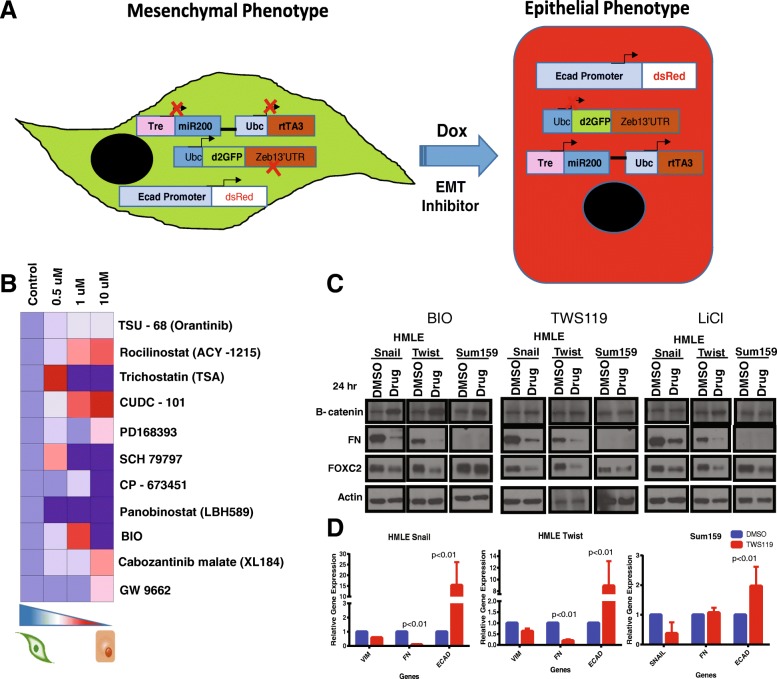
A library of compounds was screened for their ability to inhibit EMT in cells with mesenchymal phenotype as assessed using the previously described Z-cad reporters. Of the several drugs tested, GSK3β inhibitors were identified as EMT inhibitors. The effects of GSK3β inhibitors on the properties of TNBC cells with a mesenchymal phenotype were assessed using qRT-PCR, flow cytometry, western blot, mammosphere, and migration and cell viability assays. Publicly available datasets also were analyzed to examine if the expression of GSK3β correlates with the overall survival of breast cancer patients.
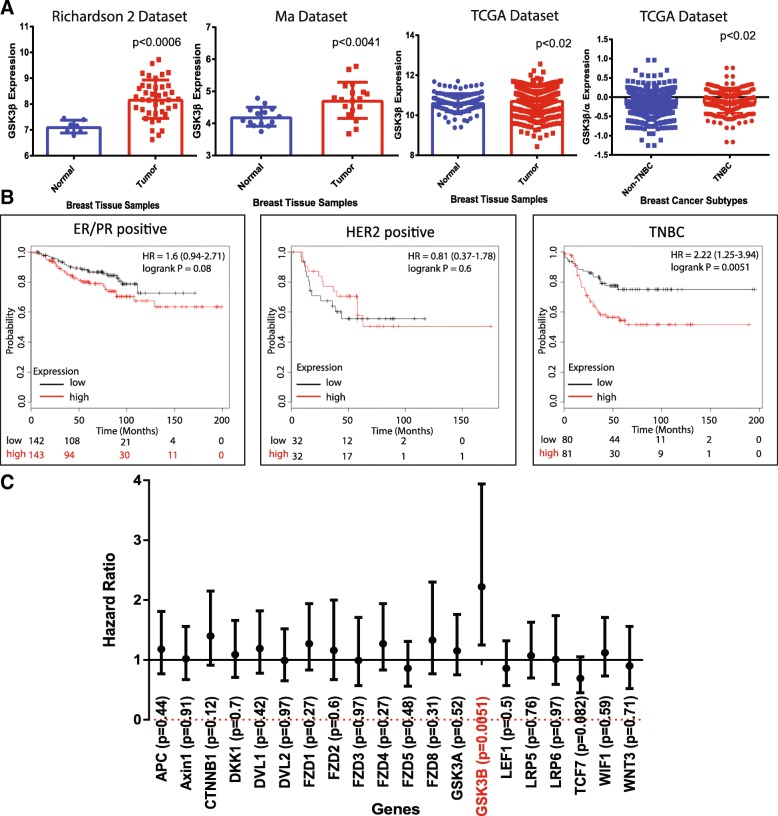
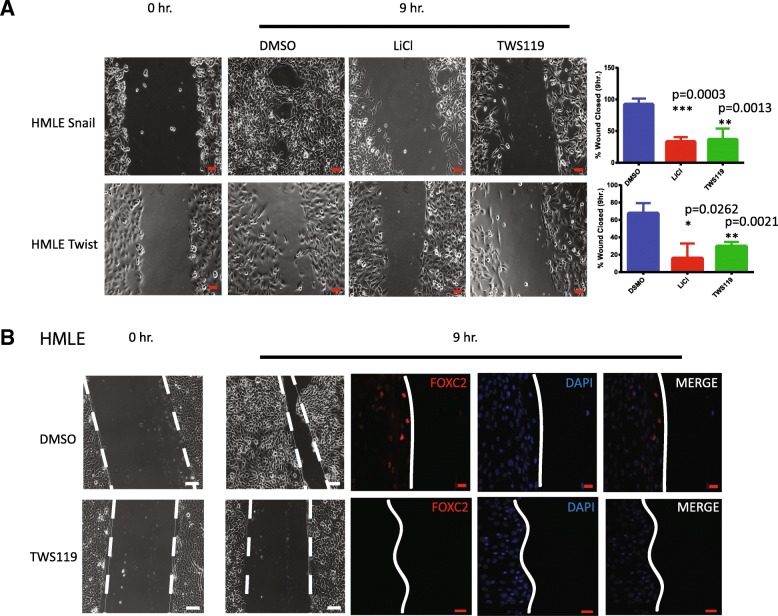
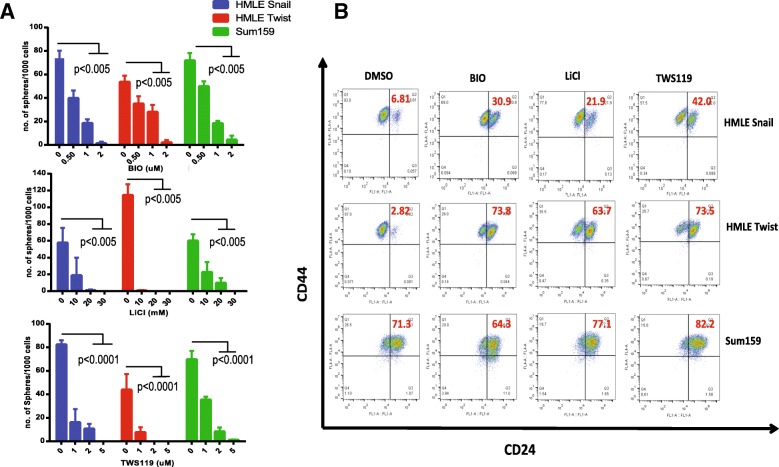
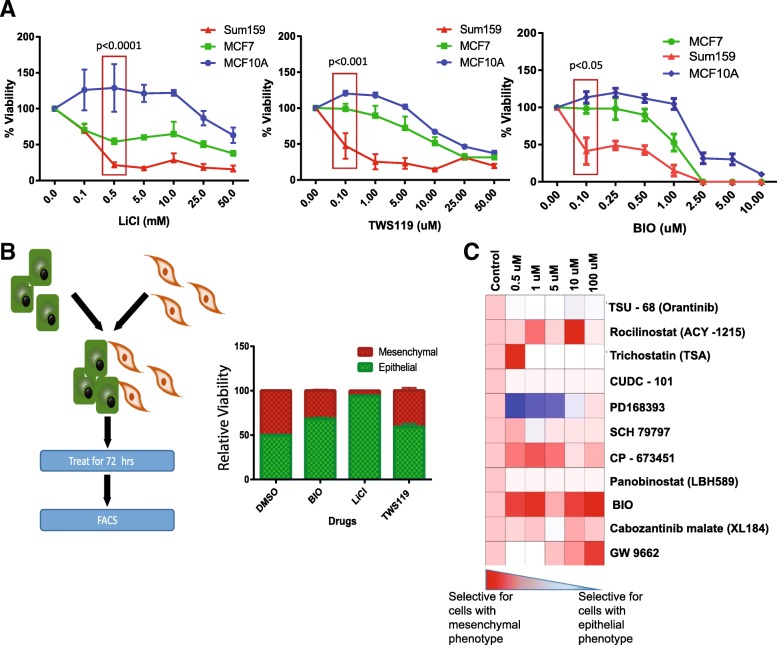
We identified a GSK3β inhibitor, BIO, in a drug screen as one of the most potent inhibitors of EMT. BIO and two other GSK3β inhibitors, TWS119 and LiCl, also decreased the expression of mesenchymal markers in several different cell lines with a mesenchymal phenotype. Further, inhibition of GSK3β reduced EMT-related migratory properties of cells with mesenchymal properties. To determine if GSK3β inhibitors target mesenchymal-like cells by affecting the CSC population, we employed mammosphere assays and profiled the stem cell-related cell surface marker CD44+/24- in cells after exposure to GSK3β inhibitors. We found that GSK3β inhibitors indeed decreased the CSC properties of cell types with mesenchymal properties. We treated cells with epithelial and mesenchymal properties with GSK3β inhibitors and found that GSK3β inhibitors selectively kill cells with mesenchymal attributes while sparing cells with epithelial properties. We analyzed patient data to identify genes predictive of poor clinical outcome that could serve as novel therapeutic targets for TNBC. The Wnt signaling pathway is critical to EMT, but among the various factors known to be involved in Wnt signaling, only the higher expression of GSK3β correlated with poorer overall patient survival.
Taken together, our data demonstrate that GSK3β is a potential target for TNBCs and suggest that GSK3β inhibitors could serve as selective inhibitors of EMT and CSC properties for the treatment of a subset of aggressive TNBC. GSK3β inhibitors should be tested for use in combination with standard-of-care drugs in preclinical TNBC models.
三阴性乳腺癌(TNBC)缺乏雌激素、孕激素受体和表皮生长因子受体 2 的扩增,侵袭性极强。因此,与其他类型的乳腺癌患者相比,TNBC 患者的总生存率和无病生存率均降低。TNBC 的特征是存在具有间充质特性的癌细胞,表明上皮间质转化(EMT)在疾病进展中起主要作用。EMT 程序还与化疗耐药性、肿瘤复发和诱导癌症干细胞(CSC)特性有关。目前,TNBC 没有靶向治疗方法,因此,确定治疗 TNBC 的新靶点至关重要。
使用先前描述的 Z-钙粘蛋白报告器评估细胞中存在的间充质表型,对化合物文库进行筛选,以确定其抑制 EMT 的能力。在测试的几种药物中,GSK3β 抑制剂被鉴定为 EMT 抑制剂。使用 qRT-PCR、流式细胞术、Western blot、乳腺球体形成、迁移和细胞活力测定评估 GSK3β 抑制剂对具有间充质表型的 TNBC 细胞特性的影响。还分析了公开可用的数据集,以检查 GSK3β 的表达是否与乳腺癌患者的总生存率相关。
我们在药物筛选中发现一种 GSK3β 抑制剂 BIO,作为 EMT 最强抑制剂之一。BIO 和另外两种 GSK3β 抑制剂 TWS119 和 LiCl 也降低了几种具有间充质表型的细胞系中间充质标记物的表达。此外,抑制 GSK3β 可降低具有间充质特性的细胞的 EMT 相关迁移特性。为了确定 GSK3β 抑制剂是否通过影响 CSC 群体来靶向间充质样细胞,我们使用乳腺球体测定法并在暴露于 GSK3β 抑制剂后对与干细胞相关的细胞表面标记物 CD44+/24-进行了分析。我们发现 GSK3β 抑制剂确实降低了具有间充质特性的细胞类型的 CSC 特性。我们用 GSK3β 抑制剂处理具有上皮和间充质特性的细胞,发现 GSK3β 抑制剂选择性杀死具有间充质属性的细胞,而保留具有上皮属性的细胞。我们分析了患者数据,以确定预测不良临床结局的基因,这些基因可作为 TNBC 的新型治疗靶点。Wnt 信号通路对 EMT 至关重要,但在已知参与 Wnt 信号的各种因素中,只有 GSK3β 的高表达与患者总体生存率较差相关。
综上所述,我们的数据表明 GSK3β 是 TNBC 的一个潜在靶点,并表明 GSK3β 抑制剂可能作为 EMT 和 CSC 特性的选择性抑制剂,用于治疗一组侵袭性 TNBC。GSK3β 抑制剂应在 TNBC 的临床前模型中与标准治疗药物联合进行测试。