International institute of Infection and Immunity, Shantou University Medical College, Shantou, 515041, China.
Central Laboratory, Maternal-Fetal Medicine Institute, Baoan Maternal and Child Health Hospital, Jinan University, Shenzhen, 518102, China.
Sci Rep. 2019 Mar 7;9(1):3856. doi: 10.1038/s41598-019-40402-2.
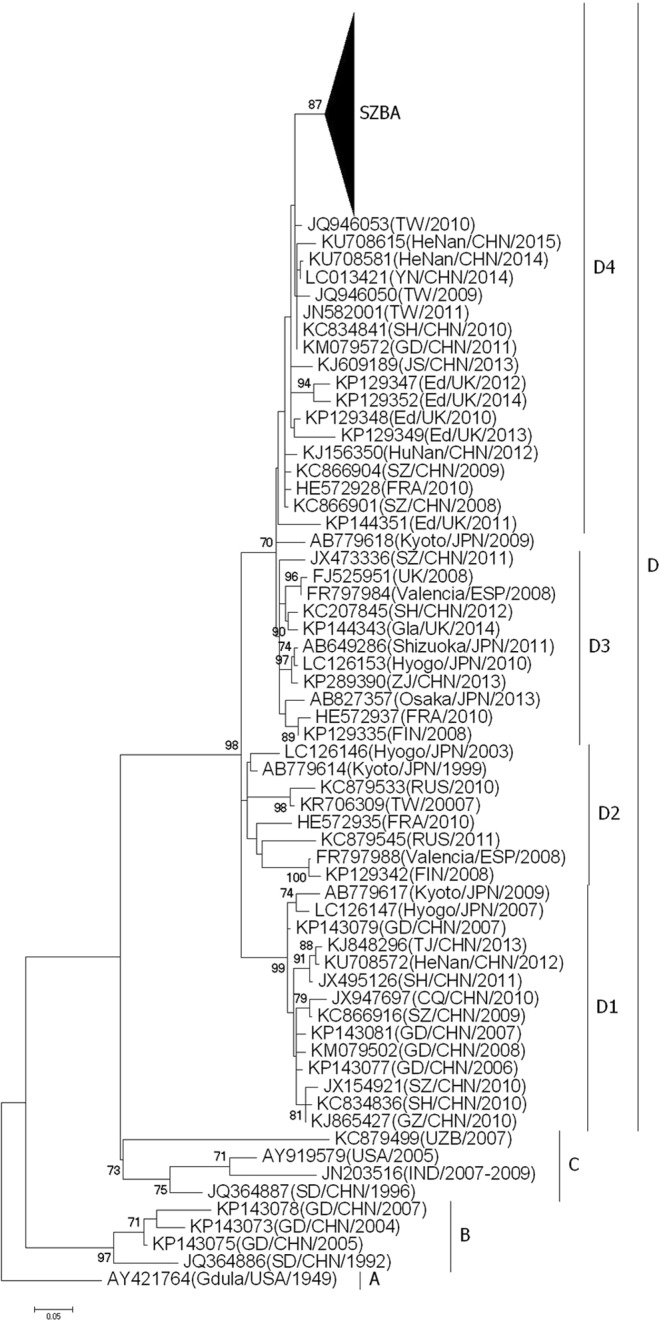
Hand, foot and mouth disease (HFMD) is responsible for a heavy economic and social burden in the Asia-Pacific region. Previous studies have shown that coxsackievirus A6 (CVA6) and coxsackievirus A10 (CVA10) have become the predominant agents of HFMD in mainland China in recent years, replacing enterovirus 71 (EV71) and coxsackievirus A16 (CVA16), although it is unclear if this is consistent throughout China. In this study, samples from 253 HFMD cases were collected in Shenzhen, China, from May 2013 through April 2014 to identify the etiological agent of HFMD. In total, 64.8% (164/253) of HFMD cases were enterovirus positive, in which 81.1% (133/164) were determined to be CVA6. The phylogenetic tree of the partial viral protein 1 sequence showed that the CVA6 isolates were divided into four clusters (Clusters A to D), and cluster D was further divided into four sub-clusters (Clusters D1 to D4). The 133 CVA6 samples isolated in our study were classified into cluster D4, in which the first identified sequence was isolated in Shenzhen in 2008. This study demonstrated that the CVA6 cluster D4, which is predominantly circulating in HFMD in mainland China, may have originated from a local strain identified in 2008 in Shenzhen.
手足口病(HFMD)在亚太地区造成了沉重的经济和社会负担。先前的研究表明,近年来柯萨奇病毒 A6(CVA6)和柯萨奇病毒 A10(CVA10)已成为中国大陆手足口病的主要病原体,取代了肠道病毒 71(EV71)和柯萨奇病毒 A16(CVA16),尽管尚不清楚这是否在中国各地都一致。在这项研究中,2013 年 5 月至 2014 年 4 月期间,从中国深圳采集了 253 例手足口病样本,以确定手足口病的病因。总共有 64.8%(164/253)的手足口病病例呈肠道病毒阳性,其中 81.1%(133/164)确定为 CVA6。病毒蛋白 1 部分序列的系统进化树显示,CVA6 分离株分为四个簇(簇 A 至 D),簇 D 进一步分为四个亚簇(簇 D1 至 D4)。本研究中分离的 133 株 CVA6 被分类为簇 D4,其中第一个鉴定的序列于 2008 年在深圳分离。本研究表明,在中国大陆手足口病中主要流行的 CVA6 簇 D4 可能源自 2008 年在深圳鉴定的本地株。