Cialoni Danilo, Brizzolari Andrea, Samaja Michele, Pieri Massimo, Marroni Alessandro
DAN Europe Research Division, Roseto degli Abruzzi, Italy.
Apnea Academy Research, Padua, Italy.
Front Physiol. 2019 Feb 21;10:57. doi: 10.3389/fphys.2019.00057. eCollection 2019.
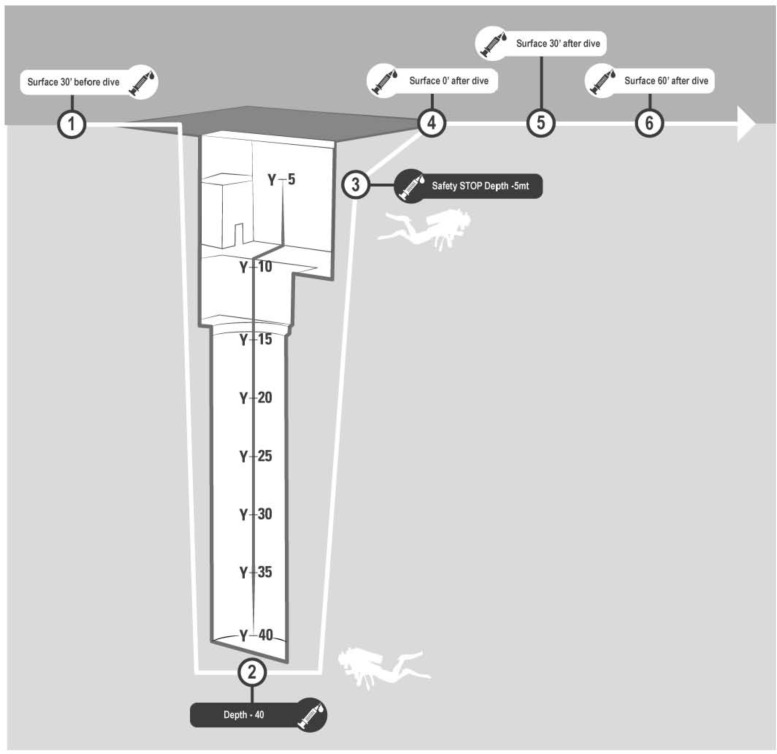
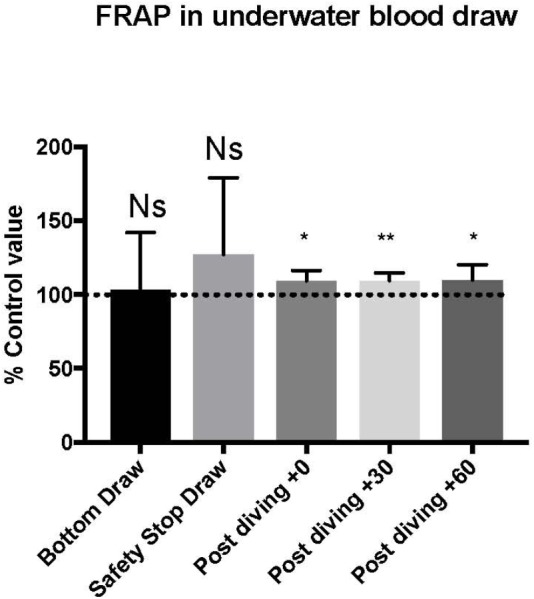
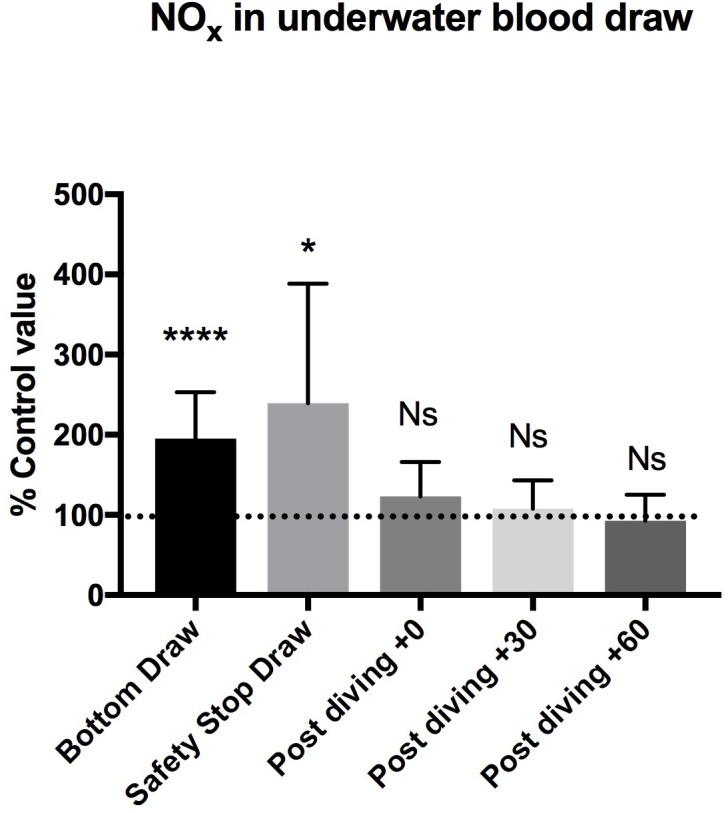
Nitric oxide (NO) plays an important role in the physiology and pathophysiology of diving, and the related endothelial dysfunction and oxidative stress roles have been extensively investigated. However, most available data have been obtained before and after the dive, whilst, as far as we know, no data is available about what happens the water immersion phase of dive. The scope of this study is to investigate the Nitrate and Nitrite (NO) concentration and the total plasma antioxidant capacity (TAC) before, and after a single SCUBA dive in healthy scuba diving volunteers, as well as to look for evidence of a possible relationship with venous gas bubble formation. Plasma, obtained from blood of 15 expert SCUBA divers, 13 male and 2 female, was investigated for differences in NO and TAC values in different dive times. Differences in NO and TAC values in subjects previously known as "bubble resistant" (non-bubblers - NB) and "bubble prone" (Bubblers - B) were investigated. We found a statistically significant increase of NO plasma concentration in the "bottom blood draw" and in the "safety stop blood draw" as compared to the basal pre diving condition. We did not find any difference in NO plasma concentration between the basal value and the post diving samples. We did not find any significant statistical difference in TAC in the bottom blood sample, while the safety-stop and the post-dive samples showed higher TAC values compared with the basal value. We did not find any difference in NO and TAC mean values between non-bubblers and Bubblers. Our protocol, by including underwater blood drawing, allowed to monitor plasma NO changes occurred diving activity, and not only by comparing pre and post diving values. It is particularly interesting to note that the increased NO values found at the bottom and at the safety stop were not observed at post dive sampling (T0, T30, T60), showing a very rapid return to the pre-dive values. In this preliminary study we did not find any relationship between bubble formation and changes in NO parameters and TAC response.
一氧化氮(NO)在潜水的生理和病理生理过程中发挥着重要作用,其相关的内皮功能障碍和氧化应激作用已得到广泛研究。然而,大多数现有数据是在潜水前后获得的,据我们所知,关于潜水的水浸阶段发生了什么尚无数据。本研究的范围是调查健康水肺潜水志愿者单次水肺潜水前后的硝酸盐和亚硝酸盐(NO)浓度以及总血浆抗氧化能力(TAC),并寻找与静脉气泡形成可能关系的证据。从15名专业水肺潜水员(13名男性和2名女性)的血液中获取血浆,研究不同潜水时间NO和TAC值的差异。调查了先前被称为“抗气泡”(无气泡者 - NB)和“易产生气泡”(有气泡者 - B)的受试者的NO和TAC值差异。我们发现,与潜水前基础状态相比,“水底采血”和“安全停留采血”时血浆NO浓度有统计学意义的升高。我们未发现基础值与潜水后样本之间的血浆NO浓度有任何差异。水底血样中的TAC没有任何显著的统计学差异,而安全停留和潜水后样本的TAC值高于基础值。我们未发现无气泡者和有气泡者之间的NO和TAC平均值有任何差异。我们的方案通过包括水下采血,能够监测潜水活动期间发生的血浆NO变化,而不仅仅是比较潜水前后的值。特别值得注意的是,在水底和安全停留时发现的NO值升高在潜水后采样(T0、T30、T60)时未观察到,显示出非常迅速地恢复到潜水前的值。在这项初步研究中,我们未发现气泡形成与NO参数变化和TAC反应之间有任何关系。