Prakosa Adityo, Arevalo Hermenegild J, Deng Dongdong, Boyle Patrick M, Nikolov Plamen P, Ashikaga Hiroshi, Blauer Joshua J E, Ghafoori Elyar, Park Carolyn J, Blake Robert C, Han Frederick T, MacLeod Rob S, Halperin Henry R, Callans David J, Ranjan Ravi, Chrispin Jonathan, Nazarian Saman, Trayanova Natalia A
Institute for Computational Medicine and Department of Biomedical Engineering, Johns Hopkins University, Baltimore, MD, USA.
Cardiac Modelling Department, Simula Research Laboratory, Fornebu, Norway.
Nat Biomed Eng. 2018 Oct;2(10):732-740. doi: 10.1038/s41551-018-0282-2. Epub 2018 Sep 3.
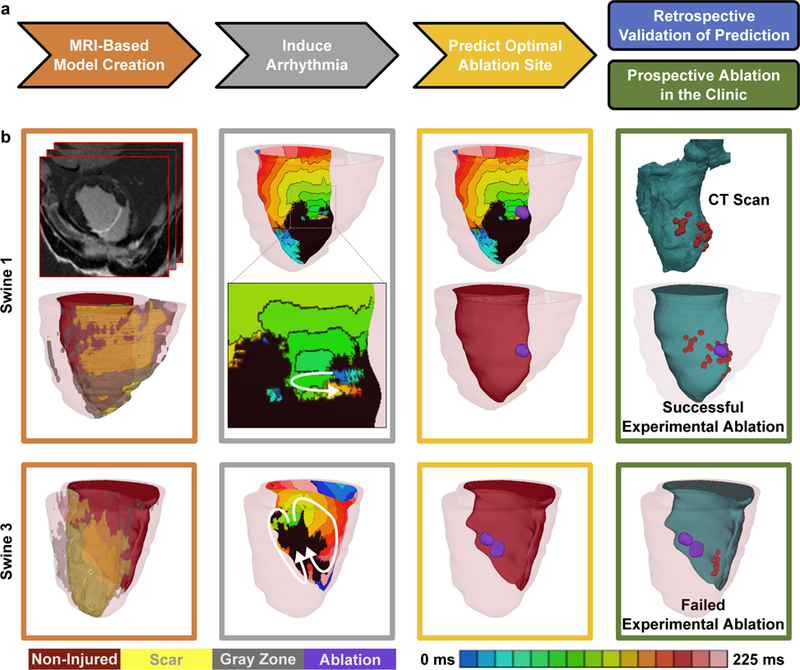
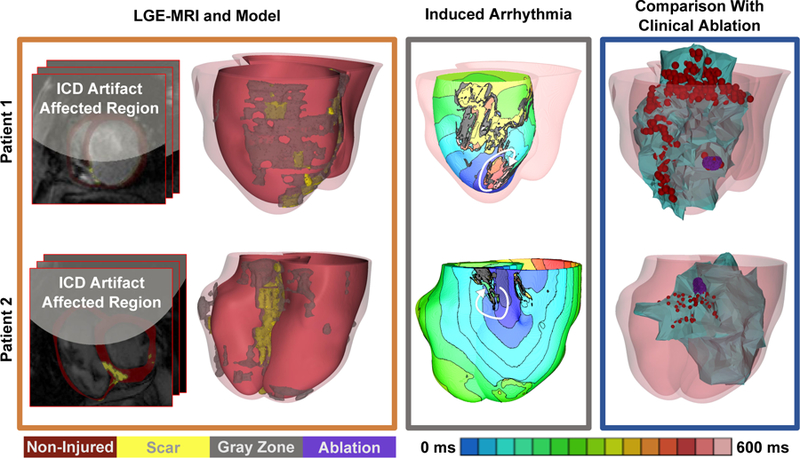
Ventricular tachycardia (VT), which can lead to sudden cardiac death, occurs frequently in patients with myocardial infarction. Catheter-based radiofrequency ablation of cardiac tissue has achieved only modest efficacy, owing to the inaccurate identification of ablation targets by current electrical mapping techniques, which can lead to extensive lesions and to a prolonged, poorly tolerated procedure. Here we show that personalized virtual-heart technology based on cardiac imaging and computational modelling can identify optimal infarct-related VT ablation targets in retrospective animal (5 swine) and human studies (21 patients) and in a prospective feasibility study (5 patients). We first assessed in retrospective studies (one of which included a proportion of clinical images with artifacts) the capability of the technology to determine the minimum-size ablation targets for eradicating all VTs. In the prospective study, VT sites predicted by the technology were targeted directly, without relying on prior electrical mapping. The approach could improve infarct-related VT ablation guidance, where accurate identification of patient-specific optimal targets could be achieved on a personalized virtual heart prior to the clinical procedure.
室性心动过速(VT)常发生于心肌梗死患者,可导致心源性猝死。基于导管的心脏组织射频消融术疗效有限,原因是当前的电标测技术对消融靶点的识别不准确,这可能导致广泛的组织损伤以及手术时间延长、耐受性差。在此,我们表明,基于心脏成像和计算建模的个性化虚拟心脏技术,在回顾性动物研究(5头猪)、人体研究(21例患者)以及前瞻性可行性研究(5例患者)中,均能够识别与梗死相关的室性心动过速的最佳消融靶点。我们首先在回顾性研究中(其中一项研究包含部分有伪影的临床图像)评估了该技术确定根除所有室性心动过速所需最小尺寸消融靶点的能力。在前瞻性研究中,该技术预测的室性心动过速部位被直接作为靶点,无需依赖先前的电标测。这种方法可改善与梗死相关的室性心动过速消融指导,即在临床手术前,可在个性化虚拟心脏上实现对患者特异性最佳靶点的准确识别。