Agroscope, Department of Agroecology & Environment, Reckenholzstrasse 191, 8046, Zürich, Switzerland.
Agroscope, Plant Production Systems, Route de Duillier 50, 1260, Nyon, Switzerland.
ISME J. 2019 Jul;13(7):1722-1736. doi: 10.1038/s41396-019-0383-2. Epub 2019 Mar 8.
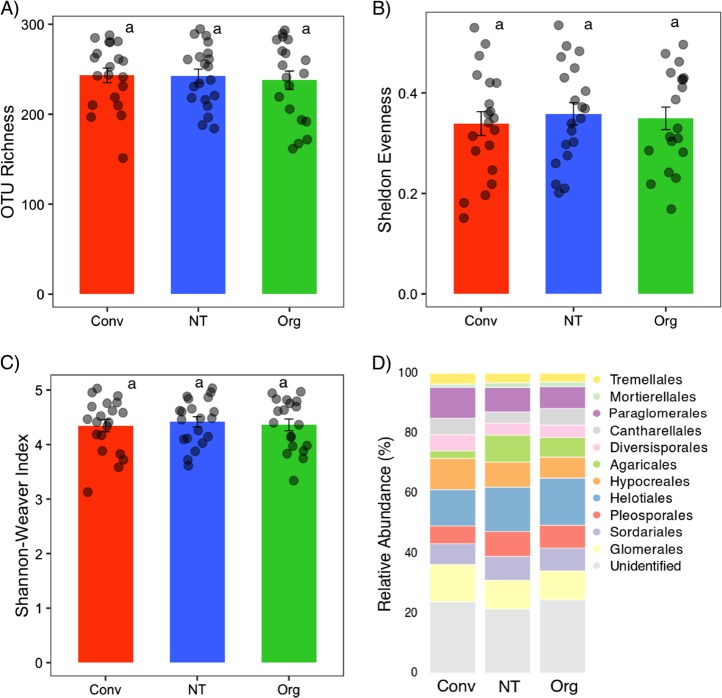
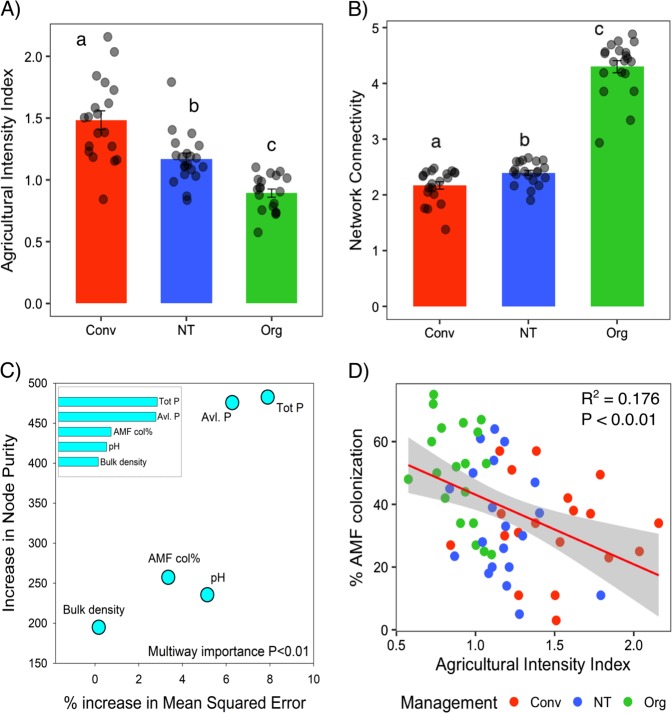
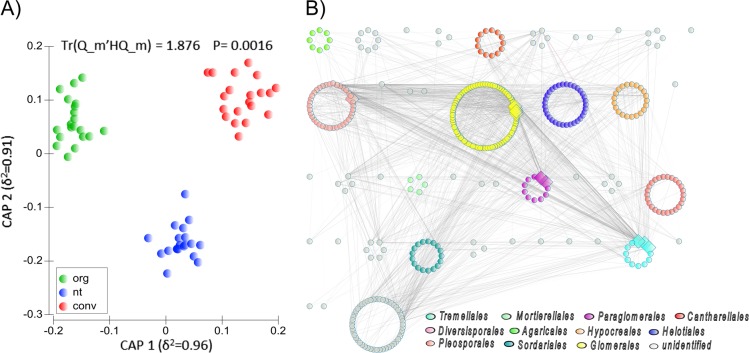
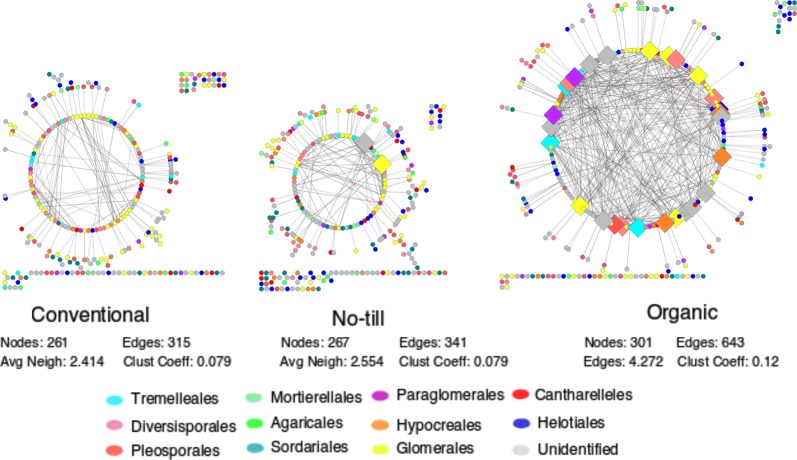
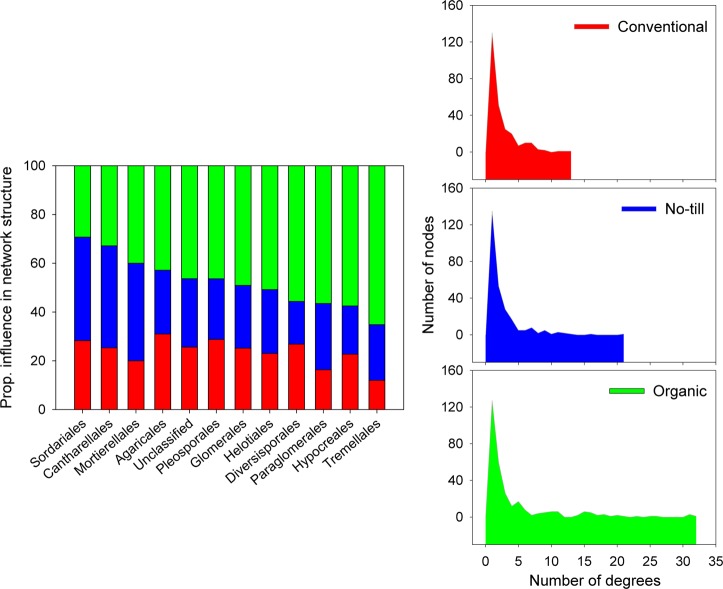
Root-associated microbes play a key role in plant performance and productivity, making them important players in agroecosystems. So far, very few studies have assessed the impact of different farming systems on the root microbiota and it is still unclear whether agricultural intensification influences the structure and complexity of microbial communities. We investigated the impact of conventional, no-till, and organic farming on wheat root fungal communities using PacBio SMRT sequencing on samples collected from 60 farmlands in Switzerland. Organic farming harbored a much more complex fungal network with significantly higher connectivity than conventional and no-till farming systems. The abundance of keystone taxa was the highest under organic farming where agricultural intensification was the lowest. We also found a strong negative association (R = 0.366; P < 0.0001) between agricultural intensification and root fungal network connectivity. The occurrence of keystone taxa was best explained by soil phosphorus levels, bulk density, pH, and mycorrhizal colonization. The majority of keystone taxa are known to form arbuscular mycorrhizal associations with plants and belong to the orders Glomerales, Paraglomerales, and Diversisporales. Supporting this, the abundance of mycorrhizal fungi in roots and soils was also significantly higher under organic farming. To our knowledge, this is the first study to report mycorrhizal keystone taxa for agroecosystems, and we demonstrate that agricultural intensification reduces network complexity and the abundance of keystone taxa in the root microbiome.
根相关微生物在植物性能和生产力中起着关键作用,使它们成为农业生态系统中的重要参与者。到目前为止,很少有研究评估不同农业系统对根微生物群的影响,也不清楚农业集约化是否会影响微生物群落的结构和复杂性。我们使用 PacBio SMRT 测序,对来自瑞士 60 个农田的样本进行研究,评估了常规、免耕和有机农业对小麦根真菌群落的影响。有机农业拥有更加复杂的真菌网络,其连通性明显高于常规和免耕农业系统。在农业集约化程度最低的有机农业中,关键类群的丰度最高。我们还发现农业集约化与根真菌网络连通性之间存在强烈的负相关(R=0.366;P<0.0001)。关键类群的出现与土壤磷水平、容重、pH 值和菌根定殖密切相关。大多数关键类群已知与植物形成丛枝菌根共生关系,属于 Glomerales、Paraglomerales 和 Diversisporales 目。支持这一点的是,有机农业下根和土壤中菌根真菌的丰度也显著更高。据我们所知,这是第一项报告农业生态系统中菌根关键类群的研究,我们证明农业集约化降低了根微生物组的网络复杂性和关键类群的丰度。