Max Planck Institute for Dynamics and Self-Organization, Am Fassberg 17, D-37077, Göttingen, Germany.
Sci Rep. 2019 Mar 8;9(1):3935. doi: 10.1038/s41598-019-40373-4.
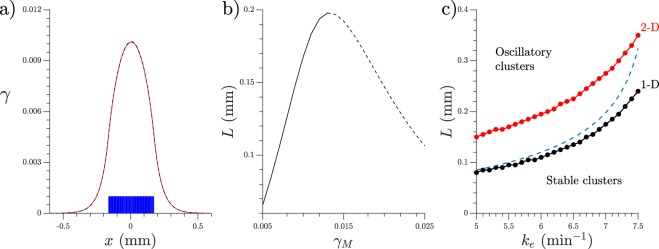
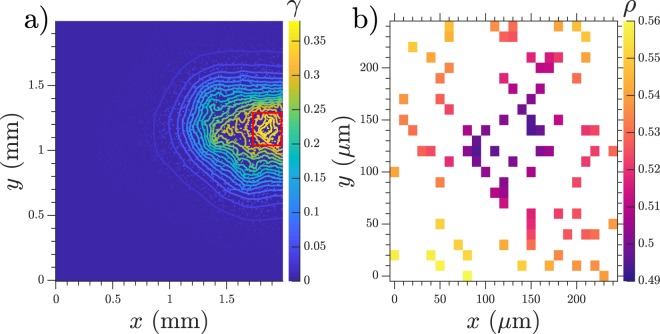
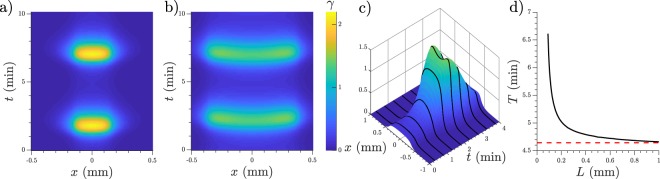
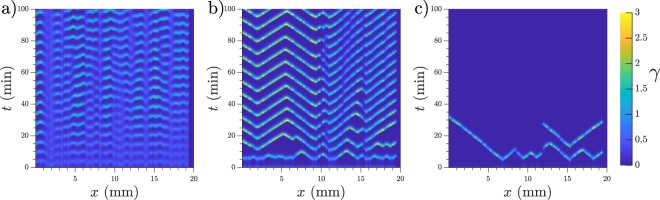
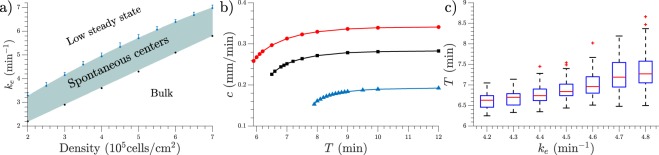
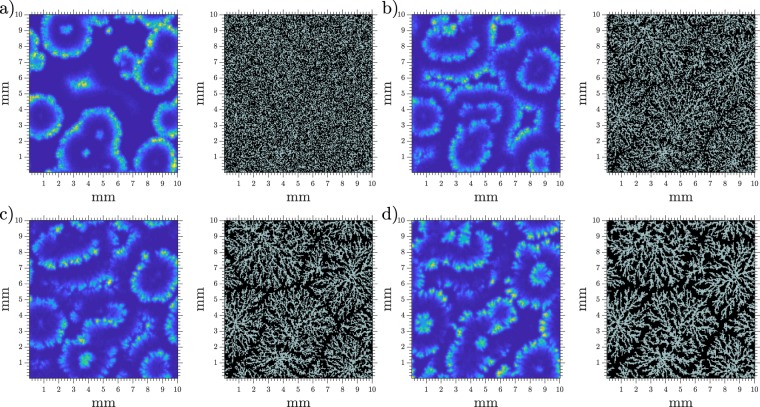
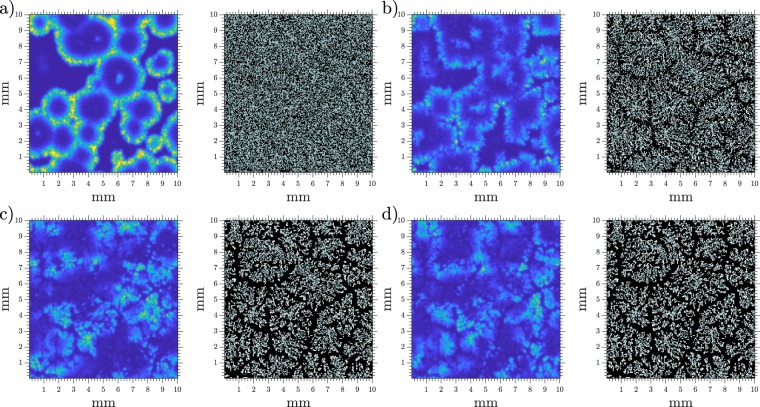
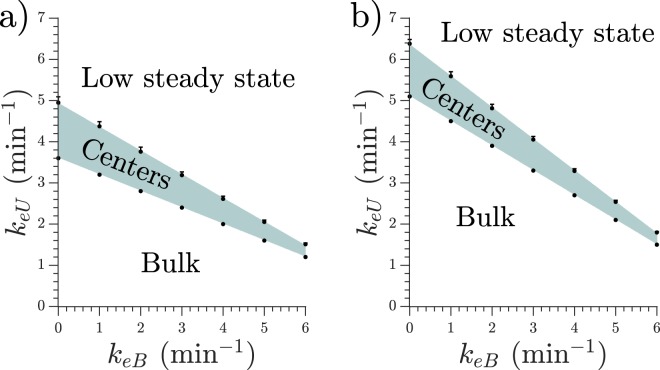
Dictyostelium discoideum (D.d.) is a widely studied amoeba due to its capabilities of development, survival, and self-organization. During aggregation it produces and relays a chemical signal (cAMP) which shows spirals and target centers. Nevertheless, the natural emergence of these structures is still not well understood. We present a mechanism for creation of centers and target waves of cAMP in D.d. by adding cell inhomogeneity to a well known reaction-diffusion model of cAMP waves and we characterize its properties. We show how stable activity centers appear spontaneously in areas of higher cell density with the oscillation frequency of these centers depending on their density. The cAMP waves have the characteristic dispersion relation of trigger waves and a velocity which increases with cell density. Chemotactically competent cells react to these waves and create aggregation streams even with very simple movement rules. Finally we argue in favor of the existence of bounded phosphodiesterase to maintain the wave properties once small cell clusters appear.
粘菌(Dictyostelium discoideum,D.d.)是一种研究广泛的变形虫,因为它具有发育、生存和自我组织的能力。在聚集过程中,它会产生并传递一种化学信号(cAMP),显示出螺旋和目标中心。然而,这些结构的自然出现仍然没有得到很好的理解。我们通过向著名的 cAMP 波反应扩散模型中添加细胞非均匀性,为 D.d. 中 cAMP 中心和目标波的产生提出了一种机制,并对其特性进行了表征。我们展示了在细胞密度较高的区域中,稳定的活性中心如何自发出现,并且这些中心的振荡频率取决于其密度。cAMP 波具有触发波的特征弥散关系和随着细胞密度增加而增加的速度。化学趋性敏感的细胞对这些波做出反应,并创建聚集流,即使使用非常简单的运动规则也是如此。最后,我们认为存在有界的磷酸二酯酶来维持波的特性是合理的,因为一旦出现小的细胞簇。