Faculty of Sports and Nutrition, Amsterdam University of Applied Sciences, Amsterdam, Netherlands.
Sticht Center on Aging, Wake Forest School of Medicine, Winston-Salem, NC.
Am J Clin Nutr. 2019 Mar 1;109(3):535-543. doi: 10.1093/ajcn/nqy341.
A higher protein intake is suggested to preserve muscle mass during aging and may therefore reduce the risk of sarcopenia.
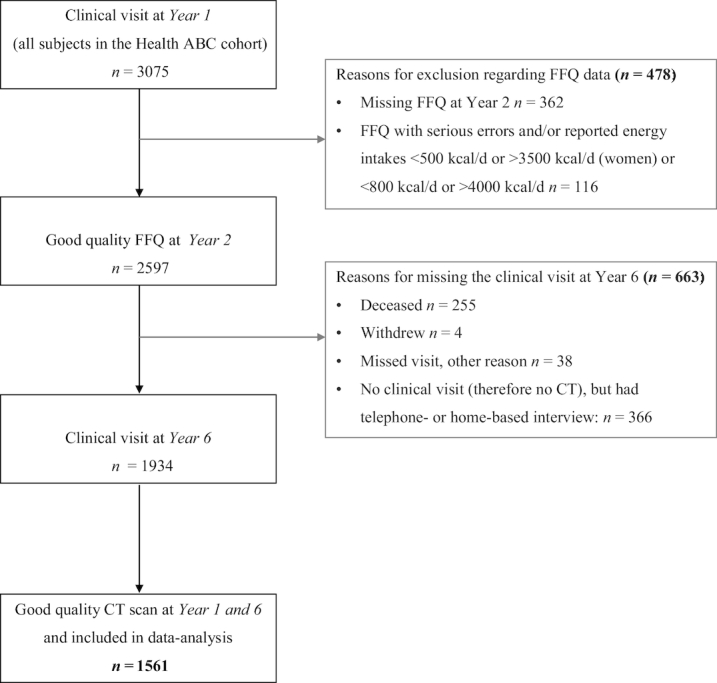
We explored whether the amount and type (animal or vegetable) of protein intake were associated with 5-y change in mid-thigh muscle cross-sectional area (CSA) in older adults (n = 1561).
Protein intake was assessed at year 2 by a Block food-frequency questionnaire in participants (aged 70-79 y) of the Health, Aging, and Body Composition (Health ABC) Study, a prospective cohort study. At year 1 and year 6 mid-thigh muscle CSA in square centimeters was measured by computed tomography. Multiple linear regression analysis was used to examine the association between energy-adjusted protein residuals in grams per day (total, animal, and vegetable protein) and muscle CSA at year 6, adjusted for muscle CSA at year 1 and potential confounders including prevalent health conditions, physical activity, and 5-y change in fat mass.
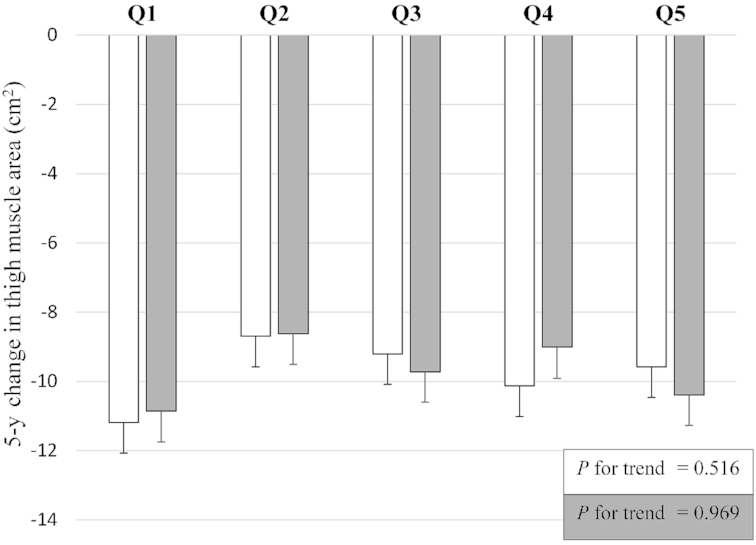
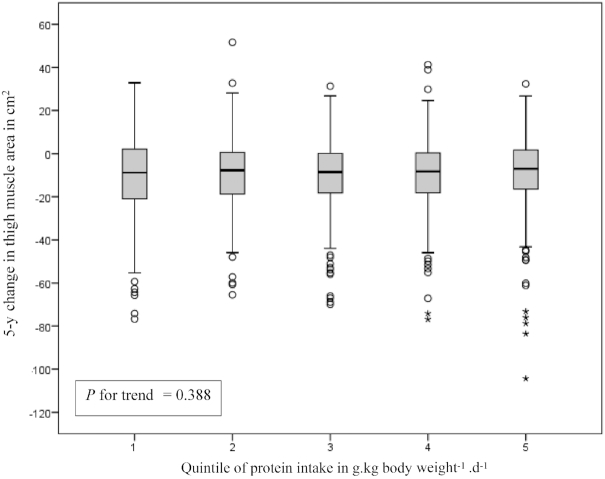
Mean (95% CI) protein intake was 0.90 (0.88, 0.92) g · kg-1 · d-1 and mean (95% CI) 5-y change in muscle CSA was -9.8 (-10.6, -8.9) cm2. No association was observed between energy-adjusted total (β = -0.00; 95% CI: -0.06, 0.06 cm2; P = 0.982), animal (β = -0.00; 95% CI: -0.06, 0.05 cm2; P = 0.923), or plant (β = +0.07; 95% CI: -0.06, 0.21 cm2; P = 0.276) protein intake and muscle CSA at year 6, adjusted for baseline mid-thigh muscle CSA and potential confounders.
This study suggests that a higher total, animal, or vegetable protein intake is not associated with 5-y change in mid-thigh muscle CSA in older adults. This conclusion contradicts some, but not all, previous research. This trial was registered at www.trialregister.nl as NTR6930.
较高的蛋白质摄入量被认为可以在衰老过程中保持肌肉质量,从而降低肌少症的风险。
我们探讨了老年人(n=1561)的蛋白质摄入量(数量和类型[动物或植物])是否与 5 年的大腿中部肌肉横截面积(CSA)变化有关。
参与者(年龄 70-79 岁)在健康、衰老和身体成分研究(健康 ABC 研究)的第 2 年通过布洛克食物频率问卷评估蛋白质摄入量,这是一项前瞻性队列研究。在第 1 年和第 6 年通过计算机断层扫描测量大腿中部肌肉 CSA。采用多元线性回归分析,调整了第 1 年的肌肉 CSA 和可能的混杂因素(包括现患疾病、身体活动和 5 年的脂肪量变化)后,研究了每天以克为单位的能量调整后的蛋白质残基(总蛋白、动物蛋白和植物蛋白)与第 6 年肌肉 CSA 之间的关系。
平均(95%CI)蛋白质摄入量为 0.90(0.88,0.92)g·kg-1·d-1,平均(95%CI)5 年肌肉 CSA 变化为-9.8(-10.6,-8.9)cm2。能量调整后的总蛋白(β=0.00;95%CI:-0.06,0.06 cm2;P=0.982)、动物蛋白(β=0.00;95%CI:-0.06,0.05 cm2;P=0.923)或植物蛋白(β=+0.07;95%CI:-0.06,0.21 cm2;P=0.276)与第 6 年的肌肉 CSA 之间无相关性,调整了基线大腿中部肌肉 CSA 和潜在混杂因素后。
本研究表明,老年人较高的总蛋白、动物蛋白或植物蛋白摄入量与大腿中部肌肉 CSA 的 5 年变化无关。这一结论与一些,但不是所有,以前的研究相矛盾。这项试验在 www.trialregister.nl 上注册为 NTR6930。