Department of Environmental and Occupational Health and Safety, Institute of Public Health, College of Medicine and Health Sciences, University of Gondar, Gondar, Ethiopia.
Department of Parasitology, School of Biomedical Science, College of Medicine and Health Sciences, University of Gondar, Gondar, Ethiopia.
Environ Health Prev Med. 2019 Mar 9;24(1):16. doi: 10.1186/s12199-019-0774-z.
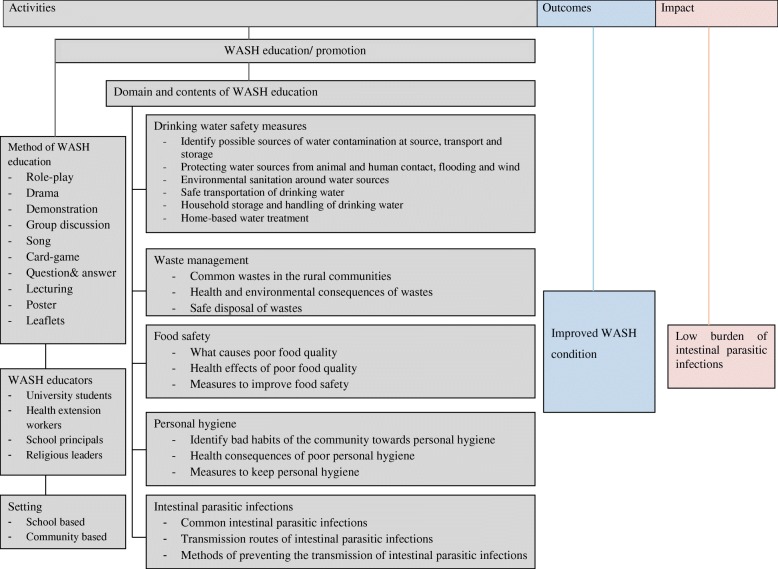
Soil-transmitted helminthes (STH) infections are among the most common infections worldwide and affect the most deprived communities. Adequate water, sanitation, and hygiene (WASH) prevents environmental contamination, thereby preventing transmission of STH. Cognizant of this, WASH education was implemented in rural Dembiya to reduce intestinal parasitic infections. This study was, therefore, conducted to assess the impacts of the intervention on households' WASH conditions and prevalence of intestinal parasitic infections.
An uncontrolled before-and-after intervention study was used. Cross-sectional studies were done before and after the intervention. Two hundred twenty-five and 302 under five children were recruited randomly at the baseline and endline, respectively. Data were collected using a structured questionnaire and observational checklists. Direct stool examination and Kato-Katz methods were used to identify parasites in the stool. We used percent point change and prevalence ratio (PR) to see the effects of the intervention on WASH conditions and prevalence of intestinal parasitic infections respectively. Pearson chi-squared and Fisher's exact tests were used to test for statistically significant percentage point changes of WASH conditions. The effect of the intervention on intestinal parasitic infections was statistically tested on the basis of PR with 95% confidence interval (CI).
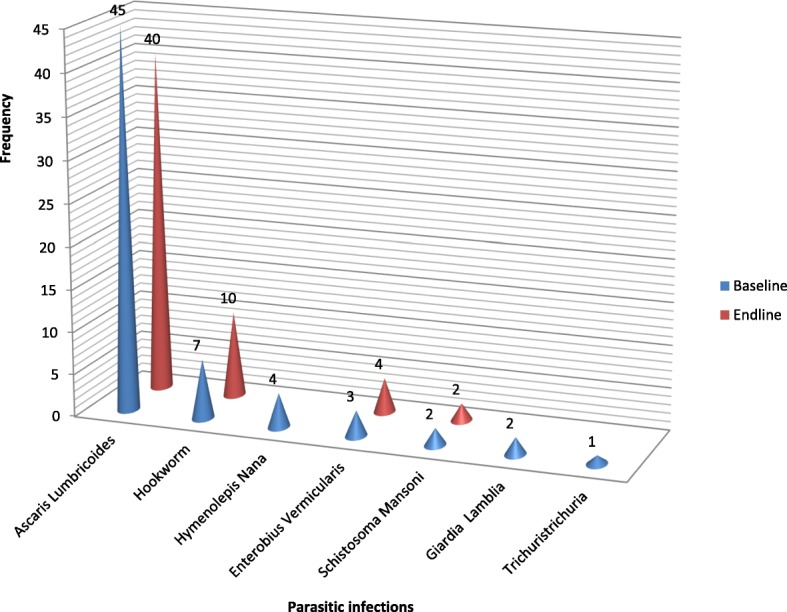
The baseline prevalence of intestinal parasitic infections was 25.8%, and the endline prevalence was 23.8%. The prevalence of intestinal parasitic infections was not significantly decreased at the endline compared with the baseline [PR = 0.92, 95% CI = (0.62, 1.38)]. Ascaris Lumbricoides was the most prevalent parasitic infection both at the baseline and endline. The proportion of children who had good hygienic condition increased from 1.3% at the baseline to 34.4% at the end line (p < 0.05). The percentage of mothers/care givers who washed hands at different pick times was significantly increased from 24.4% at the baseline to 68.2% at the endline (p < 0.001). The proportion of households who practiced home-based water treatment was significantly increased from 7.6% at the baseline to 47% at the endline (p < 0.001). The proportion of households who used sanitary latrine was increased from 32% at the baseline to 49% at the endline (p < 0.05).
This before-and-after intervention study found that households' WASH performance was significantly improved at the endline compared with the baseline. The endline prevalence of intestinal parasitic infections was slightly lower than the baseline prevalence; however, the reduction was not statistically significant. The local health office needs to strengthen the WASH education program, mobilize the community to construct WASH facilities, and support the community to sustain households' WASH performance.
土壤传播的蠕虫(STH)感染是全球最常见的感染之一,影响到最贫困的社区。适当的水、环境卫生和个人卫生(WASH)可防止环境污染,从而防止 STH 的传播。鉴于此,在农村 Dembiya 实施了 WASH 教育,以减少肠道寄生虫感染。因此,进行了这项研究,以评估该干预措施对家庭 WASH 条件和肠道寄生虫感染流行率的影响。
本研究采用了非对照前后干预研究。在干预前后进行了横断面研究。在基线和终线分别随机招募了 225 名和 302 名五岁以下儿童。使用结构化问卷和观察检查表收集数据。直接粪便检查和加藤氏法用于检测粪便中的寄生虫。我们使用百分点变化和患病率比(PR)分别来观察干预措施对 WASH 条件和肠道寄生虫感染流行率的影响。使用 Pearson 卡方检验和 Fisher 确切检验来检验 WASH 条件的统计学显著百分点变化。基于 PR 和 95%置信区间(CI),对肠道寄生虫感染的干预效果进行了统计学检验。
基线时肠道寄生虫感染的患病率为 25.8%,终线时为 23.8%。与基线相比,终线时肠道寄生虫感染的患病率没有显著下降[PR=0.92,95%CI(0.62,1.38)]。阿苯达唑是基线和终线时最常见的寄生虫感染。良好卫生条件的儿童比例从基线时的 1.3%增加到终线时的 34.4%(p<0.05)。不同时间洗手的母亲/照顾者的百分比从基线时的 24.4%增加到终线时的 68.2%(p<0.001)。家庭在家中进行水处理的比例从基线时的 7.6%显著增加到终线时的 47%(p<0.001)。使用卫生厕所的家庭比例从基线时的 32%增加到终线时的 49%(p<0.05)。
这项前后干预研究发现,与基线相比,家庭的 WASH 表现终线时显著提高。肠道寄生虫感染的终线患病率略低于基线患病率,但降低幅度无统计学意义。当地卫生办公室需要加强 WASH 教育计划,动员社区建造 WASH 设施,并支持社区维持家庭的 WASH 表现。