Department of Medical Laboratory Science, College of medicine and Health Sciences, Arba Minch University, Arba Minch, Southern Ethiopia.
PLoS One. 2022 Jun 29;17(6):e0270378. doi: 10.1371/journal.pone.0270378. eCollection 2022.
Intestinal parasitic infection (IPIs) is one of the major health problems in Sub -Saharan Africa where water, sanitation and hygiene practices are inadequate. Taking into account the national level implementation of intensive hand hygiene against COVID-19 pandemic and general protective effect this study assessed its effect on intestinal parasite.
This study aim to investigate the effect of compliance to hand hygiene practice on the prevalence of intestinal parasitic infection (IPIs) and intensity of Soil transmitted helminthes (STH) among patients attending tertiary care hospital in southern Ethiopia.
Observational study was conducted from June to September 2021. Data on socio demographic, hand hygiene practice and intestinal parasite (prevalence and intensity of helminthic infection) was collected from randomly selected and consented patients. Compliance to hand hygiene practice was assessed using pre-tested questionnaire. Fresh stool sample from each participant was examined by direct wet mount, concentration and Ziehl-Neelson (ZN) staining technique to detect intestinal parasite. Intensity of STH measurements was done through direct egg-count per gram using Kato Katz methods. Data analysis was done using SPSS version 25. Odds ratio with 95% confidence interval was used to measure association and p-value <0.05 was considered as statistically significant.
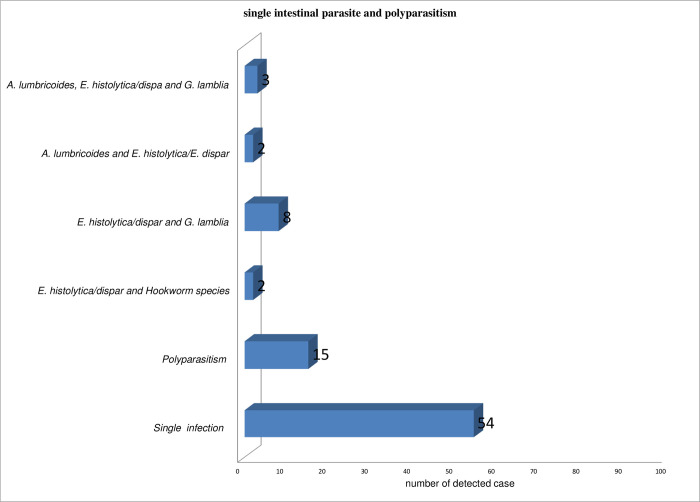
The study population (N = 264) consisted of 139(52.65%) male and 125 (47.34%) female with the mean ages of 36 ±16.12(±SD). The proportion of good compliance to hand hygiene during COVID-19 to was 43.93% (95%CI: 37% to 47) and prevalence of intestinal parasite was 26.14% (95%CI:21.2% to 31.75) comprising 23.48% intestinal protozoa and 6.43% of soil transmitted helminthic infection. Gardia lamblia, Entamoeba histolytica/dispar, Ascaris lumbricoides were the common parasite in the study area with prevalence of 15.53%, 6.44%, and 1.52% respectively. Prevalence of intestinal parasite among participants with good compliance to hand hygiene group and poor compliance to hand hygiene were (14.65% vs. 35.13%)(AOR: 0.48,95%CI:0.13 to 0.68) (p = 0.002) implying that good compliance to hand hygiene can reduce the risk of IPIs by 52%. Moreover significantly lower odds of intestinal protozoa among good compliance to hand hygiene group than the control (OR:0.38; (95%CI: 0.20 to 0.71);P = 0.001. However, no significant difference in the odds of intensity of STH infection in good compliance hand hygiene and poor compliance group. The result of this study also confirmed the association between intestinal parasitic infections and younger /adolescent age, education status, habit of eating raw vegetable and figure nail status.
Good hand hygiene compliance during COVID-19 significantly associated with reduction of intestinal parasitic infection. This finding highlights the secondary protective effect of improved hand hygiene against IPIs and suggest it can used in augmenting the existing parasitic control strategies in the study setting.
肠道寄生虫感染(IPIs)是撒哈拉以南非洲地区的主要健康问题之一,该地区的水、卫生和环境卫生条件不足。考虑到国家层面针对 COVID-19 大流行实施的强化手部卫生措施以及其对肠道寄生虫的一般保护作用,本研究评估了其对肠道寄生虫的影响。
本研究旨在调查遵守手部卫生实践对埃塞俄比亚南部三级保健医院就诊患者肠道寄生虫感染(IPIs)的患病率和土壤传播蠕虫(STH)强度的影响。
本研究于 2021 年 6 月至 9 月进行。从随机选择并同意的患者中收集社会人口统计学、手部卫生实践和肠道寄生虫(寄生虫感染的患病率和强度)的数据。使用经过预测试的问卷评估手部卫生实践的依从性。从每个参与者的新鲜粪便样本中分别使用直接湿载片、浓缩和 Ziehl-Neelson(ZN)染色技术检测肠道寄生虫。使用加藤厚涂片法直接计数每克卵来测量 STH 的强度。使用 SPSS 版本 25 进行数据分析。使用 95%置信区间的比值比(OR)来衡量关联,p 值 <0.05 被认为具有统计学意义。
研究人群(N=264)由 139 名(52.65%)男性和 125 名(47.34%)女性组成,平均年龄为 36±16.12(±SD)。在 COVID-19 期间,手部卫生良好依从性的比例为 43.93%(95%CI:37%至 47%),肠道寄生虫的患病率为 26.14%(95%CI:21.2%至 31.75%),包括 23.48%的肠道原生动物和 6.43%的土壤传播蠕虫感染。蓝氏贾第鞭毛虫、溶组织内阿米巴/迪斯帕拉、蛔虫是该研究地区常见的寄生虫,患病率分别为 15.53%、6.44%和 1.52%。手部卫生良好依从性组和手部卫生不良依从性组的肠道寄生虫患病率分别为 14.65%(95%CI:0.13 至 0.68)(AOR:0.48,95%CI:0.13 至 0.68)(p=0.002),这表明良好的手部卫生依从性可降低 52%的 IPIs 风险。此外,手部卫生良好依从性组肠道原生动物的比值比明显低于对照组(OR:0.38;95%CI:0.20 至 0.71)(p=0.001)。然而,在良好的手部卫生依从性和不良依从性组之间,STH 感染强度的比值比没有显著差异。本研究结果还证实了肠道寄生虫感染与年轻/青少年年龄、教育程度、食用生蔬菜习惯和指甲状况之间的关联。
COVID-19 期间良好的手部卫生依从性与肠道寄生虫感染的减少显著相关。这一发现强调了改善手部卫生对肠道寄生虫的二级保护作用,并表明它可以用于增强研究环境中现有的寄生虫控制策略。