Department of Anesthesiology and Intensive Care Medicine, University Hospital Bonn, Sigmund-Freud-Strasse 25, 53127, Bonn, Germany.
Department of Anesthesiology and Intensive Care Medicine, Dortmund Hospital, Beurhausstrasse 40, 44137, Dortmund, Germany.
BMC Anesthesiol. 2019 Mar 9;19(1):35. doi: 10.1186/s12871-019-0705-y.
Our objective was to evaluate if changes in on-pump cerebral blood flow, relative to the pre-bypass baseline, are associated with the risk for postoperative delirium (POD) following cardiac surgery.
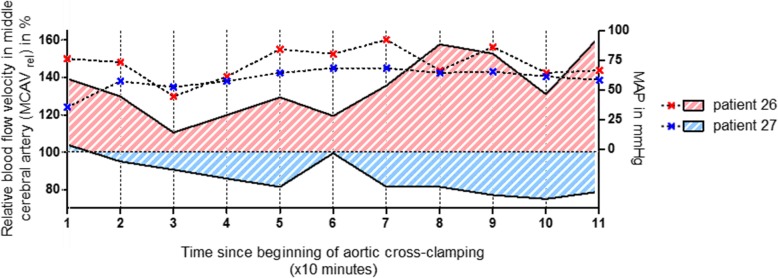
In 47 consecutive adult patients, right middle cerebral artery blood flow velocity (MCAV) was assessed using transcranial Doppler sonography. Individual values, measured during cardiopulmonary bypass (CPB), were normalized to the pre-bypass baseline value and termed MCAV. An MCAV > 100% was defined as cerebral hyperperfusion. Prevalence of POD was assessed using the Confusion Assessment Method for the Intensive Care Unit.
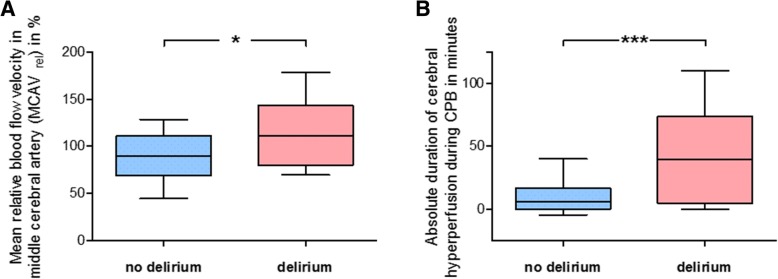
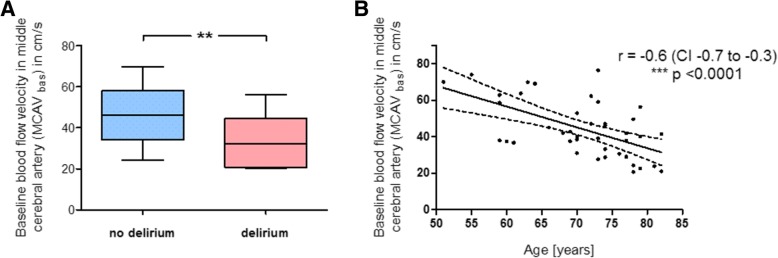
Overall prevalence of POD was 27%. In the subgroup without POD, 32% of patients had experienced relative cerebral hyperperfusion during CPB, compared to 67% in the subgroup with POD (p < 0.05). The mean averaged MCAV was 90 (±21) % in the no-POD group vs. 112 (±32) % in the POD group (p < 0.05), and patients developing delirium experienced cerebral hyperperfusion during CPB for about 39 (±35) min, compared to 6 (±11) min in the group without POD (p < 0.001). In a subcohort with pre-bypass baseline MCAV (MCAV) below the median MCAV of the whole cohort, prevalence of POD was 17% when MCAV during CPB was kept below 100%, but increased to 53% when these patients actually experienced relative cerebral hyperperfusion.
Our results suggest a critical role for cerebral hyperperfusion in the pathogenesis of POD following on-pump open-heart surgery, recommending a more individualized hemodynamic management, especially in the population at risk.
我们的目的是评估体外循环期间(CPB)大脑中动脉血流速度(MCAV)相对于旁路前基线的变化是否与心脏手术后术后谵妄(POD)的风险相关。
在 47 例连续成年患者中,使用经颅多普勒超声评估右大脑中动脉血流速度(MCAV)。在 CPB 期间测量的个体值被标准化为旁路前基线值,并称为 MCAV。MCAV>100%定义为脑过度灌注。使用重症监护病房的意识混乱评估方法评估 POD 的发生率。
POD 的总发生率为 27%。在无 POD 亚组中,32%的患者在 CPB 期间经历了相对脑过度灌注,而在 POD 亚组中为 67%(p<0.05)。无 POD 组的平均 MCAV 为 90(±21)%,POD 组为 112(±32)%(p<0.05),发生谵妄的患者在 CPB 期间经历了约 39(±35)分钟的脑过度灌注,而无 POD 组为 6(±11)分钟(p<0.001)。在基线 MCAV(MCAV)低于整个队列中位数的亚队列中,当 CPB 期间的 MCAV 保持在 100%以下时,POD 的发生率为 17%,但当这些患者实际上经历相对脑过度灌注时,发生率增加到 53%。
我们的结果表明,体外循环开胸心脏手术后 POD 的发病机制中,脑过度灌注起关键作用,建议对高危人群进行更个体化的血流动力学管理。