School of Computing, Informatics, and Decision Systems Engineering, Arizona State University, Tempe, AZ, USA.
Wellesley College, Wellesley, MA, USA.
Neuroimage Clin. 2019;22:101744. doi: 10.1016/j.nicl.2019.101744. Epub 2019 Mar 4.
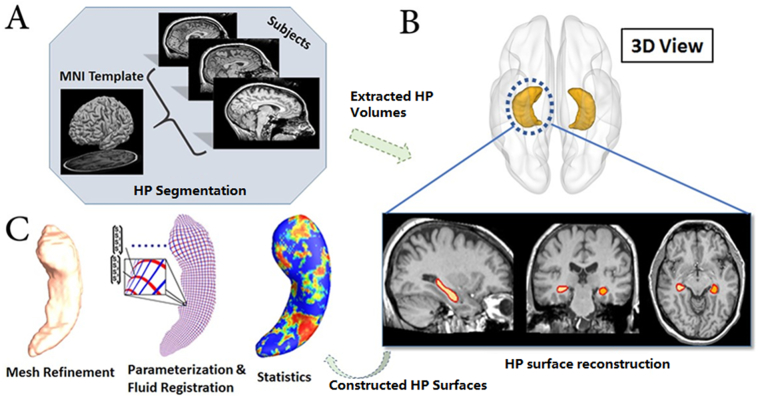
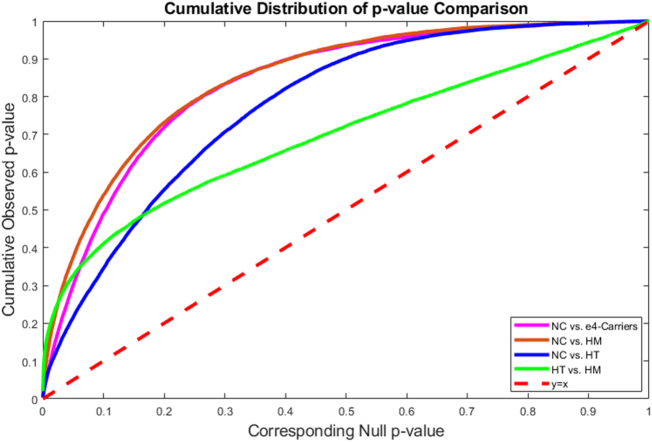
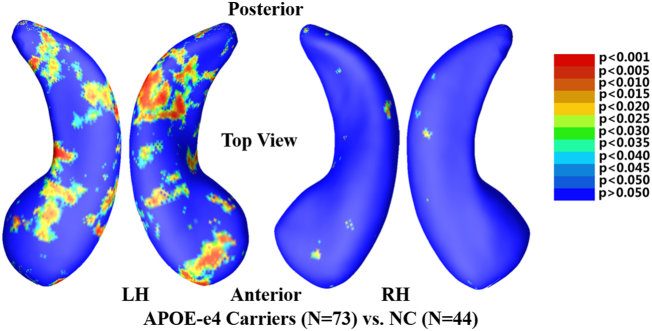
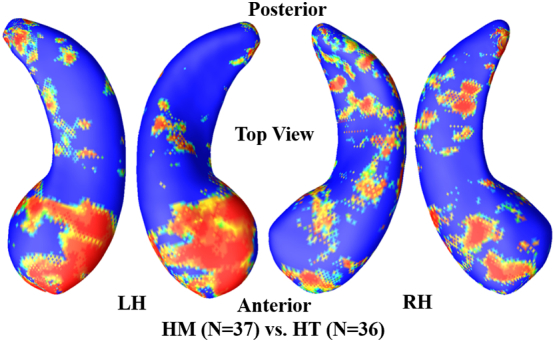
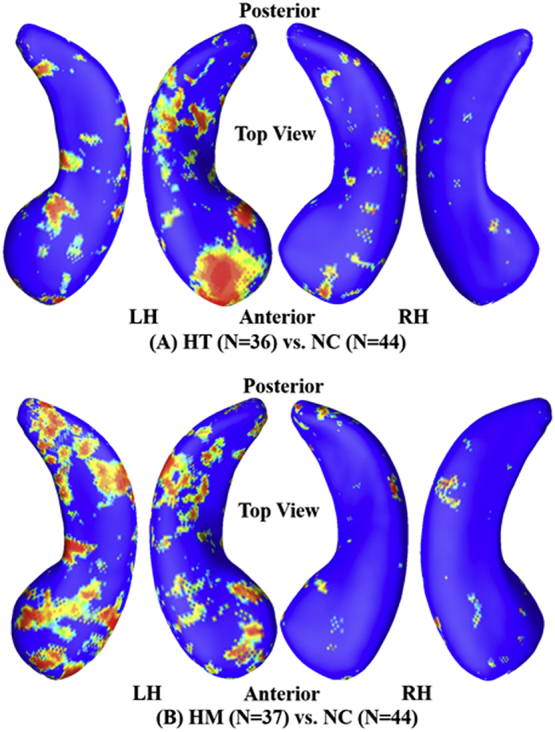
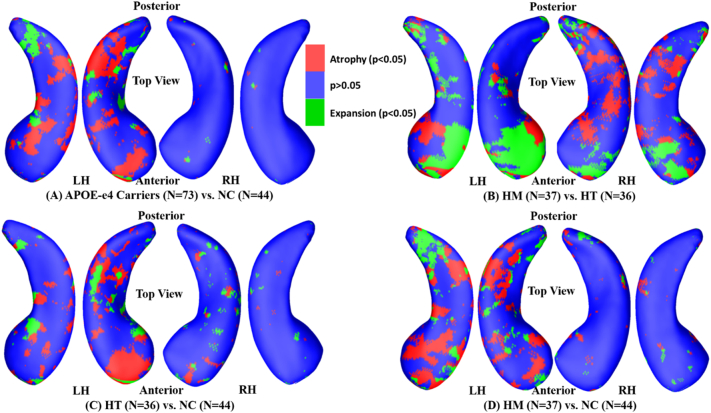
Apolipoprotein E (APOE) e4 is the major genetic risk factor for late-onset Alzheimer's disease (AD). The dose-dependent impact of this allele on hippocampal volumes has been documented, but its influence on general hippocampal morphology in cognitively unimpaired individuals is still elusive. Capitalizing on the study of a large number of cognitively unimpaired late middle aged and older adults with two, one and no APOE-e4 alleles, the current study aims to characterize the ability of our automated surface-based hippocampal morphometry algorithm to distinguish between these three levels of genetic risk for AD and demonstrate its superiority to a commonly used hippocampal volume measurement. We examined the APOE-e4 dose effect on cross-sectional hippocampal morphology analysis in a magnetic resonance imaging (MRI) database of 117 cognitively unimpaired subjects aged between 50 and 85 years (mean = 57.4, SD = 6.3), including 36 heterozygotes (e3/e4), 37 homozygotes (e4/e4) and 44 non-carriers (e3/e3). The proposed automated framework includes hippocampal surface segmentation and reconstruction, higher-order hippocampal surface correspondence computation, and hippocampal surface deformation analysis with multivariate statistics. In our experiments, the surface-based method identified APOE-e4 dose effects on the left hippocampal morphology. Compared to the widely-used hippocampal volume measure, our hippocampal morphometry statistics showed greater statistical power by distinguishing cognitively unimpaired subjects with two, one, and no APOE-e4 alleles. Our findings mirrored previous studies showing that APOE-e4 has a dose effect on the acceleration of brain structure deformities. The results indicated that the proposed surface-based hippocampal morphometry measure is a potential preclinical AD imaging biomarker for cognitively unimpaired individuals.
载脂蛋白 E(APOE)e4 是晚发性阿尔茨海默病(AD)的主要遗传风险因素。该等位基因对海马体体积的剂量依赖性影响已被记录在案,但在认知正常的个体中,其对一般海马体形态的影响仍不清楚。本研究利用大量认知正常的中老年个体的研究数据,这些个体携带两个、一个或没有 APOE-e4 等位基因,旨在描述我们基于自动表面的海马体形态计量学算法区分这三种 AD 遗传风险水平的能力,并证明其优于常用的海马体体积测量方法。我们在一个包含 117 名认知正常的 50 至 85 岁(平均年龄 57.4,标准差 6.3)个体的磁共振成像(MRI)数据库中,检查了 APOE-e4 剂量对横断面海马体形态分析的影响,这些个体包括 36 名杂合子(e3/e4)、37 名纯合子(e4/e4)和 44 名非携带者(e3/e3)。所提出的自动框架包括海马体表面分割和重建、高阶海马体表面对应计算以及具有多变量统计学的海马体表面变形分析。在我们的实验中,基于表面的方法确定了 APOE-e4 剂量对左侧海马体形态的影响。与广泛使用的海马体体积测量相比,我们的海马体形态计量学统计数据通过区分携带两个、一个和没有 APOE-e4 等位基因的认知正常个体,显示出更大的统计能力。我们的研究结果与之前的研究一致,表明 APOE-e4 对加速大脑结构畸形有剂量效应。结果表明,所提出的基于表面的海马体形态计量测量可能是认知正常个体的潜在临床前 AD 成像生物标志物。