Lee Joung Bok, Kim Sang Beom, Lee Kyeong Woo, Lee Jong Hwa, Park Jin Gee, Lee Sook Joung
Department of Physical Medicine and Rehabilitation, Dong-A University College of Medicine, Busan, Korea.
Regional Cardiocerebrovascular Center, Dong-A University Medical Center, Busan, Korea.
Ann Rehabil Med. 2019 Feb;43(1):96-105. doi: 10.5535/arm.2019.43.1.96. Epub 2019 Feb 28.
To investigate the effects of combination functional electrical stimulation (FES) and standing frame training on standing balance in stroke patients.
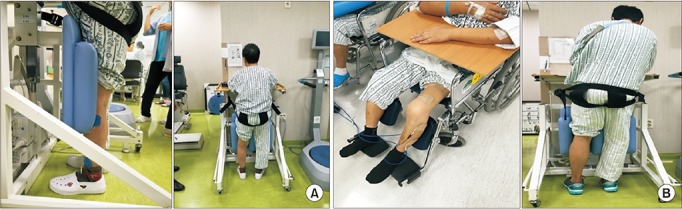
Patients who had hemiparesis and postural instability after stroke were randomly assigned to one of the two groups; study group underwent FES on the quadriceps and tibialis anterior muscle simultaneously with standing balance training. The control group received standing frame training and FES separately. Both the groups received their respective therapies for 3 weeks. Stability index in Biodex Balance master system, Berg Balance Scale (BBS), manual muscle test, the Korean version of Modified Barthel Index, and Korean version of Mini-Mental State Examination were used to evaluate the effects of the treatment.
In total, 30 patients were recruited to the study group and 30 to the control group. Three weeks after treatment, both the groups showed improvement in postural stability scores and physical and cognitive functions. When changes in postural stability were compared between the groups, the study group showed more significant improvement than the control group with regards to the scores of BBS and the stability indices.
In this study, we found the therapeutic effectiveness of combined therapy of FES and standing frame in subacute stroke patients. The presented protocol is proposed as time-saving and can be applied easily in the clinical setting. Thus, the proposed combined therapy could be a useful method for improving standing balance in subacute stroke patients.
探讨功能性电刺激(FES)与站立架训练相结合对脑卒中患者站立平衡的影响。
将脑卒中后出现偏瘫和姿势不稳的患者随机分为两组;研究组在进行站立平衡训练的同时,对股四头肌和胫前肌进行FES。对照组分别接受站立架训练和FES。两组均接受各自的治疗3周。采用Biodex平衡测试系统中的稳定性指数、伯格平衡量表(BBS)、徒手肌力测试、韩国版改良巴氏指数和韩国版简易精神状态检查表来评估治疗效果。
共招募30例患者进入研究组,30例进入对照组。治疗3周后,两组患者的姿势稳定性评分以及身体和认知功能均有所改善。比较两组之间姿势稳定性的变化时,研究组在BBS评分和稳定性指数方面的改善比对照组更显著。
在本研究中,我们发现FES与站立架联合治疗对亚急性脑卒中患者具有治疗效果。所提出的方案省时且可在临床环境中轻松应用。因此,所提出的联合治疗可能是改善亚急性脑卒中患者站立平衡的一种有用方法。