Virostko John, Sorace Anna G, Wu Chengyue, Ekrut David, Jarrett Angela M, Upadhyaya Raghave M, Avery Sarah, Patt Debra, Goodgame Boone, Yankeelov Thomas E
Department of Diagnostic Medicine.
Livestrong Cancer Institutes.
Tomography. 2019 Mar;5(1):44-52. doi: 10.18383/j.tom.2018.00019.
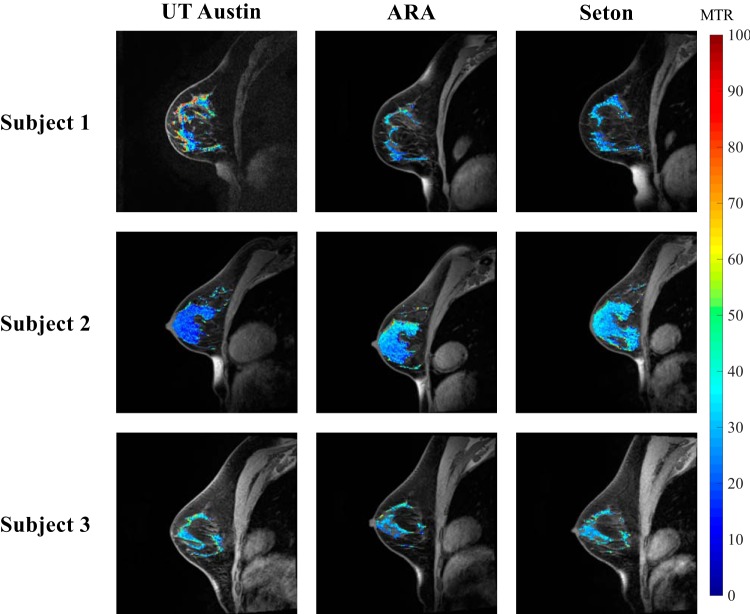
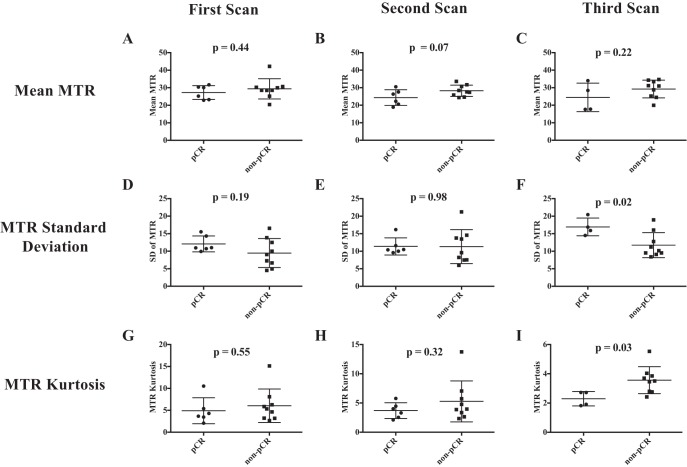
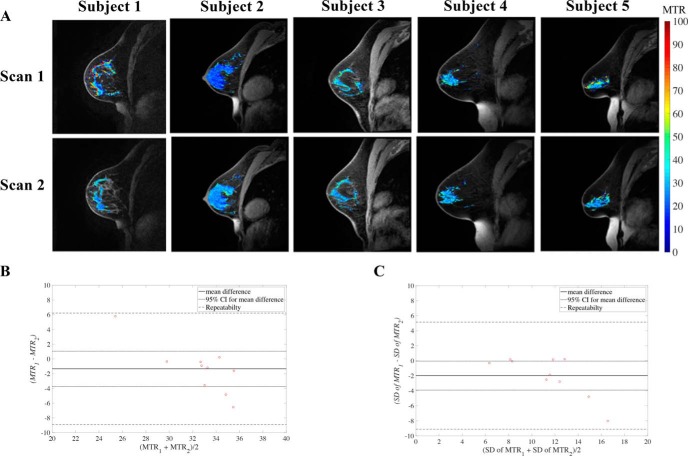
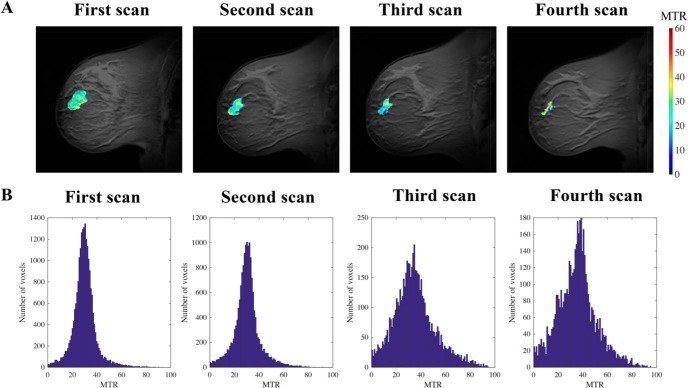
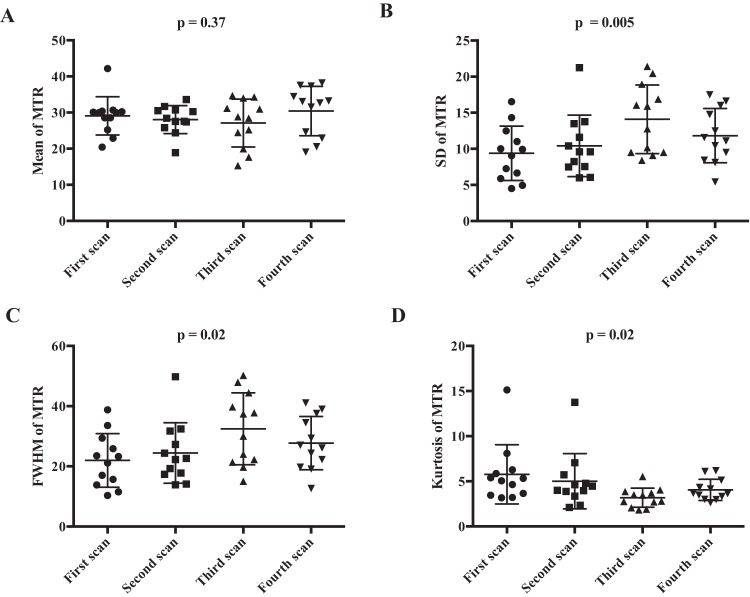
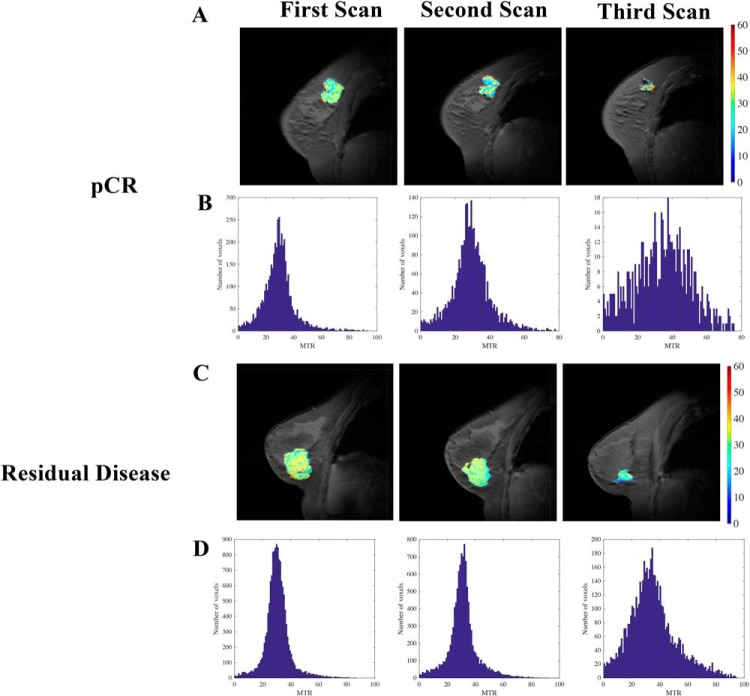
Repeatability and reproducibility of magnetization transfer magnetic resonance imaging of the breast, and the ability of this technique to assess the response of locally advanced breast cancer to neoadjuvant therapy (NAT), are determined. Reproducibility scans at 3 different 3 T scanners, including 2 scanners in community imaging centers, found a 16.3% difference (n = 3) in magnetization transfer ratio (MTR) in healthy breast fibroglandular tissue. Repeatability scans (n = 10) found a difference of ∼8.1% in the MTR measurement of fibroglandular tissue between the 2 measurements. Thus, MTR is repeatable and reproducible in the breast and can be integrated into community imaging clinics. Serial magnetization transfer magnetic resonance imaging performed at longitudinal time points during NAT indicated no significant change in average tumoral MTR during treatment. However, histogram analysis indicated an increase in the dispersion of MTR values of the tumor during NAT, as quantified by higher standard deviation ( = .005), higher full width at half maximum ( = .02), and lower kurtosis ( = .02). Patients' stratification into those with pathological complete response (pCR; n = 6) at the conclusion of NAT and those with residual disease (n = 9) showed wider distribution of tumor MTR values in patients who achieved pCR after 2-4 cycles of NAT, as quantified by higher standard deviation ( = .02), higher full width at half maximum ( = .03), and lower kurtosis ( = .03). Thus, MTR can be used as an imaging metric to assess response to breast NAT.
确定了乳腺磁化传递磁共振成像的可重复性和再现性,以及该技术评估局部晚期乳腺癌对新辅助治疗(NAT)反应的能力。在3台不同的3T扫描仪上进行的再现性扫描,包括社区影像中心的2台扫描仪,发现健康乳腺纤维腺组织的磁化传递率(MTR)存在16.3%的差异(n = 3)。重复性扫描(n = 10)发现两次测量之间纤维腺组织的MTR测量值相差约8.1%。因此,MTR在乳腺中具有可重复性和再现性,可整合到社区影像诊所中。在NAT期间的纵向时间点进行的系列磁化传递磁共振成像表明,治疗期间肿瘤平均MTR无显著变化。然而,直方图分析表明,NAT期间肿瘤MTR值的离散度增加,通过更高的标准差( = 0.005)、更高的半高宽( = 0.02)和更低的峰度( = 0.02)来量化。将患者分层为NAT结束时达到病理完全缓解(pCR;n = 6)的患者和有残留疾病的患者(n = 9),结果显示,在接受2 - 4个周期NAT后达到pCR的患者中,肿瘤MTR值分布更宽,通过更高的标准差( = 0.02)、更高的半高宽( = 0.03)和更低的峰度( = 0.03)来量化。因此,MTR可作为一种成像指标来评估乳腺NAT的反应。