Sun Ran, Dai Wei, Liu Yang, Liu Changli, Liu Yongning, Gong Ying, Sun Xiaohong, Shi Tieying, Song Mingzhi
Department of Nursing.
Operation room, the First Affiliated Hospital of Dalian Medical University.
Medicine (Baltimore). 2019 Mar;98(10):e14713. doi: 10.1097/MD.0000000000014713.
Breast disease has been a global serious health problem, among women. Surgery is the main treatment for the patients suffering from breast disease. Postoperative nausea and vomiting are still disturbing. Acupoint stimulation, an effective treatment of traditional Chinese medicine, has been used to reduce postoperative nausea and vomiting. Recently, non-needle acupoint stimulation becomes a new intervention. Though several clinical trials have been done, there is still no final conclusion on the efficacy. This Meta-Analysis aims at evaluating the efficacy of non-needle acupoint stimulation for prevention of nausea and vomiting after breast surgery.
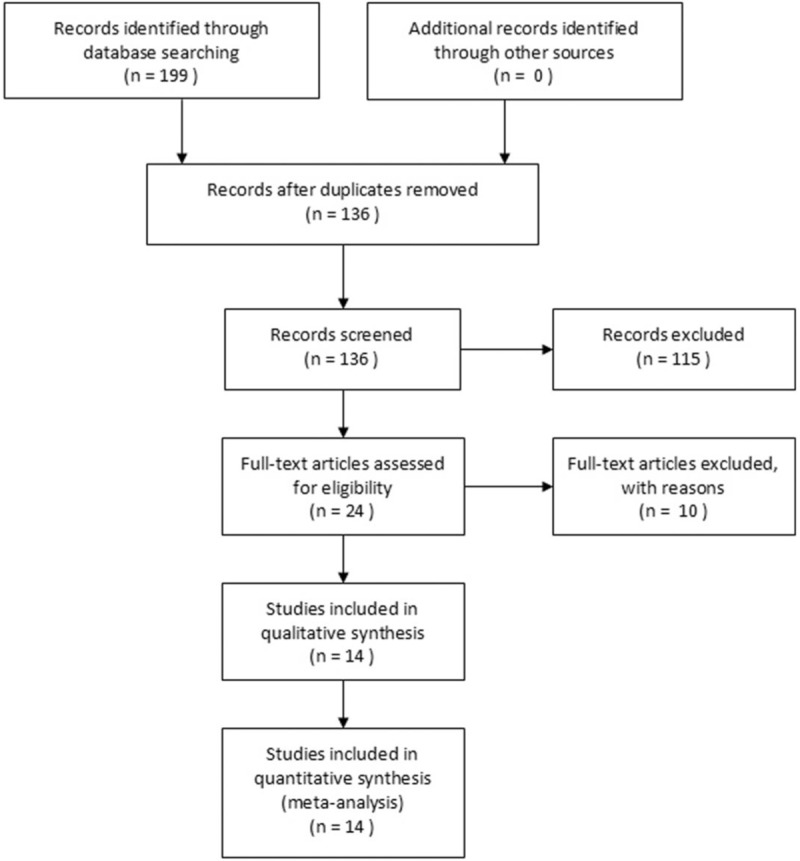
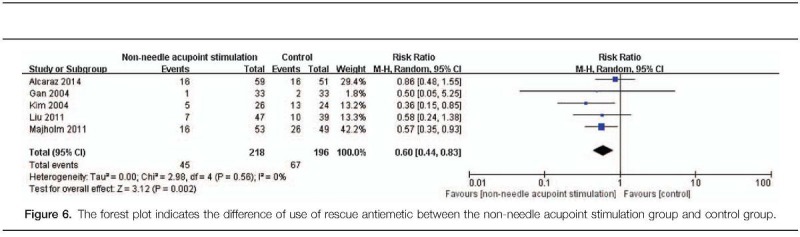
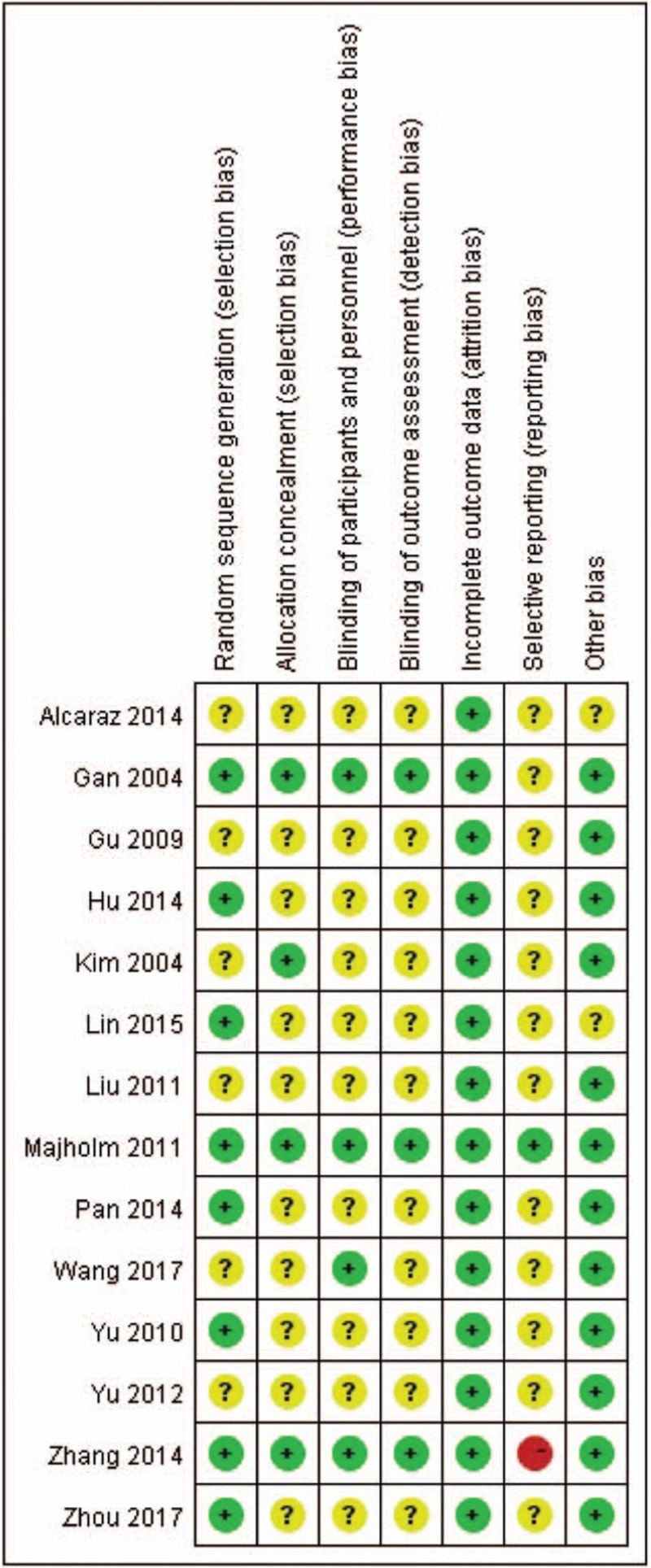
Systematic searches were conducted in PubMed, Embase, Cochrane, and Wanfang Med Online databases for studies. The review period covered from the inception of databases to December 31, 2017. The outcome measures of interest were frequency of nausea, frequency of vomiting, frequency of PONV, verbal rating scale of nausea, and use of rescue antiemetic. Data extraction and risks of bias evaluation were accomplished by 2 independent reviewers using the Cochrane Collaboration Review Manager software (RevMan 5.3.5).
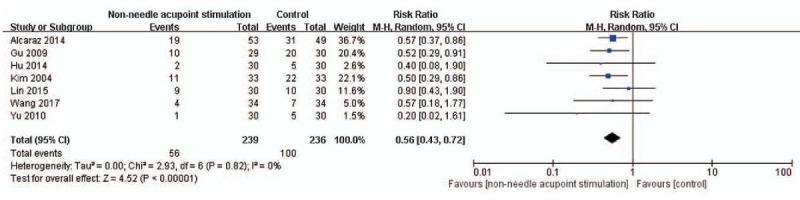
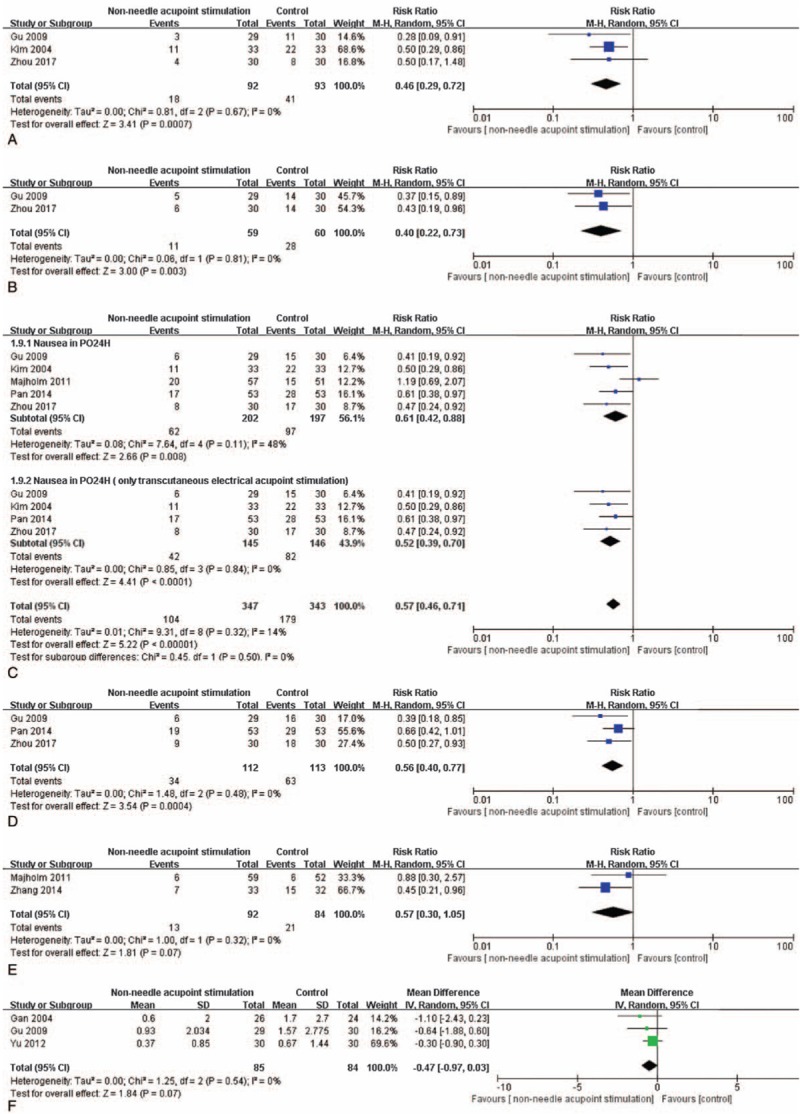
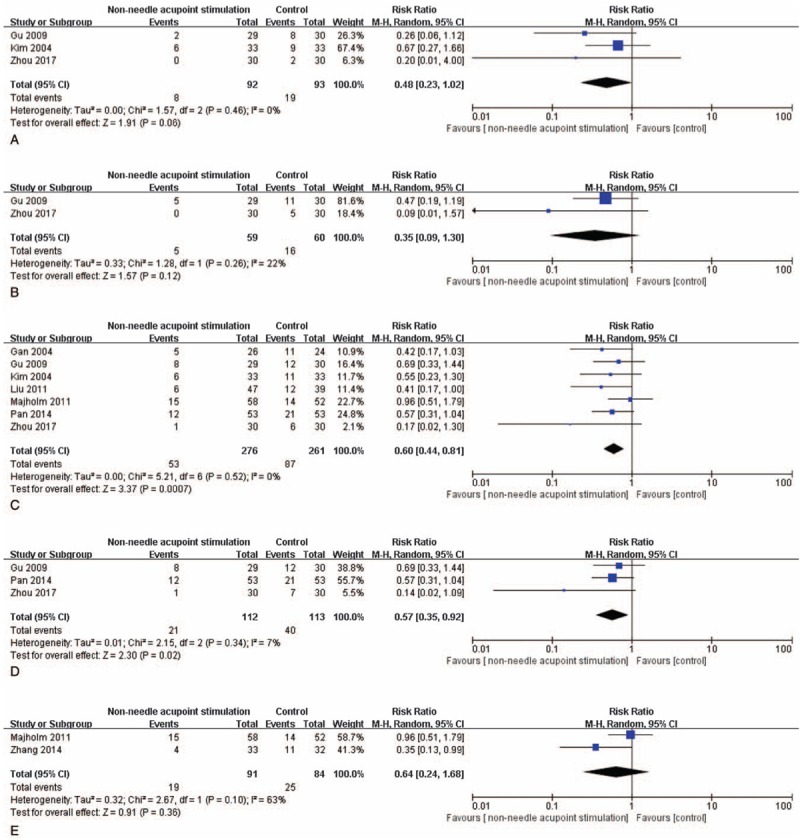
Fourteen randomized controlled trials with a total of 1009 female participants in the non-needle acupoint stimulation group and control group met the inclusion criteria. Although the therapeutically effect on vomiting within postoperative 2 hours was not obvious, non-needle acupoint stimulation still had an important role in reducing nausea and vomiting within postoperative 48 hours. According to Jadad scale, there was moderate quality evidence for the pooled analysis results in this study. In addition, stimulating acupoint by wristband acupressure was more likely to cause adverse reactions.
Non-needle acupoint stimulation can be used for female patients undergoing breast surgery to reduce postoperative nausea and vomiting. Into consideration, we recommend transcutaneous acupoint electrical stimulation on PC6 from 30 minutes before induction of anesthesia to the end of surgery for application. This non-pharmaceutical approach may be promising to promote the recovery of patients after breast surgery.
乳腺疾病一直是全球女性面临的严重健康问题。手术是乳腺疾病患者的主要治疗方式。术后恶心呕吐仍然令人困扰。穴位刺激作为一种有效的中医疗法,已被用于减少术后恶心呕吐。近年来,非针刺穴位刺激成为一种新的干预措施。尽管已经进行了多项临床试验,但关于其疗效仍无定论。本荟萃分析旨在评估非针刺穴位刺激预防乳腺手术后恶心呕吐的疗效。
在PubMed、Embase、Cochrane和万方医学在线数据库中进行系统检索以查找研究。检索期涵盖从数据库建立到2017年12月31日。感兴趣的结局指标包括恶心频率、呕吐频率、术后恶心呕吐(PONV)频率、恶心的视觉模拟评分以及急救止吐药的使用情况。数据提取和偏倚风险评估由2名独立 reviewers 使用Cochrane协作网综述管理软件(RevMan 5.3.5)完成。
14项随机对照试验,非针刺穴位刺激组和对照组共有1009名女性参与者符合纳入标准。虽然术后2小时内对呕吐的治疗效果不明显,但非针刺穴位刺激在减少术后48小时内的恶心呕吐方面仍具有重要作用。根据Jadad量表,本研究汇总分析结果有中等质量证据。此外,腕带穴位按压刺激穴位更易引起不良反应。
非针刺穴位刺激可用于接受乳腺手术的女性患者以减少术后恶心呕吐。综合考虑,我们建议在麻醉诱导前30分钟至手术结束期间对PC6进行经皮穴位电刺激。这种非药物方法可能有助于促进乳腺手术后患者的恢复。