Department of Neurology, Slagelse Hospital, Slagelse, Denmark.
Department of Clinical Immunology and Biochemistry, Lillebælt Hospital, Vejle, Denmark.
J Neuroinflammation. 2019 Mar 11;16(1):59. doi: 10.1186/s12974-019-1440-5.
Long-term outcome in multiple sclerosis (MS) depends on early treatment. In patients with acute optic neuritis (ON), an early inflammatory event, we investigated markers in cerebrospinal fluid (CSF), which may predict a diagnosis of MS.
Forty patients with acute ON were recruited in a prospective population-based cohort with median 29 months (range 19-41) of follow-up. Paired CSF and serum samples were taken within 14 days (range 2-38), prior to treatment. Prospectively, 16/40 patients were by a uniform algorithm diagnosed with MS (MS-ON) and 24 patients continued to manifest isolated ON (ION) during follow-up. Levels of cytokines and neurofilament light chain (NF-L) were measured at the onset of acute ON and compared to healthy controls (HC). Significance levels were corrected for multiple comparisons ("q"). The predictive value of biomarkers was determined with multivariable prediction models using nomograms.
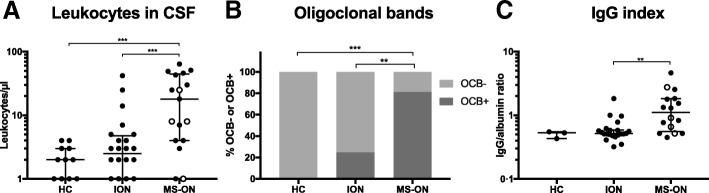
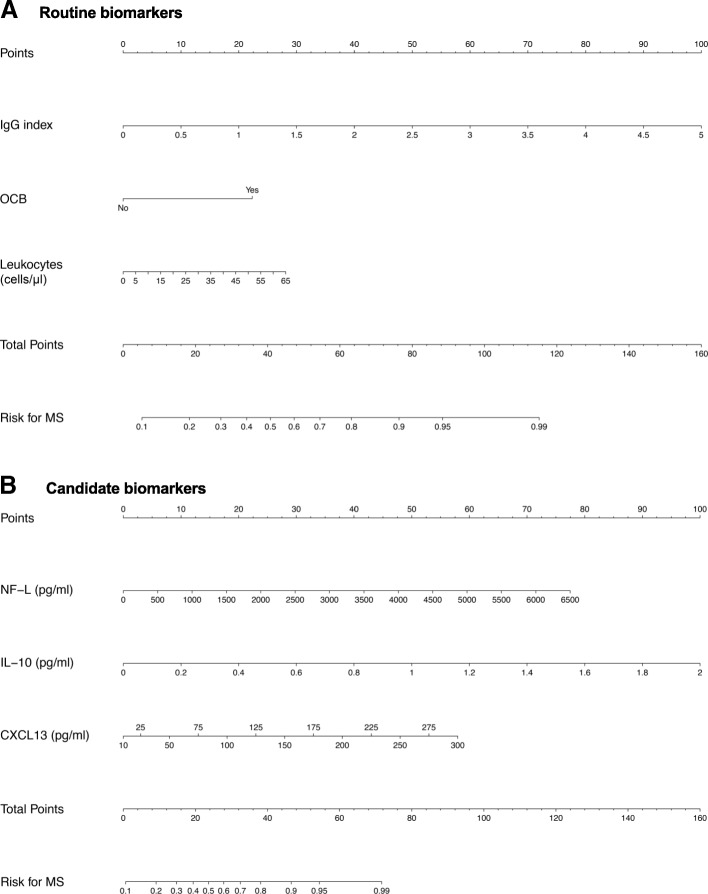
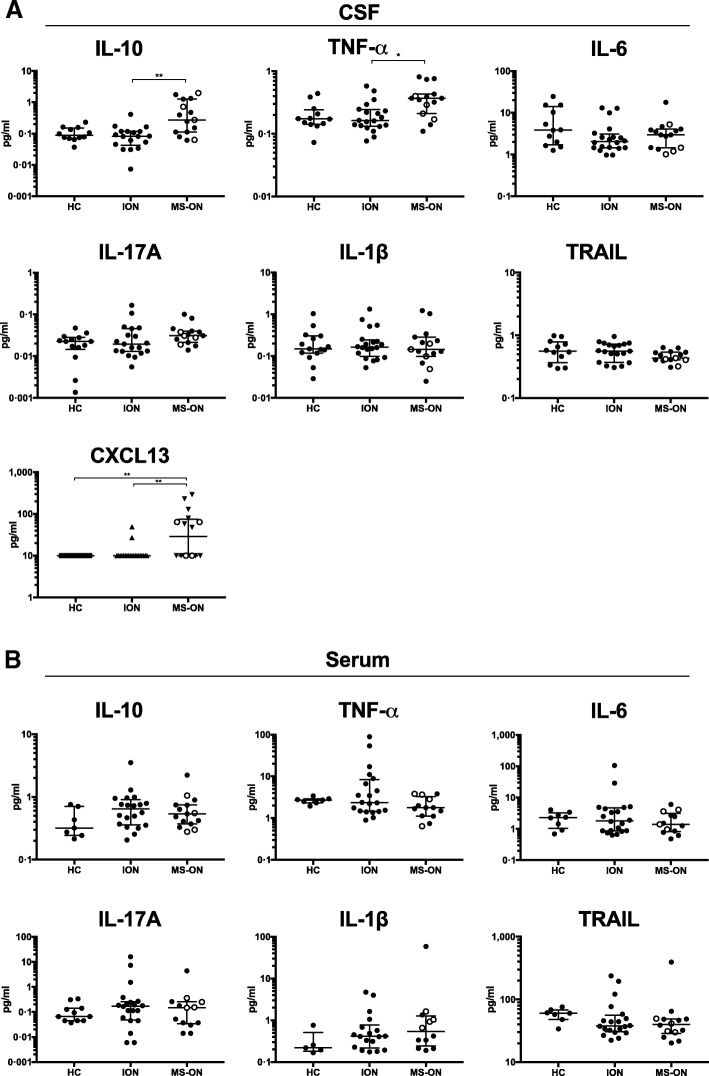
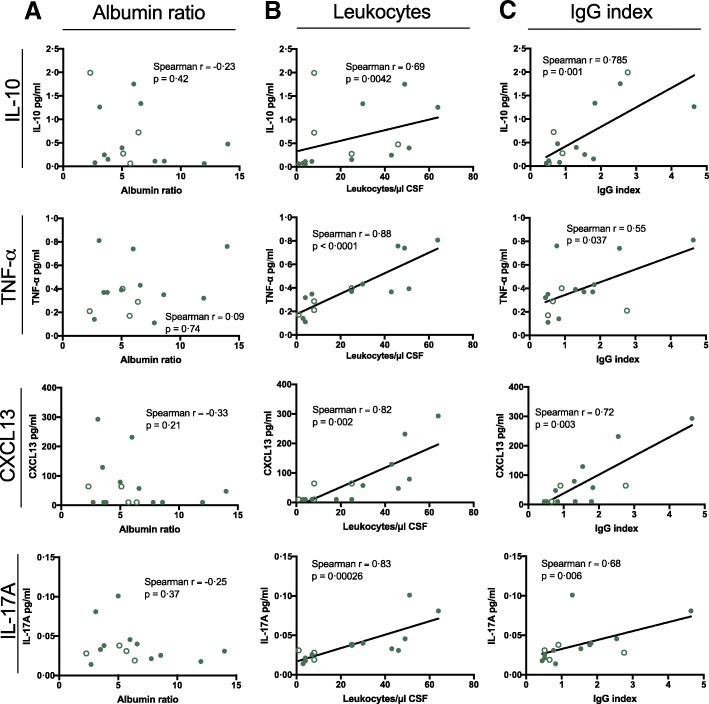
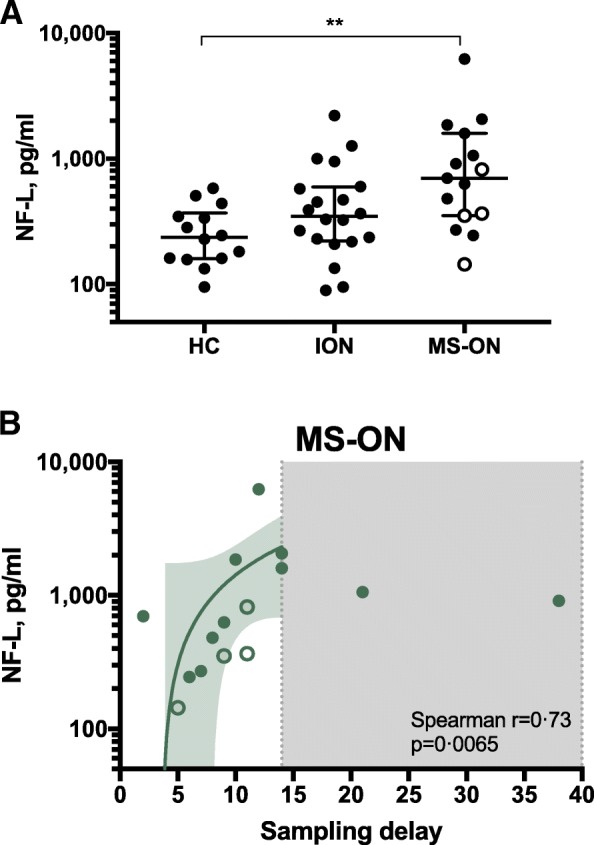
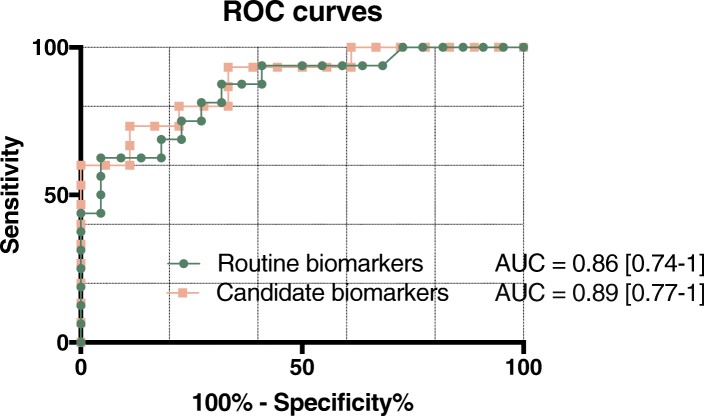
CSF TNF-α, IL-10, and CXCL13 levels were increased in MS-ON compared to those in ION patients (q = 0.021, 0.004, and 0.0006, respectively). MS-ON patients had increased CSF pleocytosis, IgG indices, and oligoclonal bands (OCBs) compared to ION (q = 0.0007, q = 0.0058, and q = 0.0021, respectively). CSF levels of IL-10, TNF-a, IL-17A, and CXCL13 in MS-ON patients correlated with leukocyte counts (r > 0.69 and p < 0.002) and IgG index (r > 0.55, p < 0.037). CSF NF-L levels were increased in ON patients compared to those in HC (q = 0.0077). In MS-ON, a progressive increase in NF-L levels was observed at 7 to 14 days after disease onset (r = 0.73, p < 0.0065). Receiver-operating characteristic (ROC) curves for two multivariable prediction models were generated, with IL-10, CXCL13, and NF-L in one ("candidate") and IgG index, OCB, and leukocytes in another ("routine"). Area under the curve was 0.89 [95% CI 0.77-1] and 0.86 [0.74-0.98], respectively. Predictions of the risk of MS diagnosis were illustrated by two nomograms.
CSF TNF-α, IL-10, CXCL13, and NF-L levels were associated with the development of MS, suggesting that the inflammatory and neurodegenerative processes occurred early. Based on subsequent diagnosis, we observed a high predictive value of routine and candidate biomarkers in CSF for the development of MS in acute ON. The nomogram predictions may be useful in the diagnostic work-up of MS.
多发性硬化症(MS)的长期预后取决于早期治疗。在急性视神经炎(ON)患者中,我们研究了发病早期炎症事件相关的脑脊液(CSF)标志物,这些标志物可能有助于预测 MS 诊断。
前瞻性纳入了 40 例急性 ON 患者,中位随访时间 29 个月(范围 19-41 个月)。所有患者均在发病后 14 天内(范围 2-38 天)采集了配对的 CSF 和血清样本,以便进行分析。按照统一的算法,前瞻性将 16/40 例患者诊断为 MS-ON,24 例患者在随访期间继续表现为孤立性 ON(ION)。在急性 ON 发病时测量 CSF 中细胞因子和神经丝轻链(NF-L)的水平,并与健康对照组(HC)进行比较。采用多重比较校正检验(q 值)。通过列线图构建多变量预测模型,评估生物标志物的预测价值。
MS-ON 患者的 CSF TNF-α、IL-10 和 CXCL13 水平高于 ION 患者(q 值分别为 0.021、0.004 和 0.0006)。与 ION 患者相比,MS-ON 患者的 CSF 白细胞增多、IgG 指数和寡克隆带(OCB)也更高(q 值分别为 0.0007、q 值为 0.0058 和 q 值为 0.0021)。MS-ON 患者的 CSF 中 IL-10、TNF-a、IL-17A 和 CXCL13 水平与白细胞计数(r 值>0.69,p 值<0.002)和 IgG 指数(r 值>0.55,p 值<0.037)相关。与 HC 相比,ON 患者的 CSF NF-L 水平升高(q 值为 0.0077)。在 MS-ON 患者中,在疾病发病后 7-14 天,NF-L 水平逐渐升高(r 值为 0.73,p 值<0.0065)。我们生成了两个多变量预测模型的 ROC 曲线,一个模型使用 IL-10、CXCL13 和 NF-L 作为候选标志物(“候选”),另一个模型使用 IgG 指数、OCB 和白细胞作为常规标志物(“常规”)。曲线下面积分别为 0.89 [95%CI 0.77-1] 和 0.86 [0.74-0.98]。通过两个列线图展示了预测 MS 诊断风险的结果。
CSF TNF-α、IL-10、CXCL13 和 NF-L 水平与 MS 的发生发展相关,提示炎症和神经退行性过程发生较早。基于随后的诊断,我们发现 CSF 中的常规和候选生物标志物对急性 ON 中 MS 的发生具有较高的预测价值。列线图预测可能有助于 MS 的诊断评估。