Division of Medical Oncology, Department of Medicine, Duke Cancer Institute, Durham, NC.
Division of Medical Oncology, Department of Medicine, Duke Cancer Institute, Durham, NC.
Clin Genitourin Cancer. 2019 Jun;17(3):e513-e521. doi: 10.1016/j.clgc.2019.01.017. Epub 2019 Feb 5.
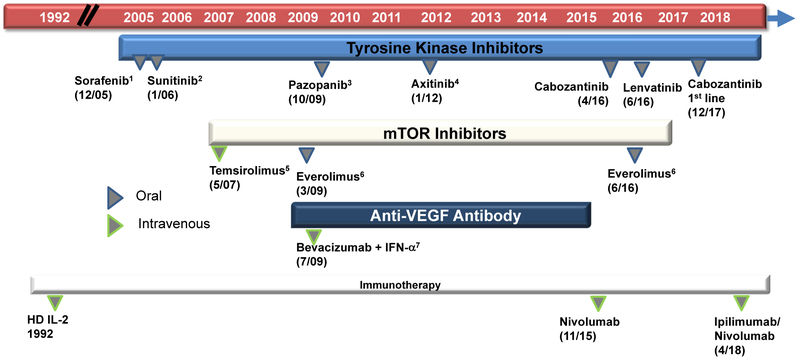
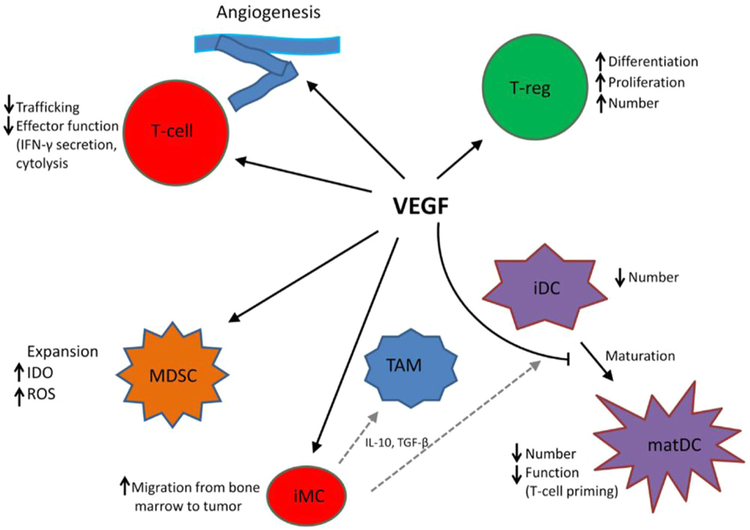
The incidence of renal-cell carcinoma has been increasing each year, with nearly one third of new cases diagnosed at advanced or metastatic stage. The advent of targeted therapies for metastatic renal-cell carcinoma (mRCC) has underscored the need to subtype tumors according to tumor-immune expression profiles that may more reliably predict treatment outcomes. Over the past 2 decades, several vascular endothelial growth factor (VEGF) and tyrosine kinase inhibitors have been the mainstay for first- and second-line treatment of mRCC. Very recently, immunotherapy checkpoint inhibitors have significantly changed the treatment landscape for patients with mRCC, particularly for first-line treatment of intermediate to poor risk mRCC patients. Now, combination immunotherapy as well as combinations of immunotherapy with targeted agents can significantly alter disease outcomes. The field of immuno-oncology for mRCC has unveiled a deeper understanding of the immunoreactivity inherent to these tumors, and as a result combination therapy is evolving as a first-line modality. This review provides a timeline of advances and controversies in first-line treatment of mRCC, describes recent advances in understanding the immunoreactivity of these tumors, and addresses the future of combination anti-VEGF and immunotherapeutic platforms.
肾细胞癌的发病率每年都在增加,近三分之一的新病例诊断为晚期或转移性。转移性肾细胞癌 (mRCC) 的靶向治疗方法的出现凸显了根据肿瘤免疫表达谱对肿瘤进行亚型分类的必要性,这种方法可能更可靠地预测治疗结果。在过去的 20 年中,几种血管内皮生长因子 (VEGF) 和酪氨酸激酶抑制剂一直是 mRCC 一线和二线治疗的主要方法。最近,免疫治疗检查点抑制剂极大地改变了 mRCC 患者的治疗格局,特别是对于中高危 mRCC 患者的一线治疗。现在,免疫联合治疗以及免疫治疗与靶向药物联合治疗可以显著改变疾病的结局。mRCC 的免疫肿瘤学领域揭示了这些肿瘤固有免疫反应性的更深入了解,因此联合治疗正在作为一线治疗模式不断发展。本文提供了 mRCC 一线治疗的进展和争议的时间线,描述了最近对这些肿瘤免疫反应性的理解进展,并探讨了抗 VEGF 和免疫治疗联合平台的未来。