Department of Radiation Oncology (MAASTRO), GROW-School for Oncology and Developmental Biology, Maastricht University Medical Centre, Maastricht, Netherlands.
OncoRay - National Center for Radiation Research in Oncology, Faculty of Medicine and University Hospital Carl Gustav Carus, Technische Universität Dresden, Helmholtz-Zentrum Dresden - Rossendorf, Dresden, Germany.
Sci Rep. 2019 Mar 11;9(1):4126. doi: 10.1038/s41598-019-40584-9.
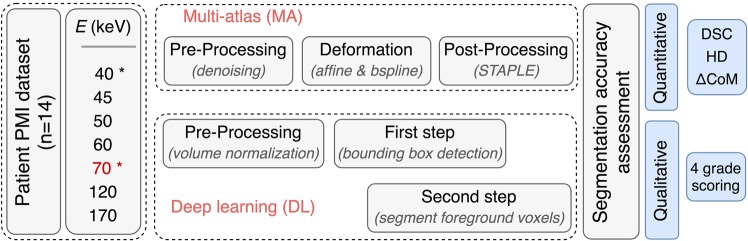
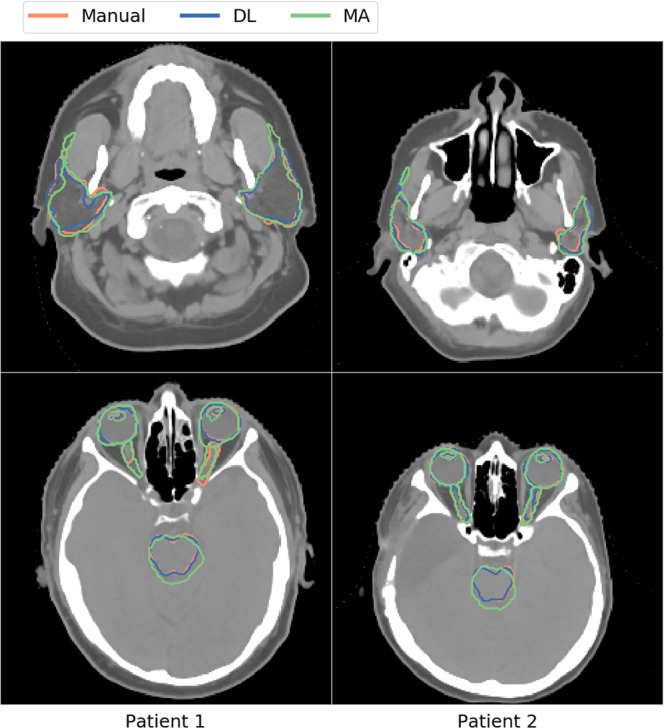
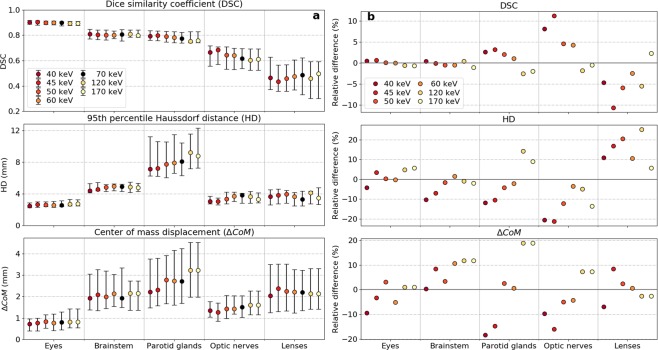
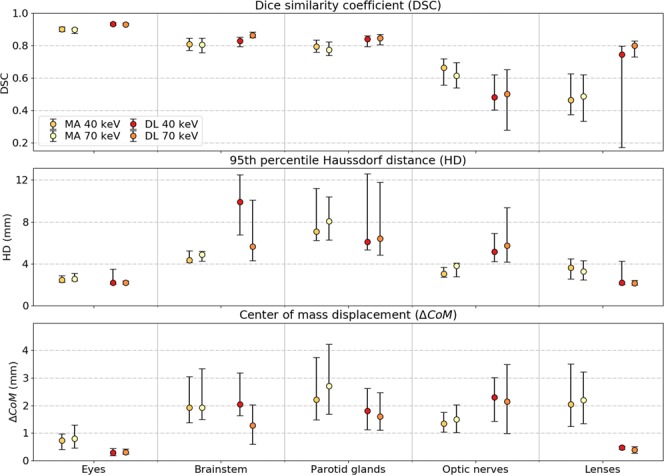
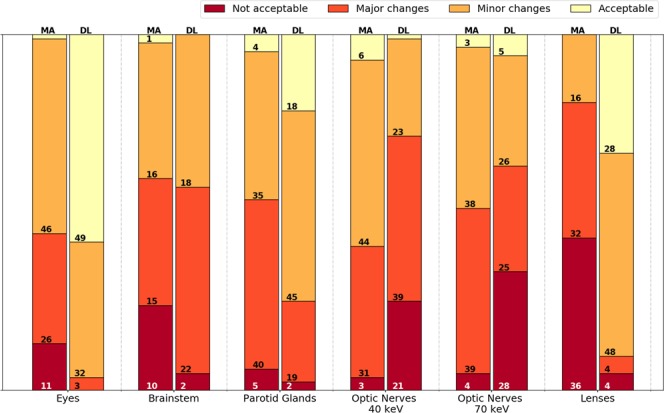
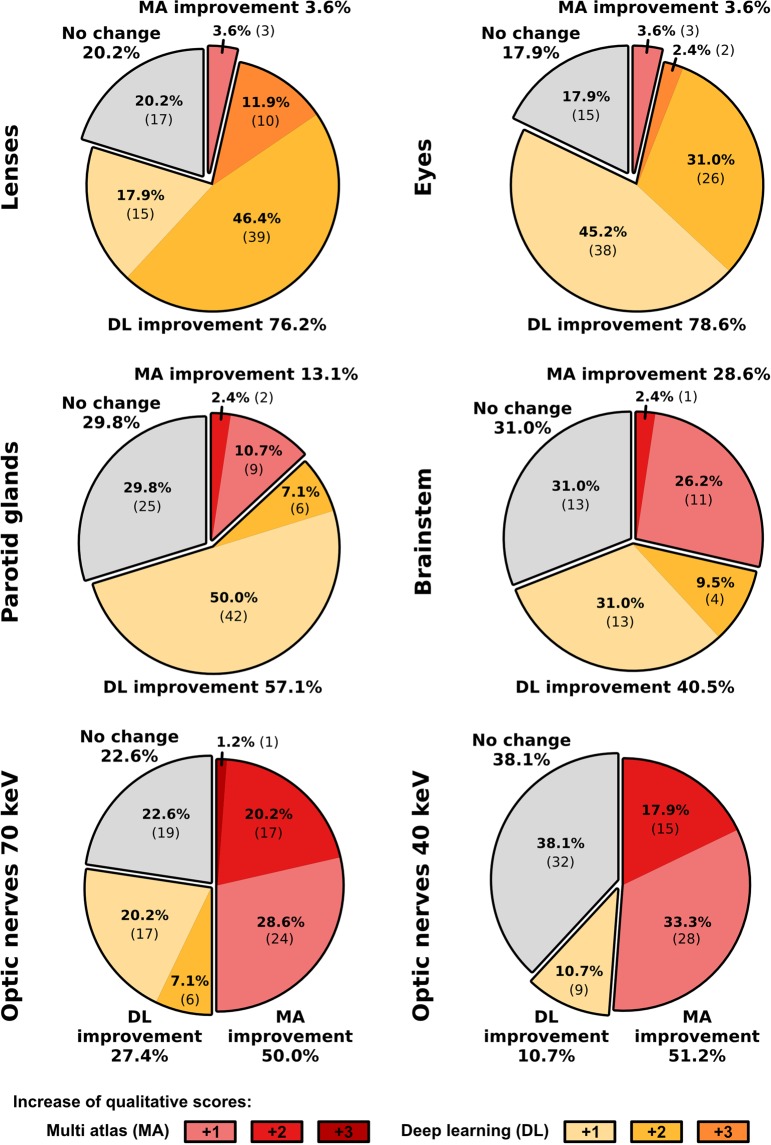
In radiotherapy, computed tomography (CT) datasets are mostly used for radiation treatment planning to achieve a high-conformal tumor coverage while optimally sparing healthy tissue surrounding the tumor, referred to as organs-at-risk (OARs). Based on CT scan and/or magnetic resonance images, OARs have to be manually delineated by clinicians, which is one of the most time-consuming tasks in the clinical workflow. Recent multi-atlas (MA) or deep-learning (DL) based methods aim to improve the clinical routine by an automatic segmentation of OARs on a CT dataset. However, so far no studies investigated the performance of these MA or DL methods on dual-energy CT (DECT) datasets, which have been shown to improve the image quality compared to conventional 120 kVp single-energy CT. In this study, the performance of an in-house developed MA and a DL method (two-step three-dimensional U-net) was quantitatively and qualitatively evaluated on various DECT-derived pseudo-monoenergetic CT datasets ranging from 40 keV to 170 keV. At lower energies, the MA method resulted in more accurate OAR segmentations. Both the qualitative and quantitative metric analysis showed that the DL approach often performed better than the MA method.
在放射治疗中,计算机断层扫描(CT)数据集大多用于放射治疗计划,以实现高适形肿瘤覆盖,同时最大限度地保护肿瘤周围的健康组织,即危及器官(OAR)。基于 CT 扫描和/或磁共振图像,临床医生必须手动勾画 OAR,这是临床工作流程中最耗时的任务之一。最近的多图谱(MA)或基于深度学习(DL)的方法旨在通过在 CT 数据集上自动分割 OAR 来改善临床常规。然而,迄今为止,尚无研究探讨这些 MA 或 DL 方法在双能 CT(DECT)数据集上的性能,与传统的 120 kVp 单能 CT 相比,DECT 已被证明可提高图像质量。在这项研究中,我们定量和定性地评估了一种内部开发的 MA 方法和一种基于两步三维 U-Net 的 DL 方法在从 40 keV 到 170 keV 的各种 DECT 衍生的伪单能 CT 数据集上的性能。在较低的能量下,MA 方法导致更准确的 OAR 分割。定性和定量指标分析均表明,DL 方法的性能通常优于 MA 方法。