Kumar Arun, Bunker Mark T, Aaronson Scott T, Conway Charles R, Rothschild Anthony J, Mordenti Giacomo, Rush Augustus J
LivaNova USA PLC, Houston, TX, USA,
Department of Clinical Research, Sheppard Pratt Health System, Baltimore, MD, USA.
Neuropsychiatr Dis Treat. 2019 Feb 13;15:457-468. doi: 10.2147/NDT.S196665. eCollection 2019.
To compare the durations of response achieved with adjunctive vagus nerve stimulation (VNS + TAU) vs treatment as usual (TAU) alone in treatment-resistant depression (TRD) over a 5-year period in the TRD registry.
Data from 271 participants on TAU and 328 participants on VNS + TAU were analyzed. Response was defined as ≥50% decrease in baseline Montgomery-Åsberg Depression Rating Scale (MADRS) score at postbaseline visit and was considered retained until the decrease was <40%. MADRS was obtained quarterly in year 1 and biannually thereafter. Time-to-events were estimated using Kaplan-Meier method and compared using log-rank test. HR was estimated using Cox proportion hazard model.
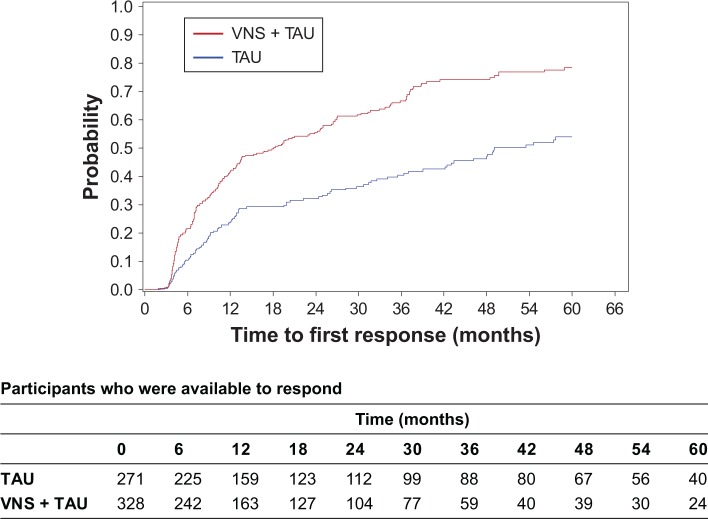
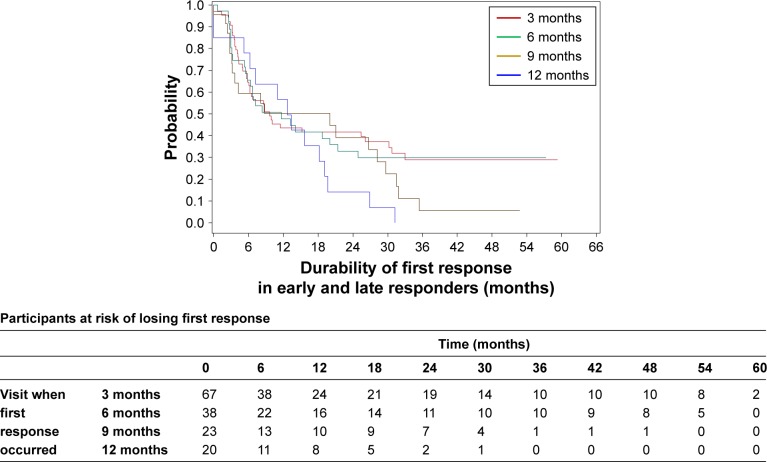
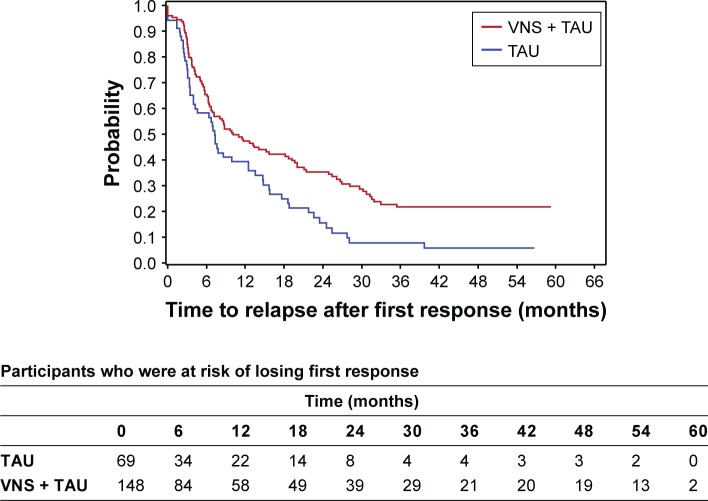
In the VNS + TAU arm, 62.5% (205/328) of participants had a first response over 5 years compared with 39.9% (108/271) in TAU. The time to first response was significantly shorter for VNS + TAU than for TAU (<0.01). For responders in the first year, median time to relapse from first response was 10.1 months (Q1=4.2, Q3=31.5) for VNS + TAU vs 7.3 months (Q1=3.1, Q3=17.6) for TAU (<0.01). HR=0.6 (95% CI: 0.4, 0.9) revealed a significantly lower chance for relapse in VNS + TAU. Probability of retaining first response for a year was 0.39 (0.27, 0.51) for TAU and 0.47 (0.38, 0.56) for VNS + TAU. Timing of the onset of the response did not impact the durability of the response.
VNS therapy added to TAU in severe TRD leads to rapid onset and higher likelihood of response, and a greater durability of the response as compared to TAU alone.
在难治性抑郁症(TRD)注册研究中,比较5年期间辅助迷走神经刺激(VNS+常规治疗)与单纯常规治疗(TAU)所达到的反应持续时间。
分析了271例接受TAU治疗的参与者和328例接受VNS+TAU治疗的参与者的数据。反应定义为基线后访视时蒙哥马利-Åsberg抑郁评定量表(MADRS)评分较基线下降≥50%,且在下降<40%之前一直视为持续存在。在第1年每季度获取一次MADRS评分,此后每半年获取一次。采用Kaplan-Meier方法估计事件发生时间,并使用对数秩检验进行比较。使用Cox比例风险模型估计风险比(HR)。
在VNS+TAU组中,62.5%(205/328)的参与者在5年内首次出现反应,而TAU组为39.9%(108/271)。VNS+TAU组的首次反应时间明显短于TAU组(<0.01)。对于第1年出现反应的患者,VNS+TAU组从首次反应到复发的中位时间为10.1个月(Q1=4.2,Q3=31.5),而TAU组为7.3个月(Q1=3.1,Q3=17.6)(<0.01)。HR=0.6(95%CI:0.4,0.9)显示VNS+TAU组复发的可能性显著降低。TAU组维持首次反应一年的概率为0.39(0.27,0.51),VNS+TAU组为0.47(0.38,0.56)。反应开始的时间不影响反应的持续时间。
在重度TRD中,VNS治疗联合TAU可导致反应快速出现且反应可能性更高,与单纯TAU相比,反应的持续时间更长。