Brain Rehabilitation Research Center, Malcom Randall VA Medical Center, Gainesville, Florida, USA.
Sleep Disorders Clinic, VA Portland Health Care System, Portland, Oregon, USA.
Sci Rep. 2019 Mar 12;9(1):4247. doi: 10.1038/s41598-018-38102-4.
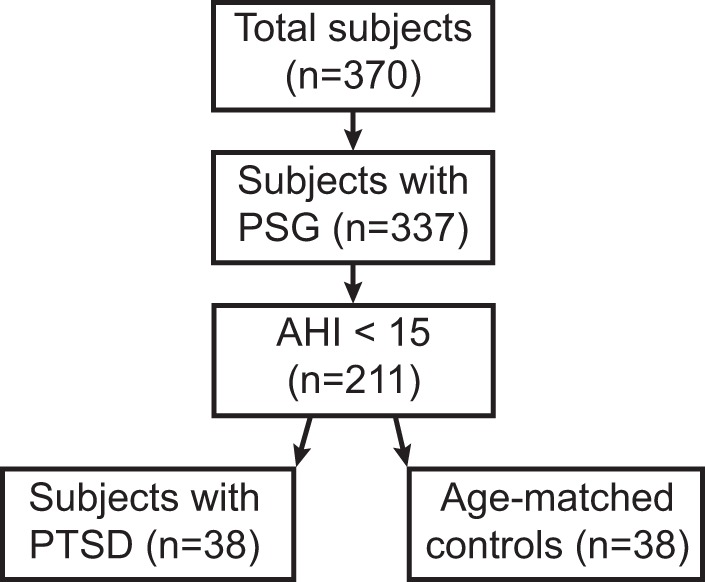
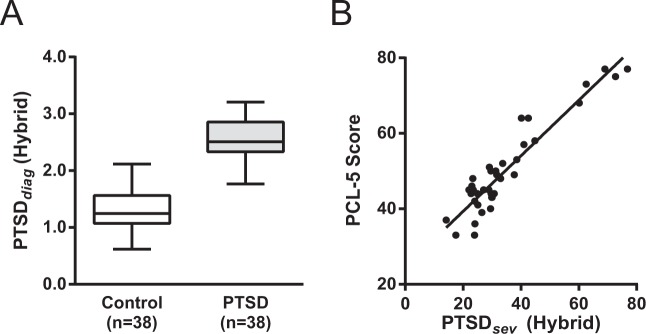
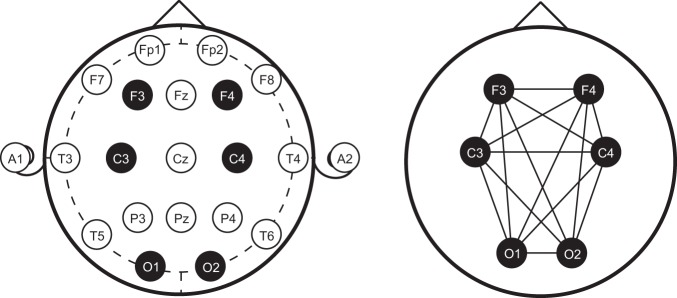
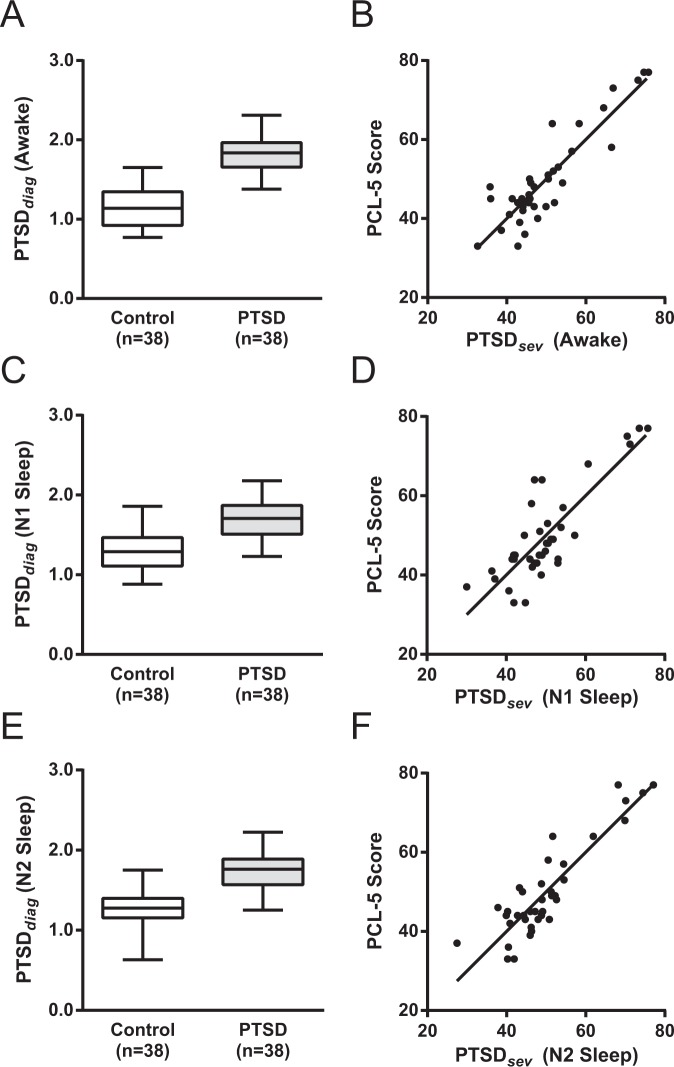
Objective biomarkers of the presence and severity of posttraumatic stress disorder (PTSD) are elusive, yet badly needed. Electroencephalographic (EEG) coherence represents a promising approach to identifying and understanding brain biomarker activity in PTSD. Overnight polysomnography data containing EEG across sleep and wake states was collected in n = 76 Veterans with and without PTSD from a single site under IRB approval. Brain coherence markers (BCM) were calculated from EEG signals using a novel approach to produce one index for PTSD diagnosis (PTSD), and another index for PTSD severity (PTSD). PTSD showed strong sensitivity to the presence of PTSD in the awake state, during non-rapid eye movement (NREM) stage N2 sleep, and in a hybrid BCM incorporating both awake and NREM sleep states. PTSD showed a strong correlation with PTSD symptom severity (using the PTSD Checklist 5, or PCL5 survey) in the awake state, during N2 sleep, and in a hybrid BCM incorporating both awake and NREM sleep states. Thus, sleep EEG-based brain coherence markers can be utilized as an objective means for determining the presence and severity of PTSD. This portable, inexpensive, and non-invasive tool holds promise for better understanding the physiological mechanisms underlying PTSD and for tracking objective responses to treatment.
创伤后应激障碍(PTSD)存在和严重程度的客观生物标志物难以捉摸,但又非常需要。脑电图(EEG)相干性代表了一种有前途的方法,可以识别和理解 PTSD 中的大脑生物标志物活动。在 IRB 批准下,在一个单一的地点,对来自 76 名 PTSD 患者和非 PTSD 患者的 Veterans 进行了包含睡眠和清醒状态 EEG 的整夜多导睡眠图数据收集。使用一种新方法从 EEG 信号中计算脑相干性标记物(BCM),以产生一个用于 PTSD 诊断(PTSD)的指标和另一个用于 PTSD 严重程度(PTSD)的指标。PTSD 在清醒状态、非快速眼动(NREM)阶段 N2 睡眠以及包含清醒和 NREM 睡眠状态的混合 BCM 中,对 PTSD 的存在具有很强的敏感性。PTSD 在清醒状态、N2 睡眠以及包含清醒和 NREM 睡眠状态的混合 BCM 中,与 PTSD 症状严重程度(使用 PTSD 检查表 5 或 PCL5 调查)有很强的相关性。因此,基于睡眠 EEG 的脑相干性标记物可以用作确定 PTSD 存在和严重程度的客观手段。这种便携式、廉价、非侵入性的工具有望更好地理解 PTSD 的生理机制,并跟踪对治疗的客观反应。