LoMauro Antonella, Molisso Maria Takeko, Mameli Francesca, Ruggiero Fabiana, Ferrucci Roberta, Dellarosa Chiara, Aglieco Giada, Aliverti Andrea, Barbieri Sergio, Vergari Maurizio
Dipartimento di Elettronica, Informazione e Bioingegneria. Politecnico di Milano, Milan, Italy.
Unità di Neurofisiopatologia, Fondazione IRCCS Ca' Granda Ospedale Maggiore Policlinico, Milan, Italy.
Front Syst Neurosci. 2022 Jul 18;16:923576. doi: 10.3389/fnsys.2022.923576. eCollection 2022.
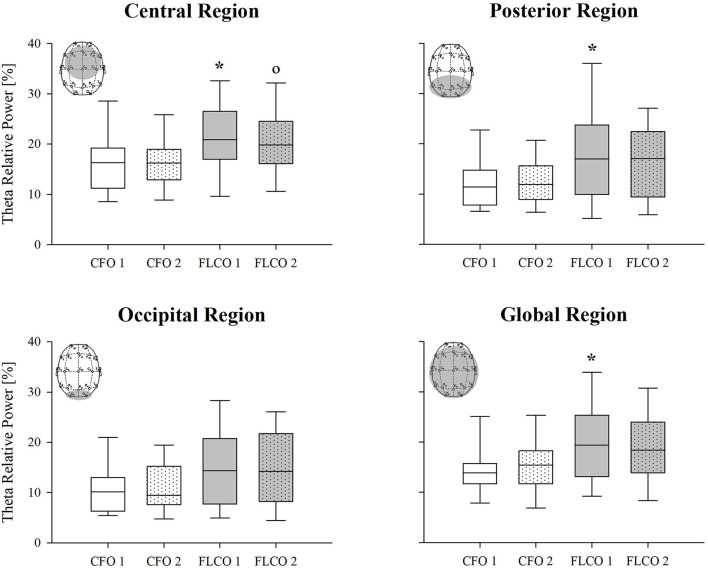
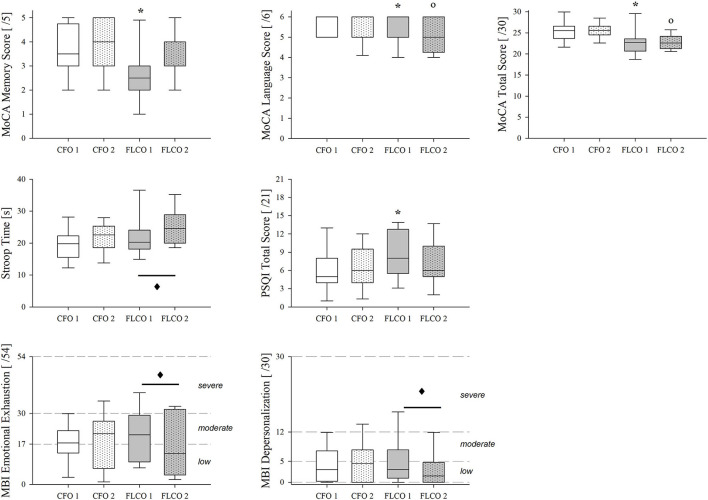
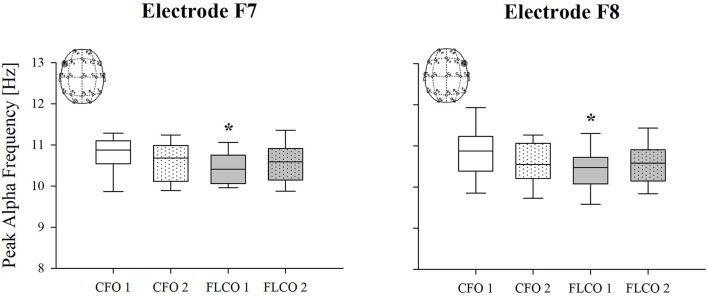
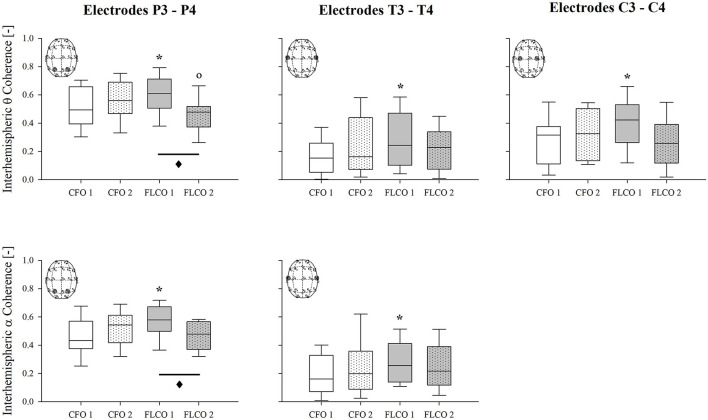
Psychological distress among healthcare professionals, although already a common condition, was exacerbated by the COVID-19 pandemic. This effect has been generally self-reported or assessed through questionnaires. We aimed to identify potential abnormalities in the electrical activity of the brain of healthcare workers, operating in different roles during the pandemic. Cortical activity, cognitive performances, sleep, and burnout were evaluated two times in 20 COVID-19 frontline operators (FLCO, median age 29.5 years) and 20 operators who worked in COVID-19-free units (CFO, median 32 years): immediately after the outbreak of the pandemic (first session) and almost 6 months later (second session). FLCO showed higher theta relative power over the entire scalp (FLCO = 19.4%; CFO = 13.9%; = 0.04) and lower peak alpha frequency of electrodes F7 (FLCO = 10.4 Hz; CFO = 10.87 Hz; = 0.017) and F8 (FLCO = 10.47 Hz; CFO = 10.87 Hz; = 0.017) in the first session. FLCO parietal interhemispheric coherence of theta (FLCO I = 0.607; FLCO II = 0.478; = 0.025) and alpha (FLCO I = 0.578; FLCO II = 0.478; = 0.007) rhythms decreased over time. FLCO also showed lower scores in the global cognitive assessment test (FLCO = 22.72 points; CFO = 25.56; = 0.006) during the first session. The quantitative evaluation of the cortical activity might therefore reveal early signs of changes secondary to stress exposure in healthcare professionals, suggesting the implementation of measures to prevent serious social and professional consequences.
医护人员的心理困扰虽然已是一种常见状况,但在新冠疫情期间进一步加剧。这种影响通常是通过自我报告或问卷调查来评估的。我们旨在识别在疫情期间担任不同角色的医护人员大脑电活动的潜在异常情况。对20名新冠疫情一线工作人员(FLCO,中位年龄29.5岁)和20名在无新冠疫情科室工作的人员(CFO,中位年龄32岁)进行了两次皮质活动、认知表现、睡眠和倦怠情况的评估:在疫情爆发后立即进行(第一次评估),以及大约6个月后(第二次评估)。在第一次评估中,FLCO在整个头皮上显示出更高的θ相对功率(FLCO = 19.4%;CFO = 13.9%;P = 0.04),电极F7(FLCO = 10.4赫兹;CFO = 10.87赫兹;P = 0.017)和F8(FLCO = 10.47赫兹;CFO = 10.87赫兹;P = 0.017)的α峰值频率更低。随着时间推移,FLCO顶叶半球间θ(FLCO I = 0.607;FLCO II = 0.478;P = 0.025)和α(FLCO I = 0.578;FLCO II = 0.478;P = 0.007)节律的相干性降低。在第一次评估期间,FLCO在整体认知评估测试中的得分也更低(FLCO = 22.72分;CFO = 25.56分;P = 0.006)。因此,对皮质活动的定量评估可能揭示医护人员因压力暴露而产生变化的早期迹象,这表明应采取措施以防止严重的社会和职业后果。