Chotiprasitsakul Darunee, Srichatrapimuk Sirawat, Kirdlarp Suppachok, Pyden Alexander D, Santanirand Pitak
Division of Infectious Diseases, Department of Medicine, Faculty of Medicine Ramathibodi Hospital, Mahidol University, Bangkok, Thailand,
Chakri Naruebodindra Medical Institute, Faculty of Medicine Ramathibodi Hospital, Mahidol University, Samutprakan, Thailand.
Infect Drug Resist. 2019 Feb 20;12:461-468. doi: 10.2147/IDR.S192540. eCollection 2019.
The incidence of carbapenem-resistant Enterobacteriaceae (CRE) has been increasing worldwide. Ertapenem resistance is mediated by non-carbapenemase mechanisms, and has less of an effect on susceptibility to imipenem and meropenem. This study aimed to study the epidemiology of CRE, and to compare risk factors and related mortality between non-susceptibility to ertapenem alone Enterobacteriaceae (NSEE), with non-susceptibility to other carbapenems (imipenem, meropenem, or doripenem) Enterobacteriaceae (NSOCE) at a tertiary care hospital in Thailand.
All CRE isolated were identified between December 2011 and December 2016. Quarterly incidence rate was estimated. Hospital-wide carbapenem consumption was calculated as defined daily doses (DDD). Relationships between hospital-wide carbapenem consumption and incidence of CRE were tested. Factors associated with NSEE and NSOCE, and risk factors associated with 14- and 30-day mortality in patients with CRE infection were determined.
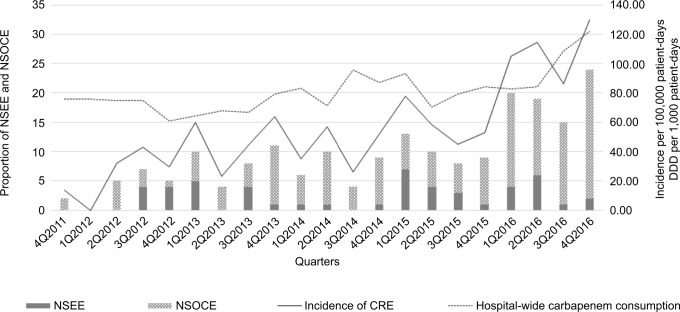
The quarterly CRE incidence increased significantly from 3.37 per 100,000 patient-days in the last quarter of 2011 to 32.49 per 100,000 patient-days in the last quarter of 2016. ( for trend <0.001). Quarterly hospital-wide carbapenem consumption increased 1.58 DDD per 1,000 patient-days ( for trend=0.004). The Poisson regression showed the expected increase of CRE incidence was 1.02 per 100,000 patient-days for a 1 DDD per 1,000 patient-days increase in carbapenem consumption (<0.001). There were 40 patients with NSEE and 134 patients with NSOCE in the 5-year study period. The NSEE group had significantly lower carbapenem exposure compared with the NSOCE group (adjusted odds ratio: 0.25; =0.001). No difference in 14-day and 30-day all-cause mortality between the two groups was observed.
The incidence of CRE has risen significantly at our institution. Previous carbapenem use was associated with NSOCE. This hospital-wide carbapenem use was significantly associated with the increasing incidence of CRE.
耐碳青霉烯类肠杆菌科细菌(CRE)在全球范围内的发病率一直在上升。厄他培南耐药由非碳青霉烯酶机制介导,对亚胺培南和美罗培南的敏感性影响较小。本研究旨在探讨泰国一家三级医疗机构中CRE的流行病学情况,并比较仅对厄他培南不敏感的肠杆菌科细菌(NSEE)与对其他碳青霉烯类药物(亚胺培南、美罗培南或多利培南)不敏感的肠杆菌科细菌(NSOCE)之间的危险因素及相关死亡率。
对2011年12月至2016年12月期间分离出的所有CRE进行鉴定。估算季度发病率。计算全院碳青霉烯类药物的消耗量,以限定日剂量(DDD)表示。检测全院碳青霉烯类药物消耗量与CRE发病率之间的关系。确定与NSEE和NSOCE相关的因素,以及CRE感染患者14天和30天死亡率的危险因素。
季度CRE发病率从2011年最后一个季度的每10万患者日3.37例显著增加至2016年最后一个季度的每10万患者日32.49例(趋势检验P<0.001)。全院季度碳青霉烯类药物消耗量每1000患者日增加1.58 DDD(趋势检验P=0.004)。泊松回归显示,碳青霉烯类药物消耗量每1000患者日增加1 DDD,CRE发病率预期增加每10万患者日1.02例(P<0.001)。在5年研究期间,有40例NSEE患者和134例NSOCE患者。NSEE组的碳青霉烯类药物暴露量显著低于NSOCE组(调整优势比:0.25;P=0.001)。两组之间14天和30天全因死亡率无差异。
我院CRE发病率显著上升。既往使用碳青霉烯类药物与NSOCE相关。全院范围内碳青霉烯类药物的使用与CRE发病率的增加显著相关。