Zhang Xiang, Wang Fei, Huang Yanbing, Ke Kun, Zhao Bixing, Chen Lihong, Liao Naishun, Wang Lei, Li Qin, Liu Xiaolong, Wang Yingchao, Liu Jingfeng
The First Affiliated Hospital of Fujian Medical University, Fuzhou, China,
The United Innovation of Mengchao Hepatobiliary Technology Key Laboratory of Fujian Province, Mengchao Hepatobiliary Hospital of Fujian Medical University, Fuzhou, China,
Cancer Manag Res. 2019 Feb 19;11:1653-1665. doi: 10.2147/CMAR.S188248. eCollection 2019.
The aim of this work was to investigate the clinicopathological significance of fibrinogen gamma chain (FGG) and its biological roles during hepatocellular carcinoma (HCC) development and progression.
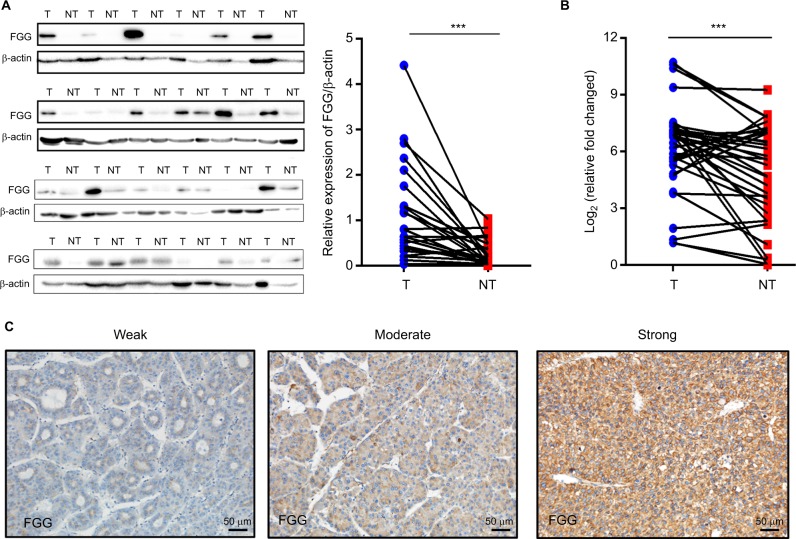
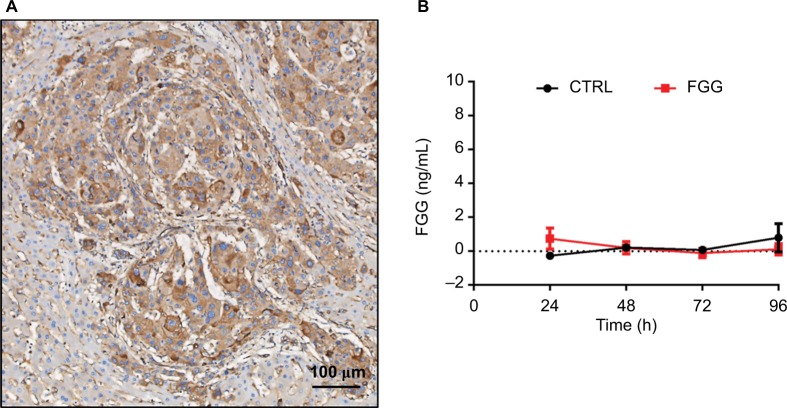
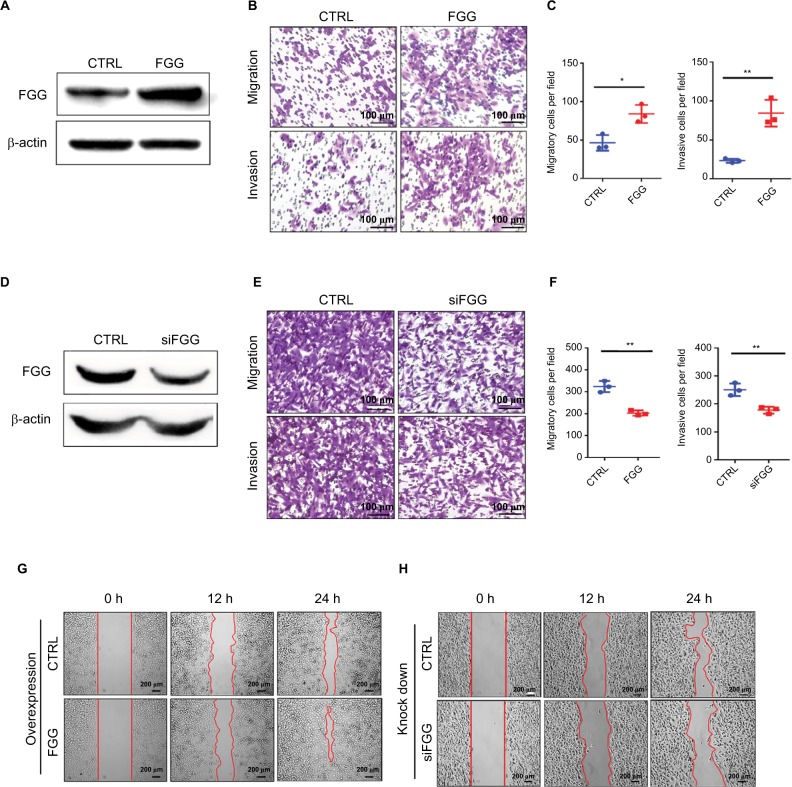
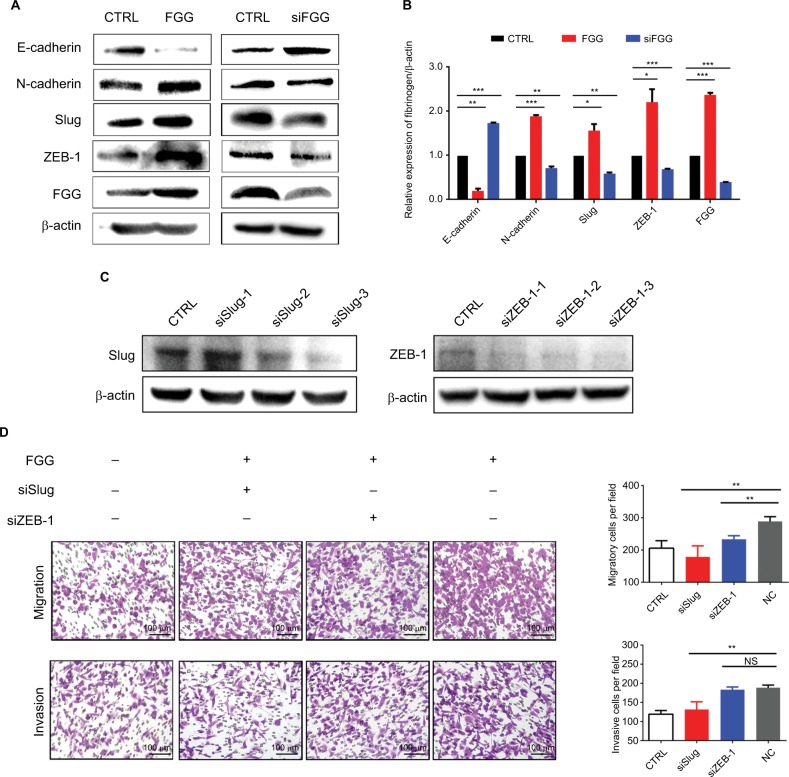
The expression of FGG was examined by Western blot and reverse transcription quantitative PCR in two different sample sets, including 24 or 35 pairs of HCC tumor tissues and their corresponding adjacent non-tumorous tissues. Afterward, association analysis between the expression of FGG and clinicopathological characteristics was systematically analyzed in 79 HCC patients. Subsequently, the mobility and invasiveness of SK-HEP-1 cells with FGG overexpression or knockdown were evaluated by transwell assay and wound healing assay. Additionally, the expressions of epithelial to mesenchymal transition (EMT)-associated markers were also detected in FGG overexpressed or silenced SK-HEP-1 cells.
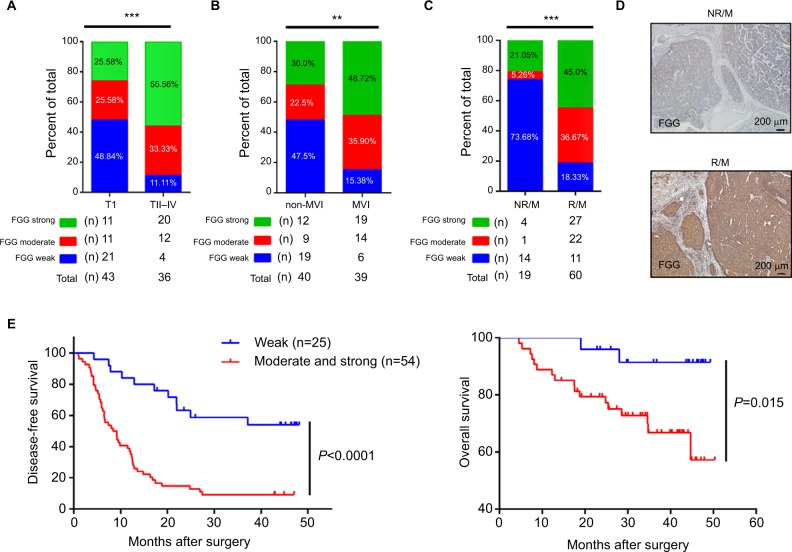
The expression of FGG was significantly increased in primary HCC tissues comparing with its corresponding adjacent non-tumorous tissues. Clinical pathological analysis demonstrated that upregulation of intracellular FGG was significantly associated with increased vascular invasion, more satellite nodules, and more advanced TNM stage, and HCC patients with stronger expression of FGG had a higher recurrence rate and correspondingly a shorter overall survival time. Meanwhile, the high expression of FGG was also proved to be an independent risk factor for disease-free survival after surgical resection. In vitro phenotype studies showed that overexpression of FGG could promote the migration and invasion in SK-HEP-1 cells; conversely, these phenotypes could be significantly inhibited by knocking down the expression of FGG. Mechanism studies indicated that FGG could promote the migration and invasion through EMT signaling pathway by regulating the expressions of Slug and ZEB1.
FGG played important roles in enhancing cancer cell motility and invasiveness through EMT signaling, and might serve as a potential prognostic biomarker for HCC patients.
本研究旨在探讨纤维蛋白原γ链(FGG)在肝细胞癌(HCC)发生发展过程中的临床病理意义及其生物学作用。
采用蛋白质免疫印迹法和逆转录定量聚合酶链反应检测两组不同样本中FGG的表达,其中包括24对或35对HCC肿瘤组织及其相应的癌旁非肿瘤组织。随后,系统分析79例HCC患者中FGG表达与临床病理特征之间的相关性。接着,通过Transwell实验和伤口愈合实验评估FGG过表达或敲低的SK-HEP-1细胞的迁移和侵袭能力。此外,还检测了FGG过表达或沉默的SK-HEP-1细胞中上皮-间质转化(EMT)相关标志物的表达。
与相应的癌旁非肿瘤组织相比,原发性HCC组织中FGG的表达显著增加。临床病理分析表明,细胞内FGG的上调与血管侵犯增加、更多卫星结节以及更晚期的TNM分期显著相关,FGG表达较强的HCC患者复发率更高,总生存时间相应更短。同时,FGG的高表达也被证明是手术切除后无病生存的独立危险因素。体外表型研究表明,FGG的过表达可促进SK-HEP-1细胞的迁移和侵袭;相反,敲低FGG的表达可显著抑制这些表型。机制研究表明,FGG可通过调节Slug和ZEB1的表达,通过EMT信号通路促进迁移和侵袭。
FGG通过EMT信号通路在增强癌细胞运动性和侵袭性方面发挥重要作用,可能作为HCC患者潜在的预后生物标志物。