Department of Critical Care Medicine, Korea University Ansan Hospital, Korea University College of Medicine, Ansan, Korea.
Department of Critical Care Medicine, Samsung Medical Center, Sungkyunkwan University School of Medicine, Seoul, Korea.
J Korean Med Sci. 2019 Feb 27;34(9):e70. doi: 10.3346/jkms.2019.34.e70. eCollection 2019 Mar 11.
Admission blood glucose (BG) level is a predictor of mortality in critically ill patients with various conditions. However, limited data are available regarding this relationship in critically ill patients with cardiovascular diseases according to diabetic status.
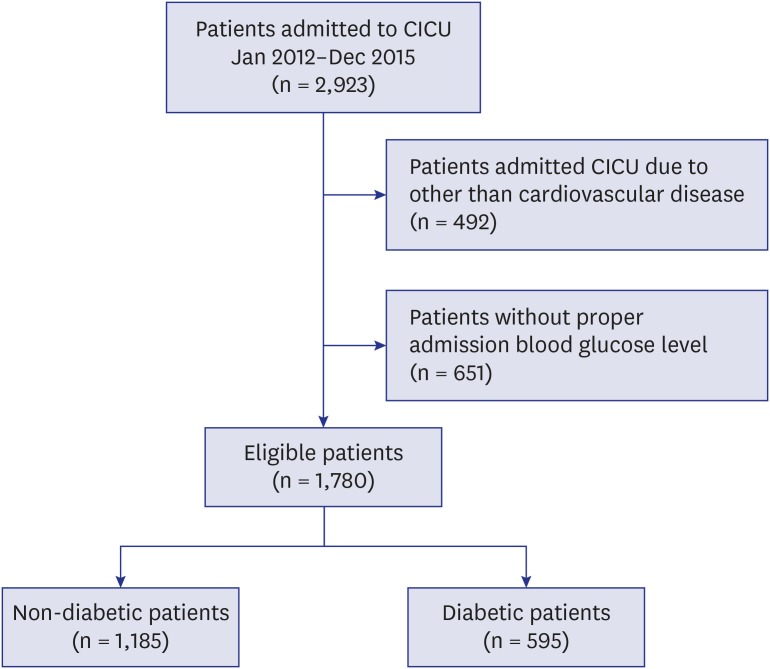
A total of 1,780 patients (595 with diabetes) who were admitted to cardiac intensive care unit (CICU) were enrolled from a single center registry. Admission BG level was defined as maximal serum glucose level within 24 hours of admission. Patients were divided by admission BG level: group 1 (< 7.8 mmol/L), group 2 (7.8-10.9 mmol/L), group 3 (11.0-16.5 mmol/L), and group 4 (≥ 16.6 mmol/L).
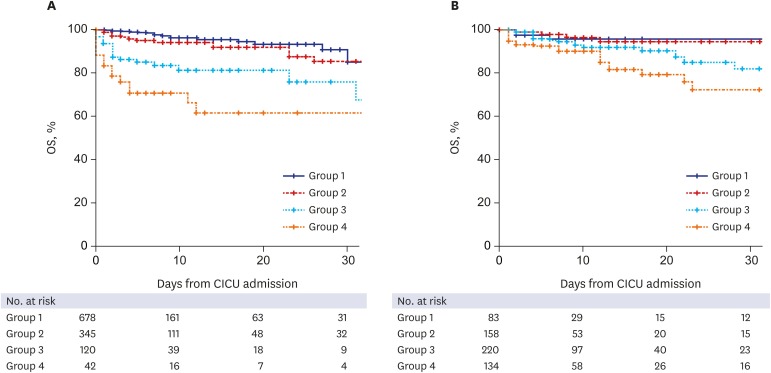
A total of 105 patients died in CICU (62 non-diabetic patients [5.2%] and 43 diabetic patients [7.9%]; = 0.105). The CICU mortality rate increased with admission BG level (1.7%, 4.8%, 10.3%, and 18.8% from group 1 to group 4, respectively; < 0.001). On multivariable analysis, hypertension, mechanical ventilator, continuous renal replacement therapy, acute physiology and chronic health evaluation II (APACHE II) score, and admission BG level significantly influenced CICU mortality in non-diabetic patients (group 1 vs. group 3: hazard ratio [HR], 3.31; 95% confidence interval [CI], 1.47-7.44; = 0.004; group 1 vs. group 4: HR, 6.56; 95% CI, 2.76-15.58; < 0.001). However, in diabetic patients, continuous renal replacement therapy and APACHE II score influenced CICU mortality but not admission BG level.
Admission BG level was associated with increased CICU mortality in critically ill, non-diabetic patients admitted to CICU but not in diabetic patients.
入院血糖(BG)水平是各种疾病重症患者死亡率的预测指标。然而,根据糖尿病状态,关于心血管疾病重症患者的这种关系,可用的数据有限。
从单一中心登记处共纳入 1780 名(595 名糖尿病患者)入住心脏重症监护病房(CICU)的患者。入院 BG 水平定义为入院 24 小时内的最大血清葡萄糖水平。根据入院 BG 水平将患者分为 4 组:组 1(<7.8mmol/L)、组 2(7.8-10.9mmol/L)、组 3(11.0-16.5mmol/L)和组 4(≥16.6mmol/L)。
共有 105 名患者在 CICU 死亡(62 名非糖尿病患者[5.2%]和 43 名糖尿病患者[7.9%];=0.105)。随着入院 BG 水平的升高,CICU 死亡率增加(分别从组 1 到组 4 为 1.7%、4.8%、10.3%和 18.8%;<0.001)。多变量分析显示,高血压、机械通气、持续肾脏替代治疗、急性生理学和慢性健康评估 II(APACHE II)评分和入院 BG 水平显著影响非糖尿病患者的 CICU 死亡率(组 1 与组 3:风险比[HR],3.31;95%置信区间[CI],1.47-7.44;=0.004;组 1 与组 4:HR,6.56;95%CI,2.76-15.58;<0.001)。然而,在糖尿病患者中,持续肾脏替代治疗和 APACHE II 评分影响 CICU 死亡率,但不影响入院 BG 水平。
入院 BG 水平与入住 CICU 的重症非糖尿病患者的 CICU 死亡率增加相关,但与糖尿病患者无关。