Manzano Nieves Gabriela, Schilit Nitenson Arielle, Lee Hye-In, Gallo Meghan, Aguilar Zachary, Johnsen Angelica, Bravo Marilyn, Bath Kevin G
Department of Neuroscience, Brown University, Providence, RI, United States.
Department of Cognitive, Linguistic and Psychological Sciences, Brown University, Providence, RI, United States.
Front Mol Neurosci. 2019 Feb 26;12:27. doi: 10.3389/fnmol.2019.00027. eCollection 2019.
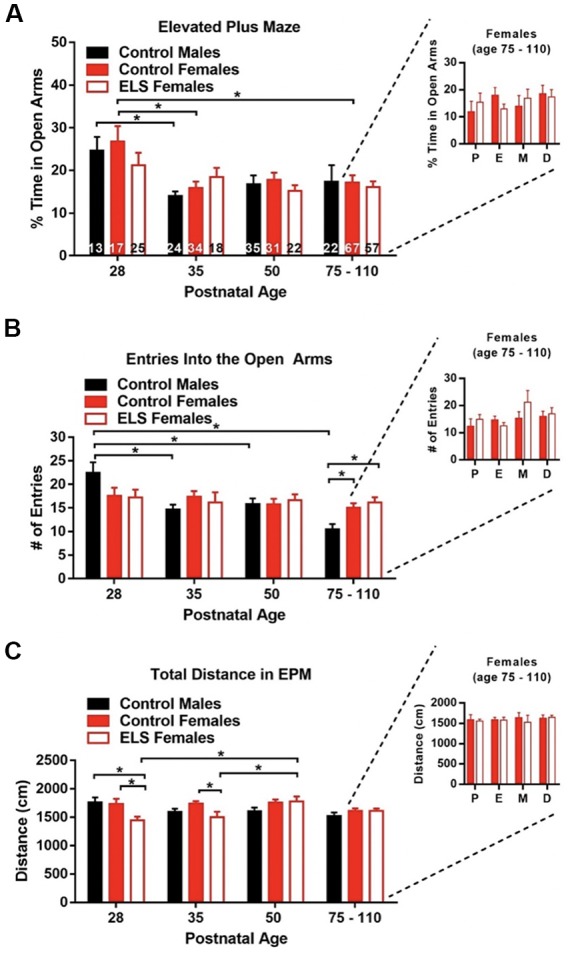
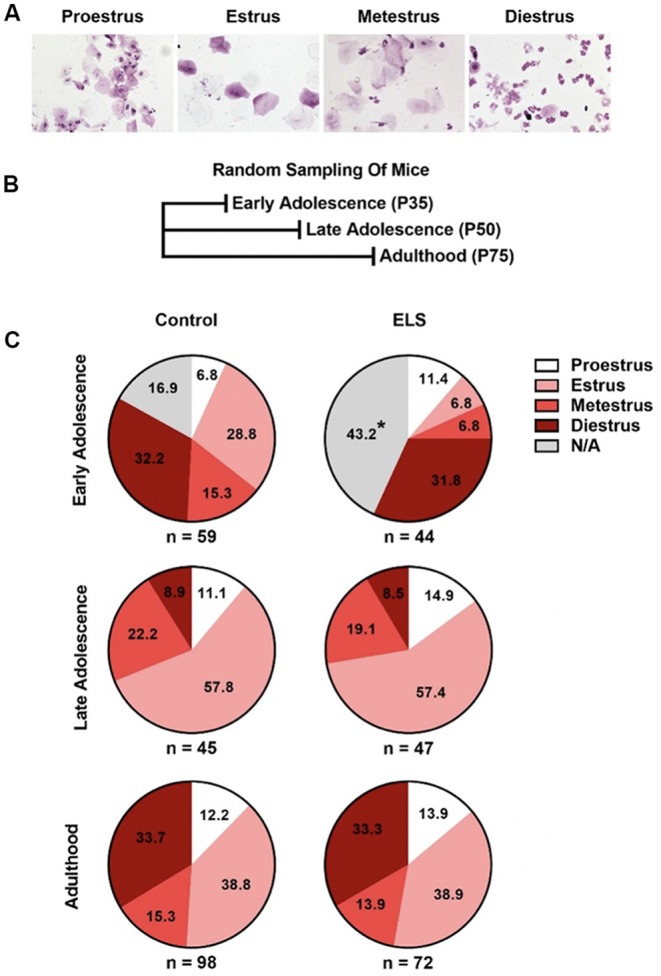
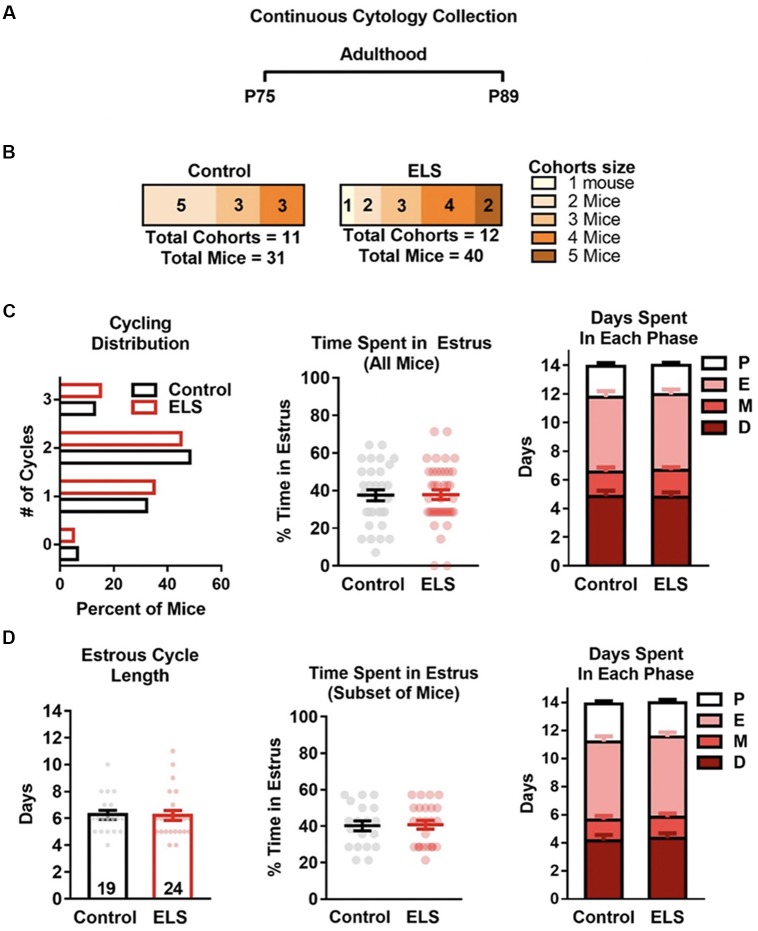
In humans, some forms of early life stress (ELS) have been linked with precocious puberty, altered brain maturation, and increased risk for a variety of forms of pathology. Interestingly, not all forms of ELS have been found to equally impact these metrics of maturation. In recent work, we have found that ELS in the form of limited bedding (LB) from P4 to P11, was associated with precocious hippocampus maturation in males and increased risk for depressive-like pathology and attentional disturbance in female mice. Here, we sought to test whether ELS in the form of LB also impacted the timing of sexual maturation in female mice. To establish rate of somatic and sexual development, distinct cohorts of mice were tested for weight gain, timing of vaginal opening, and development of estrous cycling. ELS animals weighed significantly less than controls at every timepoint measured. Onset of vaginal opening was tracked from P21 to 40, and ELS was found to significantly delay the onset of vaginal opening. To test the impact of ELS on estrous cycle duration and regularity, vaginal cytology was assessed in independent groups of animals using either a continuous sampling (daily from P40 to P57) or random sampling approach (single swab at P35, P50, or P75). ELS did impact measures of estrous cycling, but these effects were dependent upon the sampling method used. We also tested the impact of ELS on anxiety-like behaviors over development and across the estrous cycle. We observed a developmental increase in anxiety-like behavior in control but not ELS mice. No effect of estrous cycle stage was found on anxiety-like behavior for either group of mice. Together these results provide evidence that ELS in the form of LB delays somatic and sexual development. Additional work will be required to determine the mechanism by which ELS impacts these measures, and if these effects are common to other models of ELS in rodents.
在人类中,某些形式的早期生活压力(ELS)与性早熟、大脑成熟改变以及多种病理形式的风险增加有关。有趣的是,并非所有形式的ELS都被发现对这些成熟指标有同等影响。在最近的研究中,我们发现从P4到P11的有限垫料(LB)形式的ELS与雄性小鼠海马体早熟以及雌性小鼠抑郁样病理和注意力障碍风险增加有关。在此,我们试图测试LB形式的ELS是否也会影响雌性小鼠的性成熟时间。为了确定身体和性发育的速率,对不同组的小鼠进行体重增加、阴道开口时间和发情周期发育的测试。在每个测量时间点,ELS组的动物体重明显低于对照组。从P21到40追踪阴道开口的开始时间,发现ELS显著延迟了阴道开口的开始时间。为了测试ELS对发情周期持续时间和规律性的影响,使用连续采样(从P40到P57每天采样)或随机采样方法(在P35、P50或P75进行单次擦拭)对独立的动物组进行阴道细胞学评估。ELS确实影响发情周期的测量,但这些影响取决于所使用的采样方法。我们还测试了ELS对发育过程中和发情周期中焦虑样行为的影响。我们观察到对照组小鼠的焦虑样行为在发育过程中有所增加,但ELS组小鼠没有。两组小鼠的焦虑样行为均未发现受发情周期阶段的影响。这些结果共同提供了证据,表明LB形式的ELS会延迟身体和性发育。还需要进一步的研究来确定ELS影响这些指标的机制,以及这些影响是否在啮齿动物的其他ELS模型中普遍存在。