Bao Minghui, Song Yongjian, Cai Jun, Wu Shouling, Yang Xinchun
Department of Heart Center, Chaoyang Hospital, Capital Medical University, Beijing, China.
Graduate School, North China University of Science and Technology, Tangshan, China.
Int J Hypertens. 2019 Feb 3;2019:9891025. doi: 10.1155/2019/9891025. eCollection 2019.
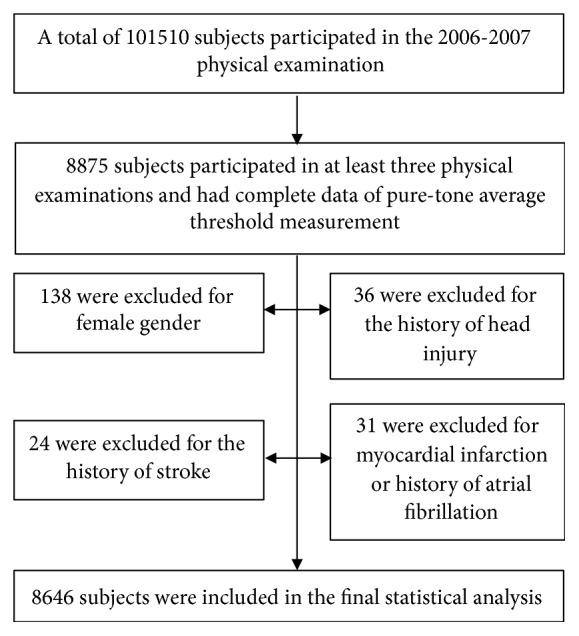
Blood pressure (BP) has been well documented to be associated with hearing loss previously. However, the role of blood pressure variability (BPV, representing BP fluctuation over a time period) on hearing remains unknown. We aimed to evaluate the relationship between BPV and hearing in Chinese population. We included 8646 male subjects from a population-based study (the Kailuan study). BP was measured every two years at routine physical examinations from 2006 to 2015. Based on five annual BP measurements, BPV was estimated by standard deviation of BP (SD), coefficient of the variation of BP (CV), and variation independent of mean of BP (VIM). Hearing was estimated by pure-tone average threshold (PTA) at low, intermediate, and high frequencies in the year of 2014. Regression models were used to evaluate the relationship between BPV and hearing. The results showed that PTAs and percentages of hearing loss at low, intermediate, and high frequencies grew gradually with increasing systolic SD (SSD) (p<0.05). After adjusting for multiple covariates, multivariate regression analyses demonstrated that variations of SBP (SSD, SCV, and VIM) were all positively correlated with PTA at intermediate and high frequencies (p<0.05). Each SD increase in SSD, SCV, and VIM was also positively associated with hearing loss at intermediate and high frequencies. No significant correlation was observed between variations of DBP and hearing. These findings suggest that increase in long-term BPV is associated with hearing and hearing loss. Kailuan study (ChiCTRTNC-11001489).
血压(BP)与听力损失之间的关联此前已有充分记录。然而,血压变异性(BPV,代表一段时间内的血压波动)对听力的作用仍不清楚。我们旨在评估中国人群中BPV与听力之间的关系。我们纳入了一项基于人群的研究(开滦研究)中的8646名男性受试者。在2006年至2015年的常规体检中,每两年测量一次血压。基于每年五次的血压测量,通过血压标准差(SD)、血压变异系数(CV)和与平均血压无关的变异(VIM)来估计BPV。在2014年通过低、中、高频纯音平均听阈(PTA)来评估听力。使用回归模型评估BPV与听力之间的关系。结果显示,随着收缩压标准差(SSD)的增加,低、中、高频的PTA和听力损失百分比逐渐增加(p<0.05)。在调整多个协变量后,多变量回归分析表明,收缩压的变异(SSD、SCV和VIM)与中高频PTA均呈正相关(p<0.05)。SSD、SCV和VIM每增加一个标准差也与中高频听力损失呈正相关。未观察到舒张压变异与听力之间存在显著相关性。这些发现表明,长期BPV的增加与听力及听力损失有关。开滦研究(ChiCTRTNC - 11001489)