Choi Kyoung-Min, Zissler Angela, Kim Eunjung, Ehrenfellner Bianca, Cho Eunji, Lee Se-In, Steinbacher Peter, Yun Ki Na, Shin Jong Hwan, Kim Jin Young, Stoiber Walter, Chung Heesun, Monticelli Fabio Carlo, Kim Jae-Young, Pittner Stefan
Graduate School of Analytical Science and Technology (GRAST), Chungnam National University, Daejeon, South Korea.
Dept. of Biosciences, University of Salzburg, Salzburg, Austria.
Int J Legal Med. 2019 May;133(3):899-908. doi: 10.1007/s00414-019-02011-6. Epub 2019 Mar 12.
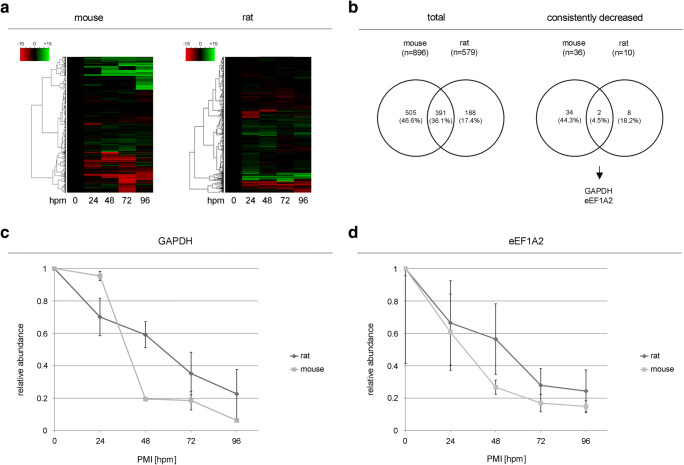
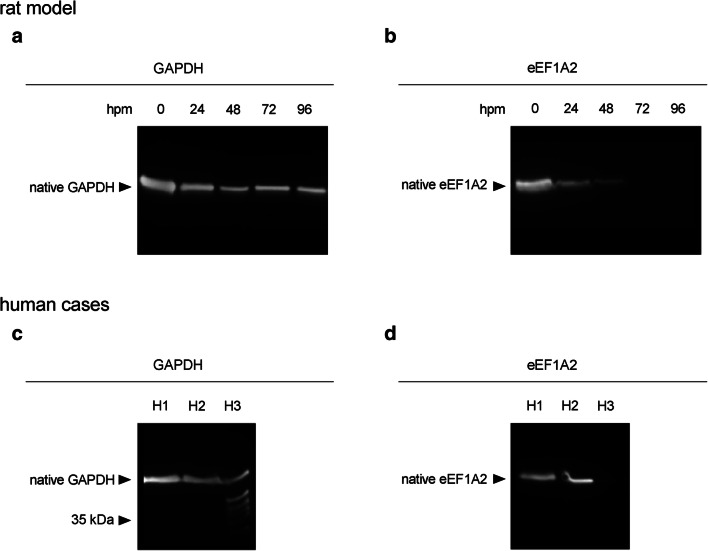
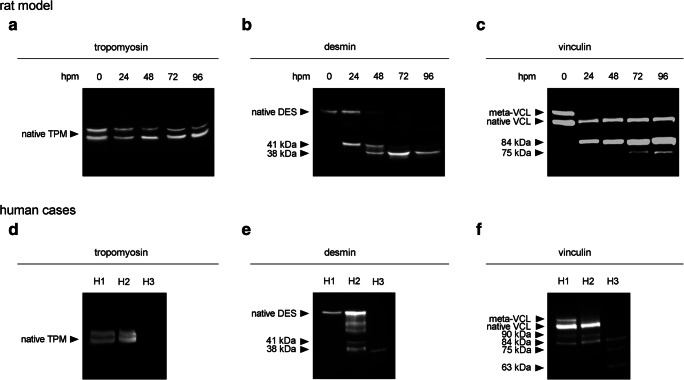
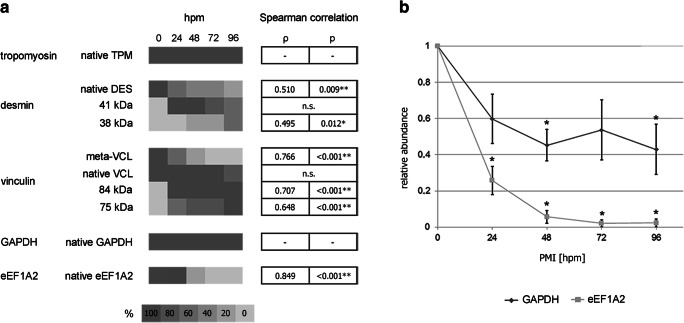
The assessment of postmortem degradation of skeletal muscle proteins has emerged as a novel approach to estimate the time since death in the early to mid-postmortem phase (approximately 24 h postmortem (hpm) to 120 hpm). Current protein-based methods are limited to a small number of skeletal muscle proteins, shown to undergo proteolysis after death. In this study, we investigated the usability of a target-based and unbiased system-wide protein analysis to gain further insights into systemic postmortem protein alterations and to identify additional markers for postmortem interval (PMI) delimitation. We performed proteomic profiling to globally analyze postmortem alterations of the rat and mouse skeletal muscle proteome at defined time points (0, 24, 48, 72, and 96 hpm), harnessing a mass spectrometry-based quantitative proteomics approach. Hierarchical clustering analysis for a total of 579 (rat) and 896 (mouse) quantified proteins revealed differentially expressed proteins during the investigated postmortem period. We further focused on two selected proteins (eEF1A2 and GAPDH), which were shown to consistently degrade postmortem in both rat and mouse, suggesting conserved intra- and interspecies degradation behavior, and thus preserved association with the PMI and possible transferability to humans. In turn, we validated the usefulness of these new markers by classical Western blot experiments in a rat model and in human autopsy cases. Our results demonstrate the feasibility of mass spectrometry-based analysis to discover novel protein markers for PMI estimation and show that the proteins eEF1A2 and GAPDH appear to be valuable markers for PMI estimation in humans.
骨骼肌蛋白质死后降解的评估已成为一种估计死后早期至中期(大约死后24小时(hpm)至120 hpm)死亡时间的新方法。目前基于蛋白质的方法仅限于少数几种骨骼肌蛋白质,这些蛋白质在死后会发生蛋白水解。在本研究中,我们调查了基于靶点且无偏倚的全系统蛋白质分析的可用性,以进一步深入了解全身死后蛋白质变化,并识别用于界定死后间隔时间(PMI)的其他标志物。我们利用基于质谱的定量蛋白质组学方法,在特定时间点(0、24、48、72和96 hpm)对大鼠和小鼠骨骼肌蛋白质组的死后变化进行了蛋白质组学分析。对总共579种(大鼠)和896种(小鼠)定量蛋白质进行的层次聚类分析揭示了在研究的死后期间差异表达的蛋白质。我们进一步聚焦于两种选定的蛋白质(eEF1A2和GAPDH),它们在大鼠和小鼠中均显示出死后持续降解,表明种内和种间降解行为具有保守性,因此与PMI保持关联并可能适用于人类。相应地,我们通过经典的蛋白质印迹实验在大鼠模型和人类尸检病例中验证了这些新标志物的实用性。我们的结果证明了基于质谱分析发现用于PMI估计的新型蛋白质标志物的可行性,并表明蛋白质eEF1A2和GAPDH似乎是人类PMI估计的有价值标志物。