Key Lab Animal Bacteriology, Ministry of Agriculture; Joint International Research Laboratory of Animal Health and Food Safety, College of Veterinary Medicine, Nanjing Agricultural University, No.1 Weigang, Nanjing, Jiangsu Province, 210095, People's Republic of China.
Jiangsu Co-innovation Center for Prevention and Control of Important Animal Infectious Diseases and Zoonoses, College of Veterinary Medicine, Yangzhou University, Yangzhou, Jiangsu, 225009, People's Republic of China.
BMC Genomics. 2019 Mar 13;20(1):212. doi: 10.1186/s12864-019-5588-2.
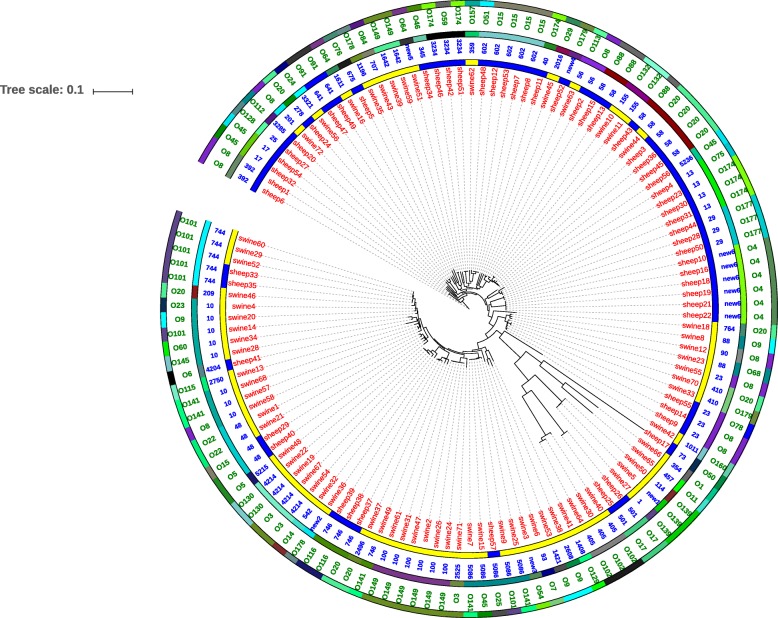
Escherichia coli is an important pathogen that causes diarrhea in both humans and animals. To determine the relationships between putative virulence factors and pathotypes or host taxa, many molecular studies on diarrhea-associated E. coli have been reported. However, little is known regarding genome-wide variation of E. coli from animal hosts. In this study, we performed whole genome sequencing of 127 E. coli isolates from sheep and swine with diarrhea in China. We compared isolates to explore the phylogenomic relatedness based on host origin. We explored the relationships of putative virulence factors across host taxa and pathotypes. Antimicrobial resistance was also tested.
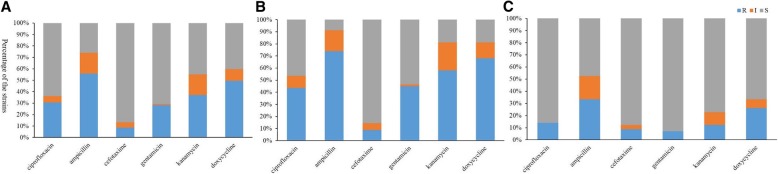
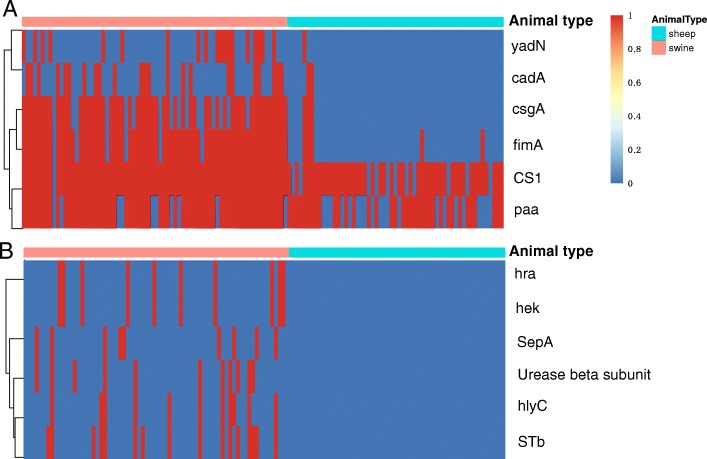
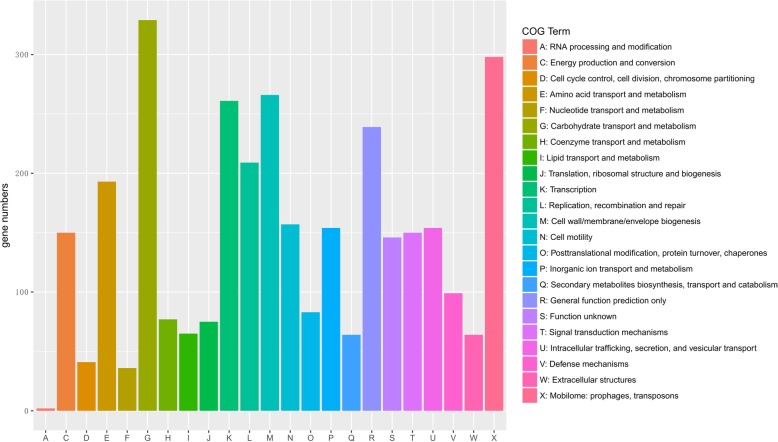
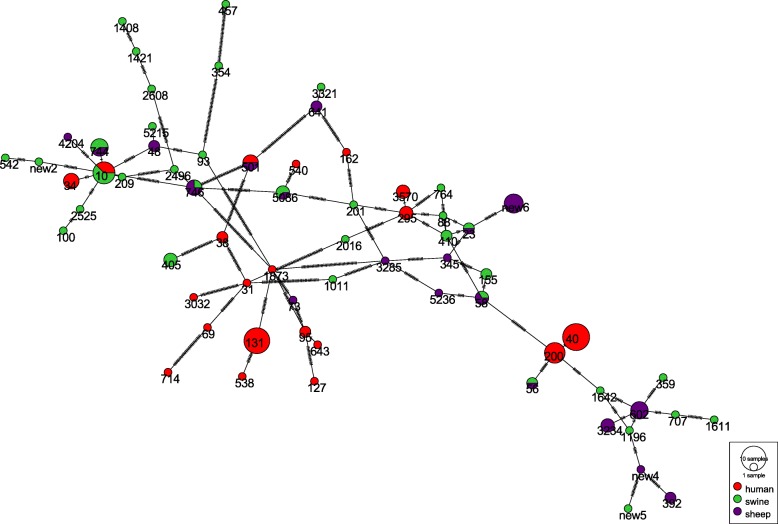
The E. coli genomes in this study were diverse with clear differences in the SNP, MLST, and O serotypes. Seven putative virulence factors (VFs) were prevalent (> 95%) across the isolates, including Hcp, csgC, dsdA, feoB, fepA, guaA, and malX. Sixteen putative VFs showed significantly different distributions (P < 0.05) in strains from sheep and swine and were primarily adhesion- and toxin-related genes. Some putative VFs were co-occurrent in some specific pathotypes and O serotypes. The distribution of 4525 accessory genes of the 127 strains significantly differed (P < 0.05) between isolates obtained from the two animal species. The 127 animal isolates sequenced in this study were each classified into one of five pathotypes: EAEC, ETEC, STEC, DAEC, and EPEC, with 66.9% of isolates belonging to EAEC. Analysis of stx subtypes and a minimum spanning tree based on MLST revealed that STEC isolates from sheep and EAEC isolates from sheep and swine have low potential to infect humans. Antibiotic resistance analysis showed that the E. coli isolates were highly resistant to ampicillin and doxycycline. Isolates from southeast China were more resistant to antibiotics than isolates from northwest China. Additionally, the plasmid-mediated colist in resistance gene mcr-1 was detected in 15 isolates, including 4 from sheep in Qinghai and 11 from swine in Jiangsu.
Our study provides insight into the genomes of E. coli isolated from animal sources. Distinguishable differences between swine and sheep isolates at the genomic level provides a baseline for future investigations of animal E. coli pathogens.
大肠杆菌是一种重要的病原体,可引起人类和动物腹泻。为了确定假定的毒力因子与病原体或宿主分类群之间的关系,已经报道了许多关于腹泻相关大肠杆菌的分子研究。然而,对于来自动物宿主的大肠杆菌全基因组变异知之甚少。在这项研究中,我们对来自中国腹泻绵羊和猪的 127 株大肠杆菌进行了全基因组测序。我们比较了分离株,以基于宿主起源探索系统发育相关性。我们探讨了假定的毒力因子在宿主分类群和病原体中的关系。还测试了抗生素耐药性。
本研究中的大肠杆菌基因组具有多样性,SNP、MLST 和 O 血清型差异明显。七种假定的毒力因子(VF)在分离株中普遍存在(>95%),包括 Hcp、csgC、dsdA、feoB、fepA、guaA 和 malX。16 种假定的 VF 在来自绵羊和猪的菌株中的分布有显著差异(P<0.05),主要是与粘附和毒素相关的基因。一些假定的 VF 存在于某些特定病原体和 O 血清型中。127 株分离株的 4525 个辅助基因的分布在两种动物来源的分离株之间有显著差异(P<0.05)。本研究中测序的 127 株动物分离株均被分类为 5 种病原体之一:EAEC、ETEC、STEC、DAEC 和 EPEC,其中 66.9%的分离株属于 EAEC。stx 亚型分析和基于 MLST 的最小生成树表明,来自绵羊的 STEC 分离株和来自绵羊和猪的 EAEC 分离株对人类的感染潜力较低。抗生素耐药性分析表明,大肠杆菌分离株对氨苄西林和强力霉素高度耐药。来自中国东南部的分离株比来自中国西北部的分离株对抗生素的耐药性更强。此外,在 15 株分离株中检测到质粒介导的 colist 耐药基因 mcr-1,包括来自青海的 4 株绵羊分离株和来自江苏的 11 株猪分离株。
本研究提供了对动物源大肠杆菌分离株基因组的深入了解。猪和绵羊分离株在基因组水平上的可区分差异为未来动物大肠杆菌病原体的研究提供了基线。