Noll Lance W, Worley Jay N, Yang Xun, Shridhar Pragathi B, Ludwig Justin B, Shi Xiaorong, Bai Jianfa, Caragea Doina, Meng Jianghong, Nagaraja T G
Department of Diagnostic Medicine/Pathobiology, Kansas State University, Manhattan, Kansas, United States of America.
Joint Institute for Food Safety and Applied Nutrition and Department of Nutrition and Food Science, University of Maryland, College Park, Maryland, United States of America.
PLoS One. 2018 Feb 1;13(2):e0191362. doi: 10.1371/journal.pone.0191362. eCollection 2018.
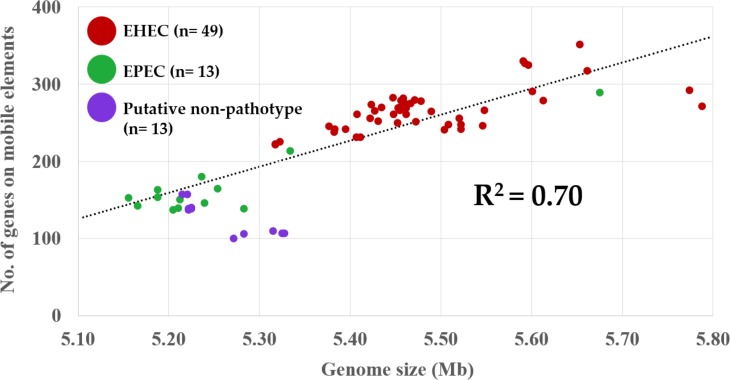
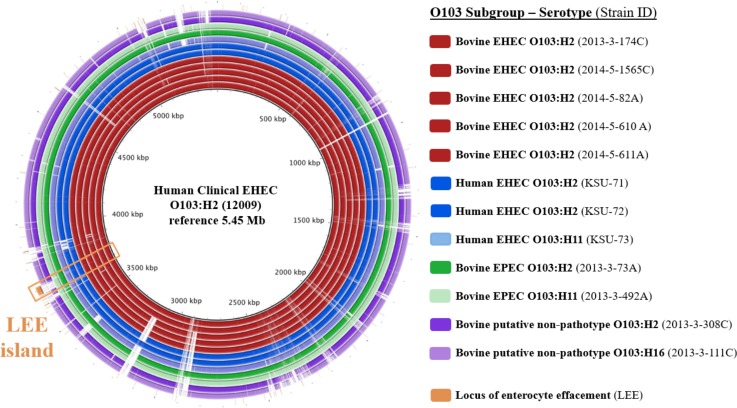
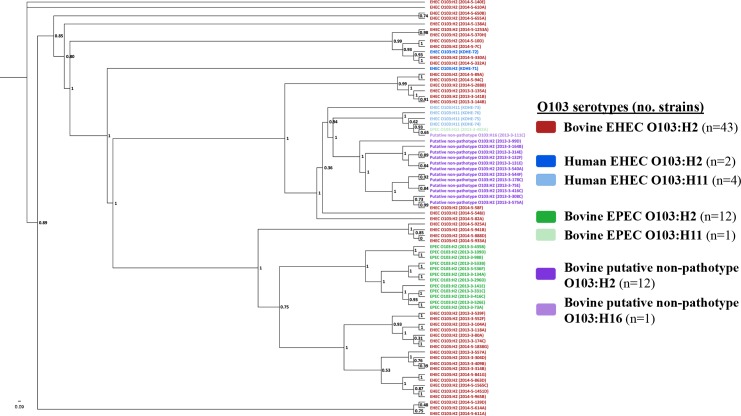
Escherichia coli O103, harbored in the hindgut and shed in the feces of cattle, can be enterohemorrhagic (EHEC), enteropathogenic (EPEC), or putative non-pathotype. The genetic diversity particularly that of virulence gene profiles within O103 serogroup is likely to be broad, considering the wide range in severity of illness. However, virulence descriptions of the E. coli O103 strains isolated from cattle feces have been primarily limited to major genes, such as Shiga toxin and intimin genes. Less is known about the frequency at which other virulence genes exist or about genes associated with the mobile genetic elements of E. coli O103 pathotypes. Our objective was to utilize whole genome sequencing (WGS) to identify and compare major and putative virulence genes of EHEC O103 (positive for Shiga toxin gene, stx1, and intimin gene, eae; n = 43), EPEC O103 (negative for stx1 and positive for eae; n = 13) and putative non-pathotype O103 strains (negative for stx and eae; n = 13) isolated from cattle feces. Six strains of EHEC O103 from human clinical cases were also included. All bovine EHEC strains (43/43) and a majority of EPEC (12/13) and putative non-pathotype strains (12/13) were O103:H2 serotype. Both bovine and human EHEC strains had significantly larger average genome sizes (P < 0.0001) and were positive for a higher number of adherence and toxin-based virulence genes and genes on mobile elements (prophages, transposable elements, and plasmids) than EPEC or putative non-pathotype strains. The genome size of the three pathotypes positively correlated (R2 = 0.7) with the number of genes carried on mobile genetic elements. Bovine strains clustered phylogenetically by pathotypes, which differed in several key virulence genes. The diversity of E. coli O103 pathotypes shed in cattle feces is likely reflective of the acquisition or loss of virulence genes carried on mobile genetic elements.
大肠杆菌O103存在于牛的后肠并随粪便排出,它可以是肠出血性的(EHEC)、肠致病性的(EPEC)或假定的非致病型。考虑到疾病严重程度的广泛差异,O103血清型内的遗传多样性,尤其是毒力基因谱的多样性可能很广泛。然而,从牛粪中分离出的大肠杆菌O103菌株的毒力描述主要限于主要基因,如志贺毒素和紧密素基因。对于其他毒力基因存在的频率或与大肠杆菌O103致病型移动遗传元件相关的基因了解较少。我们的目标是利用全基因组测序(WGS)来鉴定和比较从牛粪中分离出的肠出血性大肠杆菌O103(志贺毒素基因stx1和紧密素基因eae呈阳性;n = 43)、肠致病性大肠杆菌O103(stx1呈阴性,eae呈阳性;n = 13)和假定的非致病型O103菌株(stx和eae呈阴性;n = 13)的主要和假定毒力基因。还包括6株来自人类临床病例的肠出血性大肠杆菌O103。所有牛源肠出血性大肠杆菌菌株(43/43)以及大多数肠致病性大肠杆菌(12/13)和假定的非致病型菌株(12/13)都是O103:H2血清型。牛源和人源肠出血性大肠杆菌菌株的平均基因组大小均显著更大(P < 0.0001),并且与肠致病性大肠杆菌或假定的非致病型菌株相比,基于黏附、毒素的毒力基因以及移动元件(前噬菌体、转座元件和质粒)上的基因数量更多。三种致病型的基因组大小与移动遗传元件上携带的基因数量呈正相关(R2 = 0.7)。牛源菌株按致病型在系统发育上聚类,在几个关键毒力基因上存在差异。牛粪中排出的大肠杆菌O103致病型的多样性可能反映了移动遗传元件上携带的毒力基因的获得或丧失。