Division of Infectious Diseases, Department of Internal Medicine, Taipei Hospital, Ministry of Health and Welfare, New Taipei City, Taiwan.
Division of Infectious Diseases, Department of Internal Medicine, National Taiwan University Hospital, Taipei City, Taiwan.
BMC Infect Dis. 2019 Mar 12;19(1):245. doi: 10.1186/s12879-019-3880-z.
Increased resistance to third-generation cephalosporin (3GC) is a serious concern for community-onset Escherichia coli infection because this resistance easily delays effective treatment. This study surveyed the current antimicrobial resistance pattern among E. coli isolates that cause community-onset bacteremia, with a special focus on the prevalence of and the risk factors for 3GC resistance, and determined factors for poor outcomes among patients with community-onset E. coli bacteremia.
This retrospective study was conducted at a tertiary-care teaching hospital in Taiwan. All adult patients with community-onset E. coli bacteremia between January 1, 2015, and December 31, 2015 were enrolled and were divided into two groups depending on whether the E. coli isolate was susceptible to 3GCs. Risk factors for 3GC resistance, 14-day all-cause mortality, and length of hospital stay were analyzed.
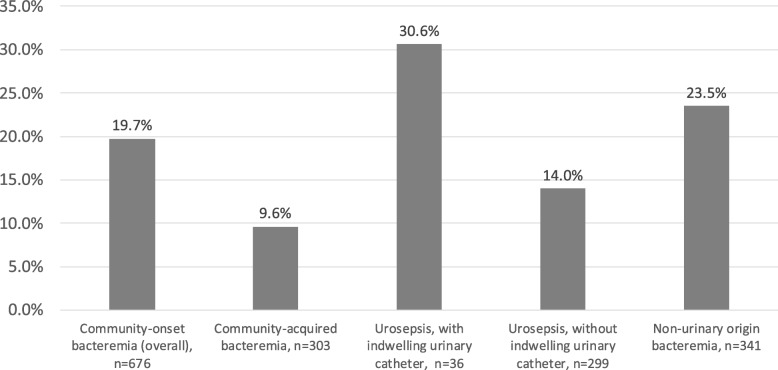
The overall rate of 3GC resistance among E. coli isolates causing community-onset bacteremia was 19.7%, whereas it was 9.6% if only isolates causing community-acquired bacteremia were considered. Independent risk factors for 3GC-resistant community-onset E. coli bacteremia were hospitalization within the past 1 year (odds ratio: 2.4, 95% confidence interval: 1.6-3.7, P < 0.001), exposure to antibiotics within the past 15 days (2.6, 1.4-4.9, P = 0.002), residence in nursing home or long-term care facility (3.6, 1.0-12.3, P = 0.044), presence of underlying genitourinary disease (1.9, 1.2-2.9, P = 0.005), and presence of indwelling implantable intravenous port (2.2, 1.1-4.1, P = 0.021). 3GC resistance was independently associated with increased length of hospital stays (P < 0.001).
In this study, the prevalence of 3GC resistance was high among both patients with community-onset and those with community-acquired E. coli bacteremia. 3GC resistance is a strong independent risk factor for length of hospital stay. The effectiveness of empirical antibiotic treatment would partially explain the impact of 3GC resistance, but more evidence is needed. The choice of appropriate empirical antibiotics for community-onset E. coli bacteremia might impact outcomes in terms of the length of hospital stay and need to be individualized according to the patient-specific risk for acquiring drug-resistant pathogens.
社区获得性大肠杆菌感染对第三代头孢菌素(3GC)的耐药性增加令人担忧,因为这种耐药性容易延误有效治疗。本研究调查了引起社区获得性菌血症的大肠杆菌分离株目前的抗菌药物耐药模式,特别关注 3GC 耐药的流行情况和危险因素,并确定了社区获得性大肠杆菌菌血症患者不良预后的相关因素。
本回顾性研究在台湾一家三级教学医院进行。2015 年 1 月 1 日至 12 月 31 日期间,所有成人社区获得性大肠杆菌菌血症患者均纳入研究,并根据 3GC 对大肠杆菌分离株的敏感性分为两组。分析 3GC 耐药的危险因素、14 天全因死亡率和住院时间。
社区获得性菌血症中大肠杆菌分离株的整体 3GC 耐药率为 19.7%,而仅考虑社区获得性菌血症的分离株则为 9.6%。3GC 耐药性社区获得性大肠杆菌菌血症的独立危险因素为:过去 1 年内住院(比值比:2.4,95%置信区间:1.6-3.7,P<0.001)、过去 15 天内使用抗生素(2.6,1.4-4.9,P=0.002)、居住在疗养院或长期护理机构(3.6,1.0-12.3,P=0.044)、存在潜在的泌尿道疾病(1.9,1.2-2.9,P=0.005)和存在留置植入式静脉端口(2.2,1.1-4.1,P=0.021)。3GC 耐药与住院时间延长独立相关(P<0.001)。
在本研究中,社区获得性和社区获得性大肠杆菌菌血症患者的 3GC 耐药率均较高。3GC 耐药是住院时间延长的独立危险因素。经验性抗生素治疗的有效性部分解释了 3GC 耐药的影响,但还需要更多证据。根据患者获得耐药病原体的特定风险,选择适当的经验性抗生素治疗社区获得性大肠杆菌菌血症可能会影响住院时间和预后。