Wisselink Henk J, Smid Bregtje, Plater Jane, Ridley Anne, Andersson Anna-Maria, Aspán Anna, Pohjanvirta Tarja, Vähänikkilä Nella, Larsen Helene, Høgberg Jonas, Colin Adélie, Tardy Florence
Wageningen Bioveterinary Research, P.O. Box 65, 8200 AB, Lelystad, The Netherlands.
Animal and Plant Health Agency (APHA), Surrey, UK.
BMC Vet Res. 2019 Mar 12;15(1):86. doi: 10.1186/s12917-019-1819-7.
Several species-specific PCR assays, based on a variety of target genes are currently used in the diagnosis of Mycoplasma bovis infections in cattle herds with respiratory diseases and/or mastitis. With this diversity of methods, and the development of new methods and formats, regular performance comparisons are required to ascertain diagnostic quality. The present study compares PCR methods that are currently used in six national veterinary institutes across Europe. Three different sample panels were compiled and analysed to assess the analytical specificity, analytical sensitivity and comparability of the different PCR methods. The results were also compared, when appropriate, to those obtained through isolation by culture. The sensitivity and comparability panels were composed of samples from bronchoalveolar fluids of veal calves, artificially contaminated or naturally infected, and hence the comparison of the different methods included the whole workflow from DNA extraction to PCR analysis.
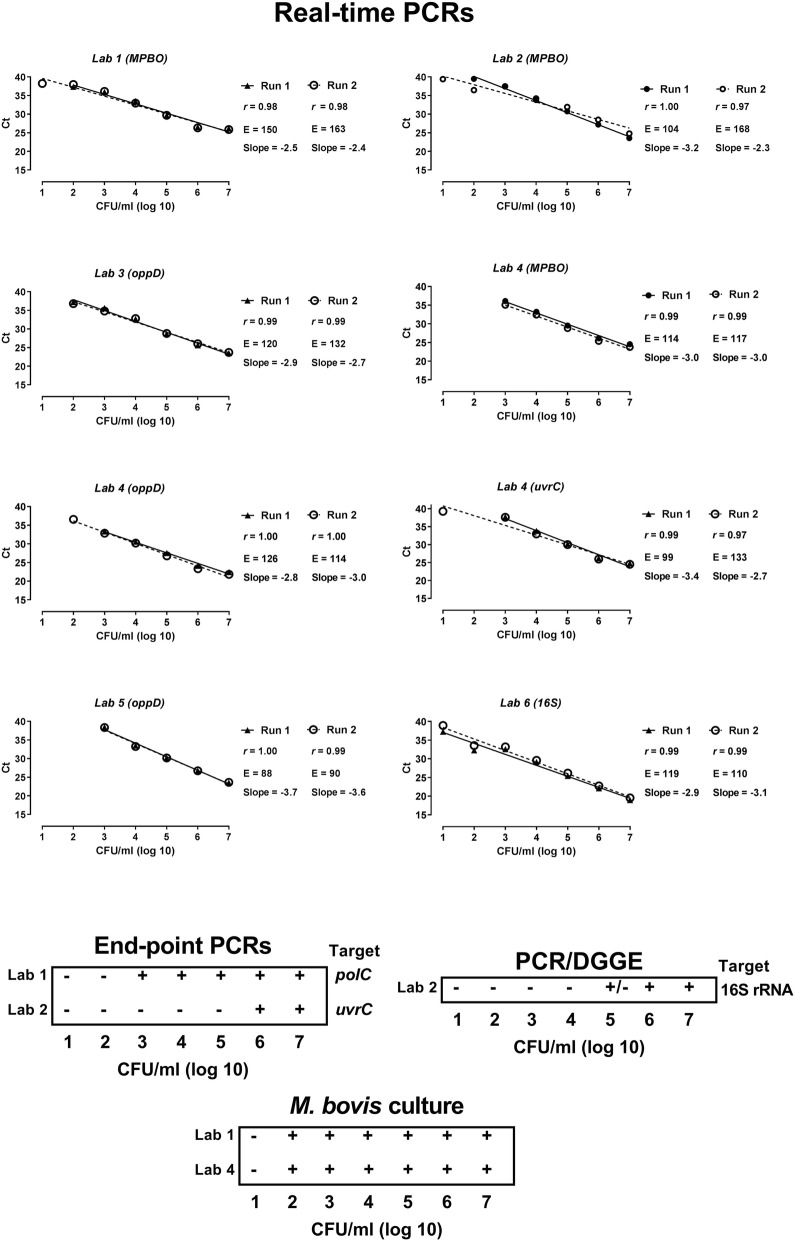
The participating laboratories used i) five different DNA extraction methods, ii) seven different real-time and/or end-point PCRs targeting four different genes and iii) six different real-time PCR platforms. Only one commercial kit was assessed; all other PCR assays were in-house tests adapted from published methods. The analytical specificity of the different PCR methods was comparable except for one laboratory where Mycoplasma agalactiae was tested positive. Frequently, weak-positive results with Ct values between 37 and 40 were obtained for non-target Mycoplasma strains. The limit of detection (LOD) varied from 10 to 10 CFU/ml to 10 and 10 CFU/ml for the real-time and end-point assays, respectively. Cultures were also shown to detect concentrations down to 10 CFU/ml. Although Ct values showed considerable variation with naturally infected samples, both between laboratories and tests, the final result interpretation of the samples (positive versus negative) was essentially the same between the different laboratories.
With a few exceptions, all methods used routinely in the participating laboratories showed comparable performance, which assures the quality of diagnosis, despite the multiplicity of the methods.
目前,基于多种靶基因的几种物种特异性PCR检测方法被用于诊断患有呼吸道疾病和/或乳腺炎的牛群中的牛支原体感染。由于方法多样,且新方法和新形式不断发展,需要定期进行性能比较以确定诊断质量。本研究比较了欧洲六个国家兽医研究所目前使用的PCR方法。编制并分析了三个不同的样本组,以评估不同PCR方法的分析特异性、分析灵敏度和可比性。还在适当的时候将结果与通过培养分离获得的结果进行了比较。灵敏度和可比性样本组由人工污染或自然感染的犊牛支气管肺泡液样本组成,因此不同方法的比较包括从DNA提取到PCR分析的整个工作流程。
参与实验室使用了:i)五种不同的DNA提取方法,ii)针对四个不同基因的七种不同的实时和/或终点PCR,以及iii)六种不同的实时PCR平台。仅评估了一种商业试剂盒;所有其他PCR检测均为根据已发表方法改编的内部测试。除了一个实验室检测无乳支原体呈阳性外,不同PCR方法的分析特异性具有可比性。对于非靶标支原体菌株,经常获得Ct值在37至40之间的弱阳性结果。实时检测和终点检测的检测限分别为10⁻¹至10⁻⁵CFU/ml和10⁻²至10⁻⁵CFU/ml。培养也显示可检测到低至10⁻¹CFU/ml的浓度。尽管Ct值在天然感染样本中在不同实验室和测试之间显示出相当大的差异,但不同实验室对样本的最终结果解释(阳性与阴性)基本相同。
除少数例外,参与实验室常规使用的所有方法均表现出可比的性能,这确保了诊断质量,尽管方法多种多样。