Cancer Biology and Epigenetics Group (CBEG), IPO Porto Research Center (CI-IPOP), Portuguese Oncology Institute of Porto (IPO Porto) & Porto Comprehensive Cancer Center (P.CCC), R. Dr. António Bernardino de Almeida, 4200-072, Porto, Portugal.
Department of Pathology, Portuguese Oncology Institute of Porto (IPOP), R. Dr. António Bernardino de Almeida, 4200-072, Porto, Portugal.
J Transl Med. 2019 Mar 12;17(1):79. doi: 10.1186/s12967-019-1837-z.
Covalent RNA modifications, such as N-6-methyladenosine (mA), have been associated with various biological processes, but their role in cancer remains largely unexplored. mA dynamics depends on specific enzymes whose deregulation may also impact in tumorigenesis. Herein, we assessed the differential abundance of mA, its writer VIRMA and its reader YTHDF3, in testicular germ cell tumors (TGCTs), looking for clinicopathological correlates.
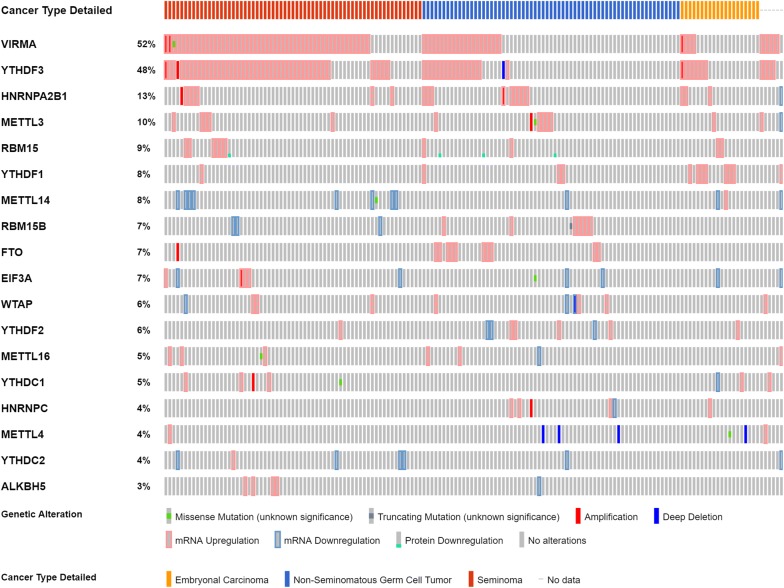
In silico analysis of TCGA data disclosed altered expression of VIRMA (52%) and YTHDF3 (48%), prompting subsequent validation. Formalin-fixed paraffin-embedded tissues from 122 TGCTs (2005-2016) were selected. RNA extraction, cDNA synthesis and real-time qPCR (Taqman assays) for VIRMA and YTHDF3 were performed, as well as immunohistochemistry for VIRMA, YTHDF3 and mA, for staining intensity assessment. Associations between categorical variables were assessed using Chi square and Fisher's exact test. Distribution of continuous variables between groups was compared using the nonparametric Mann-Whitney and Kruskal-Wallis tests. Biomarker performance was assessed through receiver operating characteristics (ROC) curve construction and a cut-off was established by Youden's index method. Statistical significance was set at p < 0.05.
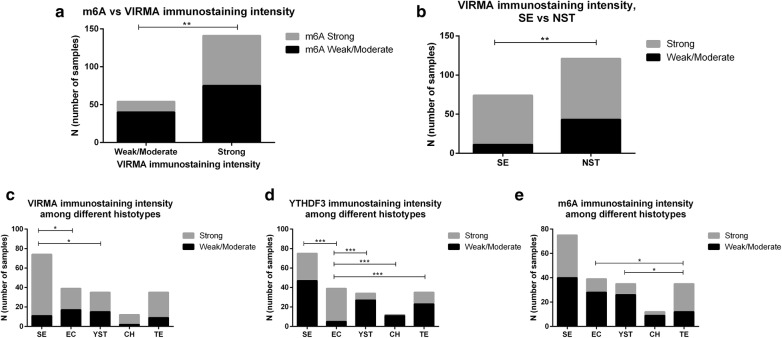
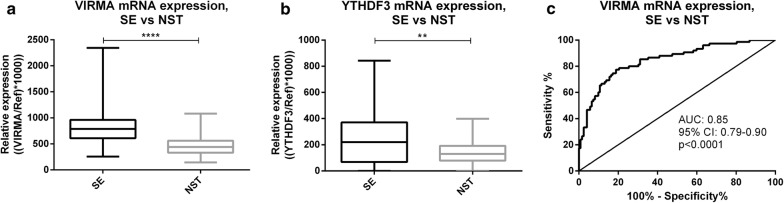
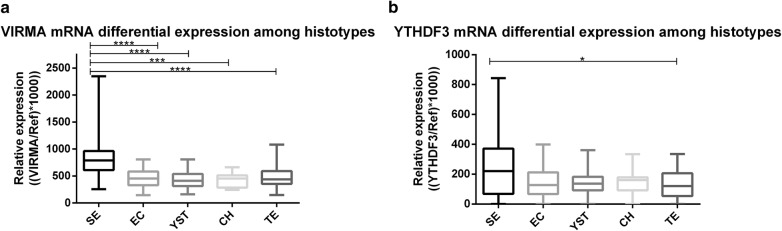
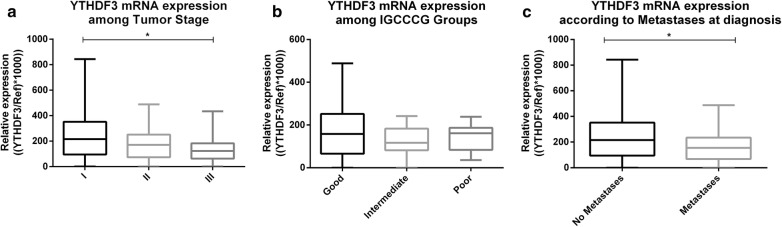
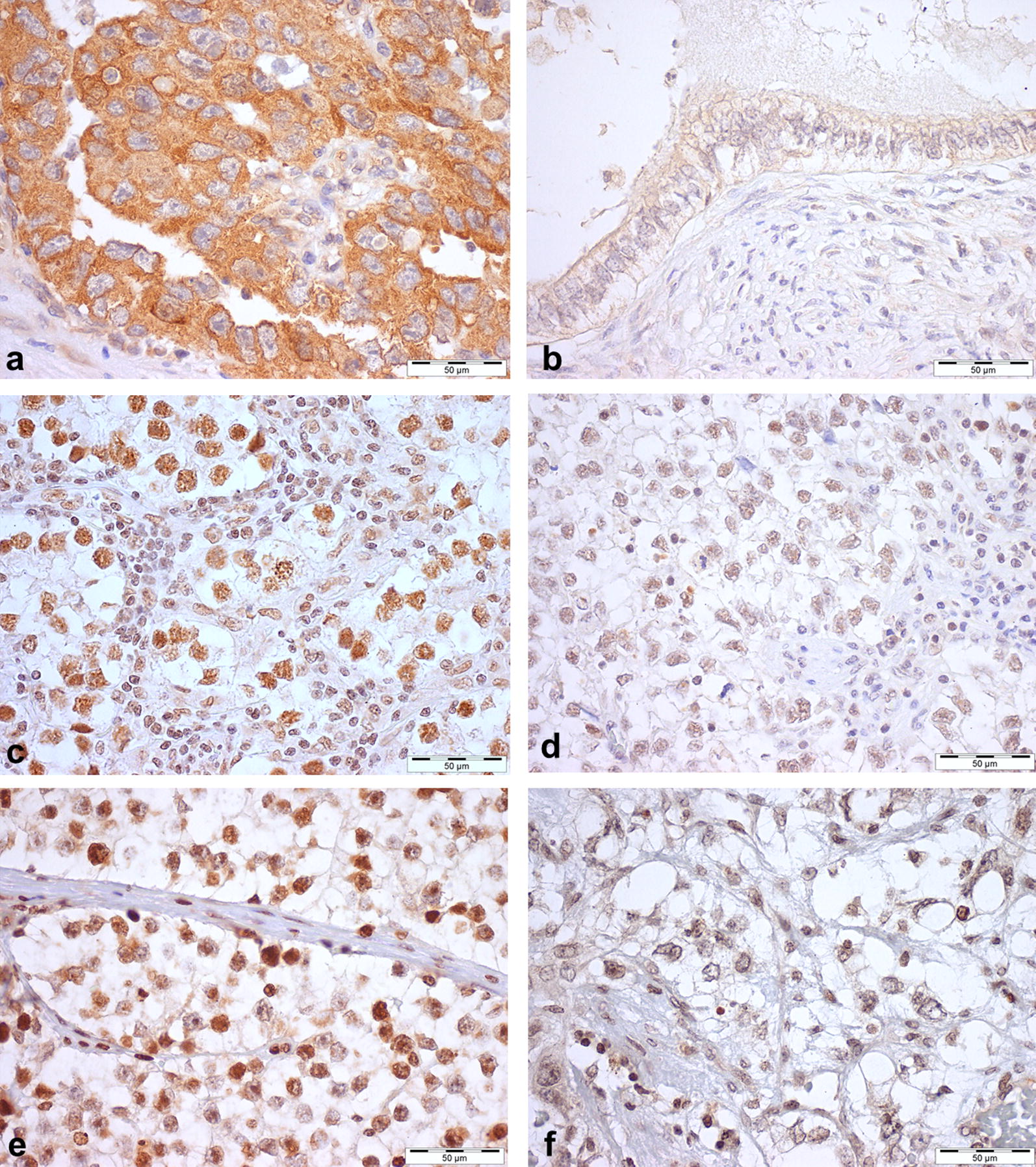
In our cohort, VIRMA and YTHDF3 mRNA expression levels differed among TGCT subtypes, with Seminomas (SEs) depicting higher levels than Non-Seminomatous tumors (NSTs) (p < 0.01 for both). A positive correlation was found between VIRMA and YTHDF3 expression levels. VIRMA discriminated SEs from NSTs with AUC = 0.85 (Sensitivity 77.3%, Specificity 81.1%, PPV 71.6%, NPV 85.3%, Accuracy 79.7%). Immunohistochemistry paralleled transcript findings, as patients with strong mA immunostaining intensity depicted significantly higher VIRMA mRNA expression levels and stronger VIRMA immunoexpression intensity (p < 0.001 and p < 0.01, respectively).
Abundance of mA and expression of VIRMA/YTHDF3 were different among TGCT subtypes, with higher levels in SEs, suggesting a contribution to SE phenotype maintenance. VIRMA and YTHDF3 might cooperate in mA establishment in TGCTs, and their transcript levels accurately discriminate between SEs and NSTs, constituting novel candidate biomarkers for patient management.
共价 RNA 修饰,如 N-6-甲基腺苷(mA),与各种生物学过程有关,但它们在癌症中的作用在很大程度上仍未得到探索。mA 的动态取决于特定的酶,其失调也可能影响肿瘤发生。在此,我们评估了睾丸生殖细胞肿瘤(TGCTs)中 mA、其书写酶 VIRMA 和其读取酶 YTHDF3 的差异丰度,寻找临床病理相关性。
TCGA 数据的计算机分析揭示了 VIRMA(52%)和 YTHDF3(48%)表达的改变,随后进行了验证。选择了 122 例 TGCTs(2005-2016 年)的福尔马林固定石蜡包埋组织。进行了 VIRMA 和 YTHDF3 的 RNA 提取、cDNA 合成和实时 qPCR(Taqman 测定),以及 VIRMA、YTHDF3 和 mA 的免疫组织化学染色,以评估染色强度。使用卡方检验和 Fisher 精确检验评估分类变量之间的关联。使用非参数 Mann-Whitney 和 Kruskal-Wallis 检验比较组间连续变量的分布。通过构建受试者工作特征(ROC)曲线评估生物标志物的性能,并通过 Youden 指数法建立截止值。统计学意义设定为 p<0.05。
在我们的队列中,VIRMA 和 YTHDF3 mRNA 表达水平在 TGCT 亚型之间存在差异,精原细胞瘤(SEs)的表达水平高于非精原细胞瘤(NSTs)(均为 p<0.01)。发现 VIRMA 和 YTHDF3 的表达水平之间存在正相关。VIRMA 以 AUC=0.85(敏感性 77.3%,特异性 81.1%,PPV 71.6%,NPV 85.3%,准确性 79.7%)区分 SEs 和 NSTs。免疫组织化学与转录结果平行,具有强烈 mA 免疫染色强度的患者具有显著更高的 VIRMA mRNA 表达水平和更强的 VIRMA 免疫表达强度(均为 p<0.001 和 p<0.01)。
mA 和 VIRMA/YTHDF3 的丰度在 TGCT 亚型之间存在差异,SEs 中的水平更高,表明其对 SE 表型维持有贡献。VIRMA 和 YTHDF3 可能在 TGCTs 中共同参与 mA 的建立,其转录水平准确地区分 SEs 和 NSTs,是患者管理的新候选生物标志物。