Coronary Research Group, University Hospital Southampton NHS Foundation Trust, Southampton, UK.
Biochemistry Department, University Hospital Southampton NHS Foundation Trust, Southampton, UK.
BMJ. 2019 Mar 13;364:l729. doi: 10.1136/bmj.l729.
To determine the distribution, and specifically the true 99th centile, of high sensitivity cardiac troponin I (hs-cTnI) for a whole hospital population by applying the hs-cTnI assay currently used routinely at a large teaching hospital.
Prospective, observational cohort study.
University Hospital Southampton NHS Foundation Trust, Southampton, United Kingdom, between 29 June 2017 and 24 August 2017.
20 000 consecutive inpatients and outpatients undergoing blood tests for any clinical reason. Hs-cTnI concentrations were measured in all study participants and nested for analysis except when the supervising doctor had requested hs-cTnI for clinical reasons.
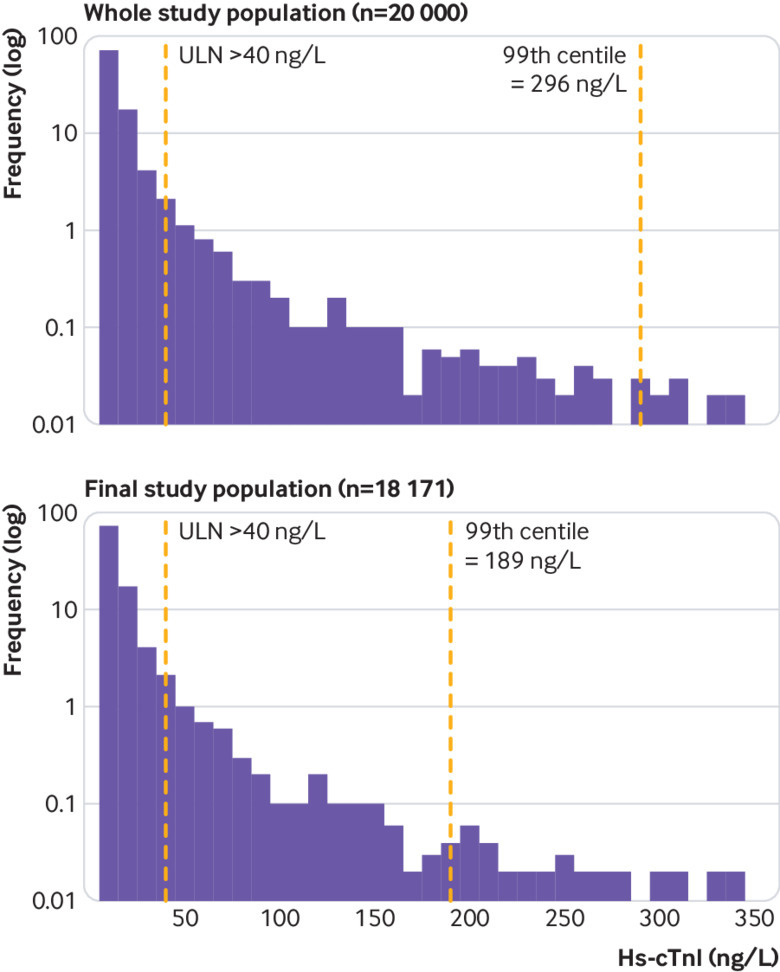
Distribution of hs-cTnI concentrations of all study participants and specifically the 99th centile.
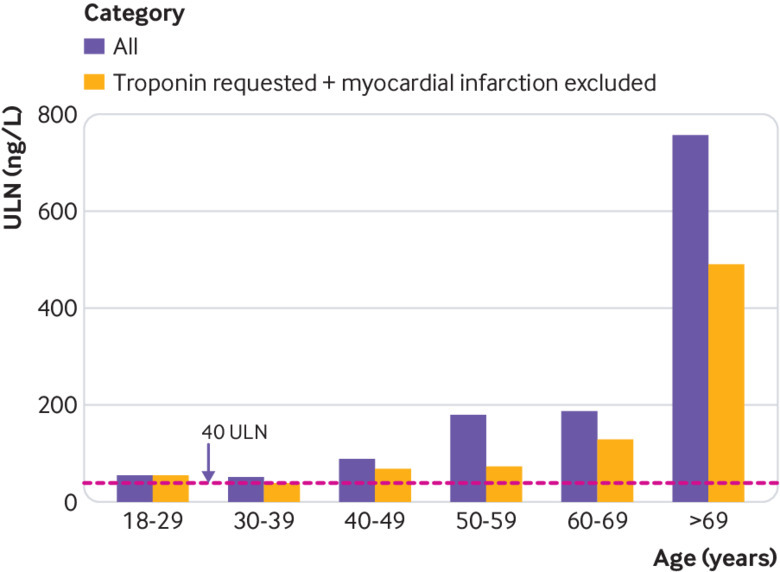
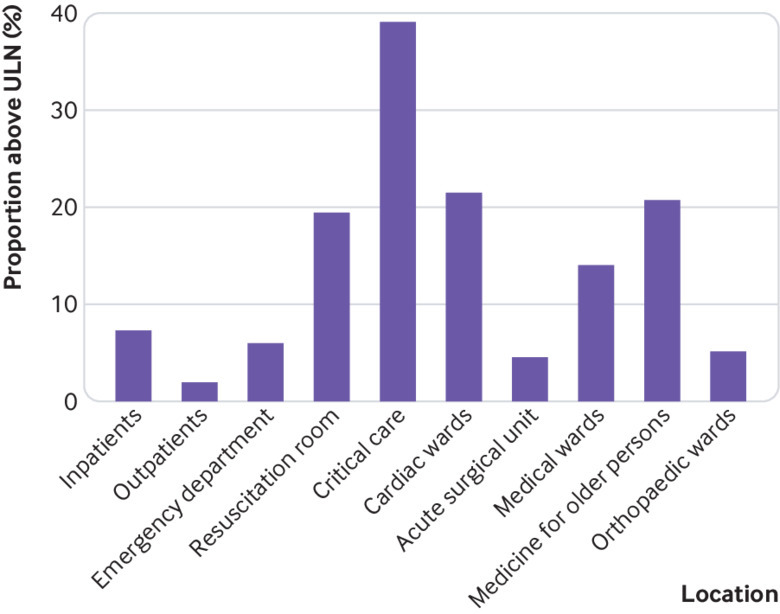
The 99th centile of hs-cTnI for the whole population was 296 ng/L compared with the manufacturer's quoted level of 40 ng/L (currently used clinically as the upper limit of normal; ULN). Hs-cTnI concentrations were greater than 40 ng/L in one in 20 (5.4%, n=1080) of the total population. After excluding participants diagnosed as having acute myocardial infarction (n=122) and those in whom hs-cTnI was requested for clinical reasons (n=1707), the 99th centile was 189 ng/L for the remainder (n=18 171). The 99th centile was 563 ng/L for inpatients (n=4759) and 65 ng/L for outpatients (n=9280). Patients from the emergency department (n=3706) had a 99th centile of 215 ng/L, with 6.07% (n=225) greater than the recommended ULN. 39.02% (n=48) of all patients from the critical care units (n=123) and 14.16% (n=67) of all medical inpatients had an hs-cTnI concentration greater than the recommended ULN.
Of 20 000 consecutive patients undergoing a blood test for any clinical reason at our hospital, one in 20 had an hs-cTnI greater than the recommended ULN. These data highlight the need for clinical staff to interpret hs-cTnI concentrations carefully, particularly when applying the recommended ULN to diagnose acute myocardial infarction, in order to avoid misdiagnosis in the absence of an appropriate clinical presentation.
Clinicaltrials.gov NCT03047785.
通过应用目前在一家大型教学医院常规使用的高敏肌钙蛋白 I(hs-cTnI)检测方法,确定整个医院人群中高敏肌钙蛋白 I 的分布情况,特别是 99 百分位数。
前瞻性观察队列研究。
南安普顿大学医院 NHS 基金会信托基金,英国南安普顿,2017 年 6 月 29 日至 2017 年 8 月 24 日。
20000 例连续接受任何临床原因血液检查的住院患者和门诊患者。对所有研究参与者进行 hs-cTnI 浓度检测,并进行嵌套分析,除非主治医生出于临床原因要求进行 hs-cTnI 检测。
所有研究参与者的 hs-cTnI 浓度分布情况,特别是 99 百分位数。
整个人群的 hs-cTnI 99 百分位数为 296ng/L,而制造商规定的 hs-cTnI 水平为 40ng/L(目前临床上作为正常值上限使用)。总人群中每 20 人就有 1 人(5.4%,n=1080)hs-cTnI 浓度大于 40ng/L。排除诊断为急性心肌梗死的参与者(n=122)和因临床原因要求进行 hs-cTnI 检测的参与者(n=1707)后,其余(n=18171)参与者的 99 百分位数为 189ng/L。住院患者(n=4759)的 99 百分位数为 563ng/L,门诊患者(n=9280)为 65ng/L。来自急诊科的患者(n=3706)的 99 百分位数为 215ng/L,其中 6.07%(n=225)高于推荐的正常值上限。所有来自重症监护病房的患者(n=123)的 39.02%(n=48)和所有内科住院患者的 14.16%(n=67)的 hs-cTnI 浓度均高于推荐的正常值上限。
在我们医院,连续 20000 例因任何临床原因接受血液检查的患者中,有 1/20 的患者 hs-cTnI 高于推荐的正常值上限。这些数据突出表明,临床医务人员在解读 hs-cTnI 浓度时需要格外谨慎,特别是在应用推荐的正常值上限来诊断急性心肌梗死时,以避免在没有适当临床表现的情况下误诊。
Clinicaltrials.gov NCT03047785。