Department of Systems Neuroscience, University Medical Centre Hamburg-Eppendorf, Martinistrasse 52, D-20246, Hamburg, Germany.
Sci Rep. 2019 Mar 13;9(1):4349. doi: 10.1038/s41598-019-40935-6.
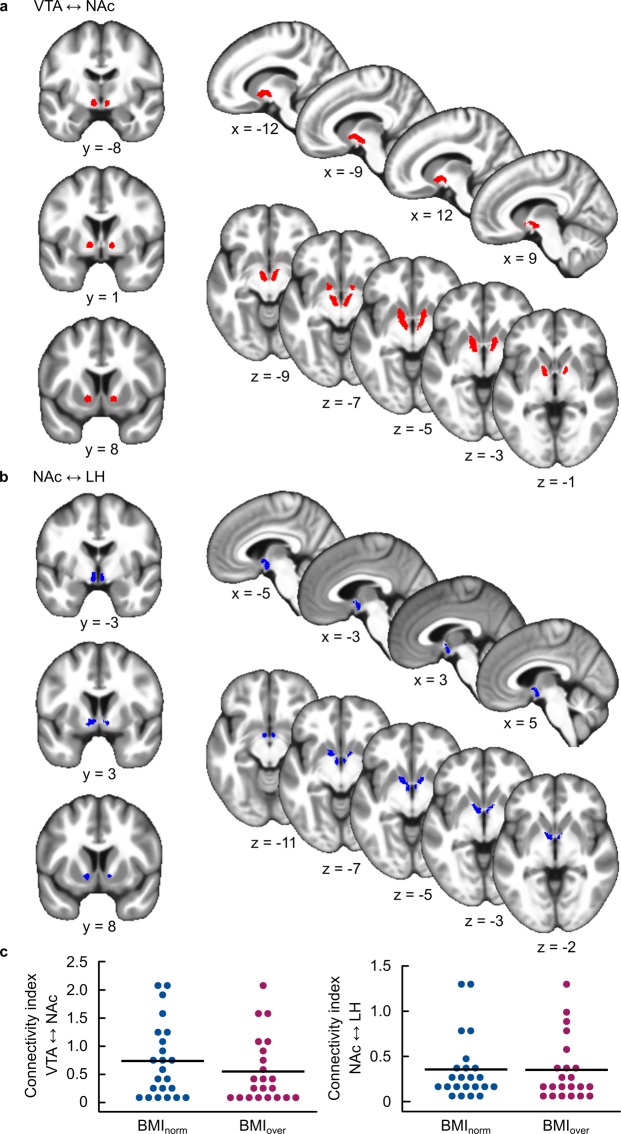
Dopaminergic brain structures like the nucleus accumbens (NAc) are thought to encode the incentive salience of palatable foods motivating appetitive behaviour. Animal studies have identified neural networks mediating the regulation of hedonic feeding that comprise connections of the NAc with the ventral tegmental area (VTA) and the lateral hypothalamus (LH). Here, we investigated how structural connectivity of these pathways relates to individual variability in decisions on sweet food consumption in humans. We therefore combined probabilistic tractography on diffusion imaging data from 45 overnight fasted lean to overweight participants with real decisions about high and low sugar food consumption. Across all individuals, sugar preference and connectivity strength were not directly related, however, multiple regression analysis revealed interaction of mesolimbic structure and sugar preference to depend on individuals' BMI score. In overweight individuals (BMI: ≥25 kg/m², N = 22) higher sugar preference was thereby specifically related to stronger connectivity within the VTA-NAc pathway while the opposite pattern emerged in participants with normal BMI (BMI: <25 kg/m², N = 23). Our structural results complement previous functional findings on the critical role of the human mesolimbic system for regulating hedonic eating in overweight individuals.
多巴胺能脑区结构,如伏隔核(NAc),被认为编码美味食物的激励显著性,从而激发食欲行为。动物研究已经确定了调节享乐性进食的神经网络,包括 NAc 与腹侧被盖区(VTA)和外侧下丘脑(LH)的连接。在这里,我们研究了这些通路的结构连接如何与人类对甜食消费决策的个体差异相关。因此,我们将 45 名禁食过夜的瘦到超重参与者的弥散成像数据的概率追踪与关于高糖和低糖食物消费的真实决策相结合。在所有个体中,糖偏好和连接强度没有直接相关,但多元回归分析显示,中脑边缘结构和糖偏好的相互作用取决于个体的 BMI 评分。在超重个体(BMI:≥25kg/m²,N=22)中,更高的糖偏好与 VTA-NAc 通路内更强的连接有关,而在 BMI 正常的个体(BMI:<25kg/m²,N=23)中则出现相反的模式。我们的结构结果补充了先前关于人类中脑边缘系统在调节超重个体享乐性进食方面的关键作用的功能研究结果。