Deng Yuanjun, Tang Kairui, Chen Runsen, Nie Huan, Liang Shu, Zhang Jinwen, Zhang Yupei, Yang Qinhe
School of Traditional Chinese Medicine, Jinan University, Guangzhou, Guangdong 510632, P.R. China.
Exp Ther Med. 2019 Mar;17(3):2091-2098. doi: 10.3892/etm.2019.7208. Epub 2019 Jan 28.
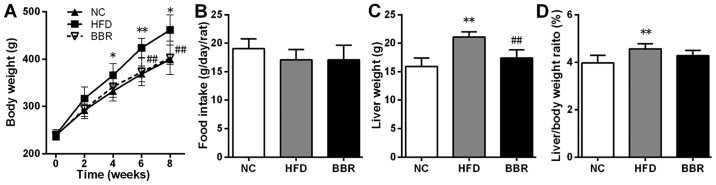
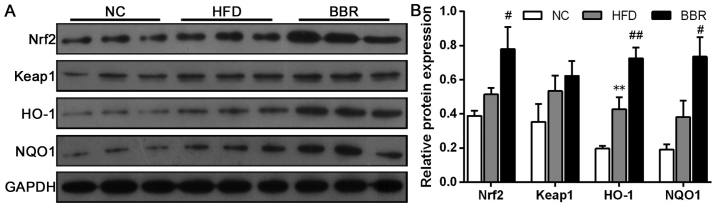
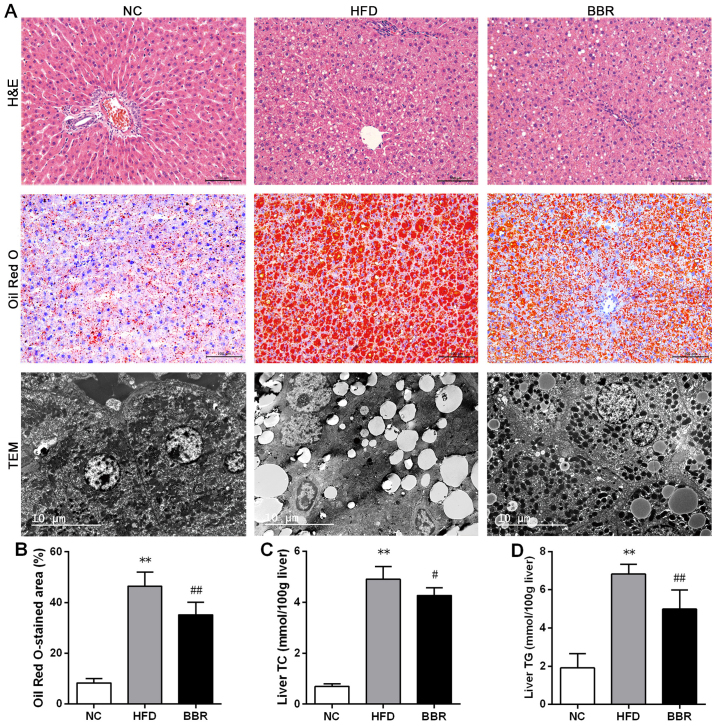
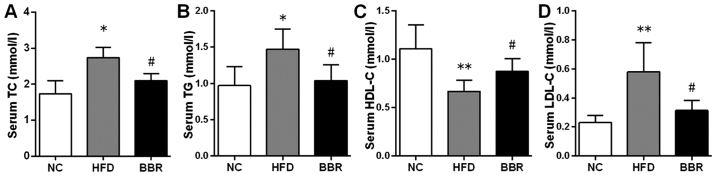
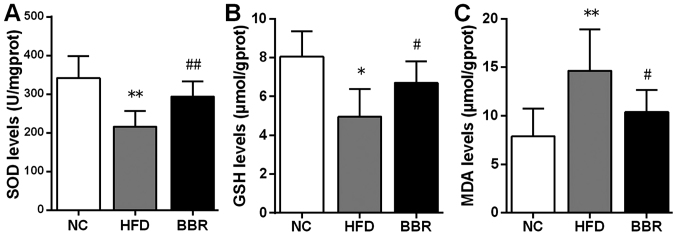
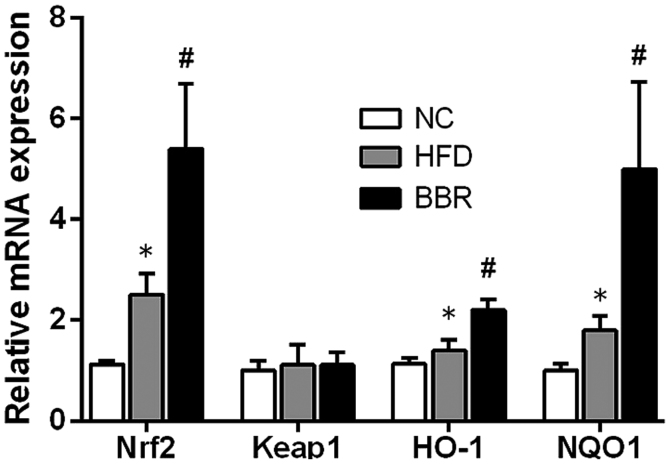
The present study investigated the effects of berberine (BBR) on hepatic oxidative stress and the nuclear factor erythroid 2-related factor 2/antioxidant response element (Nrf2/ARE) signalling pathway in rats in which non-alcoholic fatty liver disease (NAFLD) was induced by a high-fat diet. Rats were randomly divided into three groups: The normal control (NC), high-fat diet (HFD) and BBR groups. The NC group received a normal diet, while the other two groups were fed a high-fat diet. The rats in the BBR group were also fed BBR (100 mg/kg body weight) daily. A total of 8 weeks later, serum and liver lipid levels were measured. Hepatic histopathological changes were observed with haematoxylin and eosin and Oil Red O staining. Transmission electron microscopy was performed to observe the ultrastructural changes of the liver. The levels of superoxide dismutase (SOD), glutathione (GSH) and malondialdehyde (MDA) in the liver were measured. Quantitative polymerase chain reaction and western blotting were performed to investigate the expression of genes in the Nrf2/ARE signalling pathway in the liver. Histopathological results demonstrated that rats fed a high-fat diet for 8 weeks developed NAFLD, characterized by hepatic steatosis. BBR significantly decreased the body weight and liver weight. BBR markedly reduced hepatic steatosis, and the serum and liver lipid levels. Hepatic SOD and GSH levels were increased, while MDA levels were decreased by BBR co-administered with a high-fat diet. Additionally, the Nrf2/ARE signalling pathway was revealed to be involved in the protective effect of BBR on rats fed a high-fat diet. In conclusion, BBR may alleviate hepatic oxidative stress in rats with NAFLD, which may be partly attributed to the activation of the Nrf2/ARE signalling pathway.
本研究探讨了黄连素(BBR)对高脂饮食诱导非酒精性脂肪性肝病(NAFLD)大鼠肝脏氧化应激及核因子红细胞2相关因子2/抗氧化反应元件(Nrf2/ARE)信号通路的影响。将大鼠随机分为三组:正常对照组(NC)、高脂饮食组(HFD)和BBR组。NC组给予正常饮食,其他两组给予高脂饮食。BBR组大鼠还每日给予BBR(100 mg/kg体重)。共8周后,检测血清和肝脏脂质水平。用苏木精-伊红和油红O染色观察肝脏组织病理学变化。进行透射电子显微镜观察肝脏超微结构变化。检测肝脏中超氧化物歧化酶(SOD)、谷胱甘肽(GSH)和丙二醛(MDA)水平。采用定量聚合酶链反应和蛋白质免疫印迹法研究肝脏中Nrf2/ARE信号通路相关基因的表达。组织病理学结果表明,高脂饮食喂养8周的大鼠发生了以肝脂肪变性为特征的NAFLD。BBR显著降低了体重和肝脏重量。BBR明显减轻了肝脂肪变性以及血清和肝脏脂质水平。与高脂饮食共同给予BBR可使肝脏SOD和GSH水平升高,而MDA水平降低。此外,Nrf2/ARE信号通路参与了BBR对高脂饮食喂养大鼠的保护作用。总之,BBR可能减轻NAFLD大鼠的肝脏氧化应激,这可能部分归因于Nrf2/ARE信号通路的激活。