Yang Jin, Ma Xiao-Jie, Li Ling, Wang Lei, Chen Ying-Gi, Liu Jing, Luo Yan, Zhuang Zhen-Jie, Yang Wen-Jun, Zang Shu-Fei, Shi Jun-Ping
Center for Translational Medicine, The Affiliated Hospital of Hangzhou Normal University, Hangzhou, Zhejiang 310015, P.R. China.
College of Medical Science, Zhejiang Chinese Medical University, Hangzhou 310053, Zhejiang, P.R. China.
Exp Ther Med. 2017 Nov;14(5):4134-4140. doi: 10.3892/etm.2017.5051. Epub 2017 Aug 28.
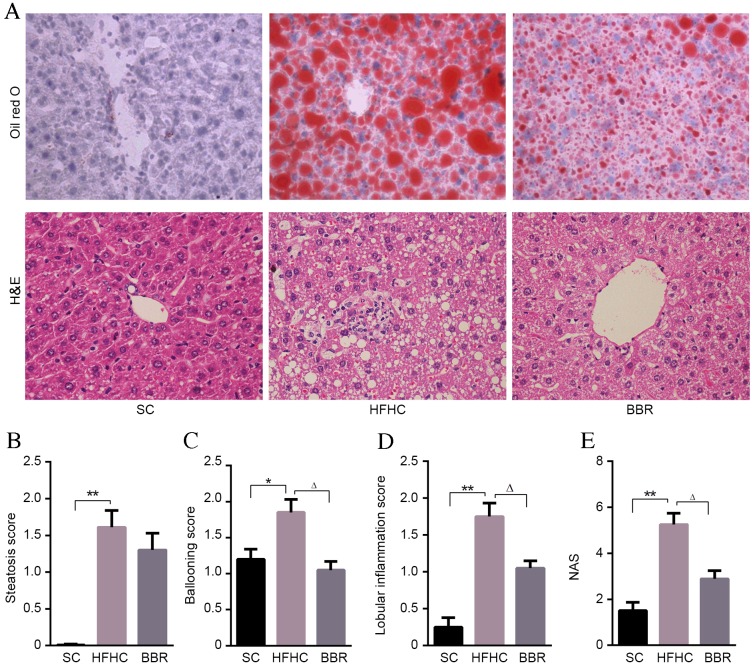
The aim of the present study was to explore the protective effects of Berberine (BBR) against non-alcoholic steatohepatitis (NASH). Male 4-week-old C57BL/6J Apolipoprotein E-deficient (ApoE) mice were divided into the following three groups, which were given different diets: Normal chow diet (SC group); high-fat high-cholesterol diet (HFHC group); and HFHC diet supplemented with BBR (BBR group). Serum biochemical indicators of hepatic function and histological liver tissue changes were evaluated. The expression of neutrophil elastase (NE) and genes involved in the inflammatory response was measured. ApoE mice fed a HFHC diet for 12 weeks developed NASH, characterized by steatosis and liver inflammation. Body weight, and serum triglyceride and cholesterol levels were markedly reduced by BBR. BBR supplementation significantly lowered serum alanine aminotransferase and aspartate aminotransferase levels in mice with HFHC diet-induced NASH, and significantly downregulated hepatic expression and activity of NE, whereas α1-antitrypsin (α1-AT) expression was significantly recovered by BBR (all P<0.05 vs. the HFHC group). Furthermore, treatment with BBR induced a significant reduction in the expression of key genes, including phospoinositide 3-kinase, nuclear factor-κB and interleukin-8, in the C-X-C chemokine receptor type 4 (CXCR4) signaling pathway (all P<0.05 vs. the HFHC group). These results suggest that BBR alleviates NASH in ApoE mice fed a HFHC diet. Restoration of the balance of NE and α1-AT levels, which in turn facilitate the inhibition of the CXCR4 signaling pathways, may be involved in the hepatoprotective effect of BBR. These results indicate that BBR may be a candidate therapeutic agent for the treatment of NASH.
本研究的目的是探讨黄连素(BBR)对非酒精性脂肪性肝炎(NASH)的保护作用。将4周龄雄性C57BL/6J载脂蛋白E缺陷(ApoE)小鼠分为以下三组,给予不同饮食:正常饲料饮食(SC组);高脂高胆固醇饮食(HFHC组);以及补充BBR的HFHC饮食(BBR组)。评估肝功能的血清生化指标和肝组织学变化。检测中性粒细胞弹性蛋白酶(NE)的表达及参与炎症反应的基因。喂食HFHC饮食12周的ApoE小鼠发生了NASH,其特征为脂肪变性和肝脏炎症。BBR可显著降低体重、血清甘油三酯和胆固醇水平。补充BBR可显著降低HFHC饮食诱导的NASH小鼠的血清丙氨酸氨基转移酶和天冬氨酸氨基转移酶水平,并显著下调肝脏NE的表达和活性,而BBR可使α1-抗胰蛋白酶(α1-AT)表达显著恢复(与HFHC组相比,所有P<0.05)。此外,BBR处理可显著降低C-X-C趋化因子受体4(CXCR4)信号通路中关键基因的表达,包括磷酸肌醇3激酶、核因子-κB和白细胞介素-8(与HFHC组相比,所有P<0.05)。这些结果表明,BBR可减轻喂食HFHC饮食的ApoE小鼠的NASH。NE和α1-AT水平平衡的恢复,进而促进CXCR4信号通路的抑制,可能参与了BBR的肝脏保护作用。这些结果表明,BBR可能是治疗NASH的候选治疗药物。