McLaughlin Katherine R, Johnston Lisa G, Gamble Laura J, Grigoryan Trdat, Papoyan Arshak, Grigoryan Samvel
Department of Statistics, Oregon State University, Corvallis, OR, United States.
5% Initiative, Expertise France, Paris, France.
JMIR Public Health Surveill. 2019 Mar 14;5(1):e12034. doi: 10.2196/12034.
Estimates of the sizes of hidden populations, including female sex workers (FSW), men who have sex with men (MSM), and people who inject drugs (PWID), are essential for understanding the magnitude of vulnerabilities, health care needs, risk behaviors, and HIV and other infections.
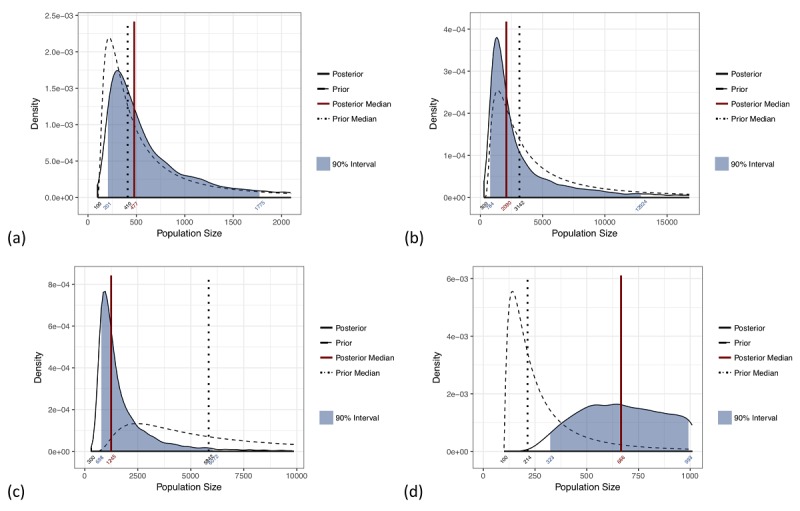
This article advances the successive sampling-population size estimation (SS-PSE) method by examining the performance of a modification allowing visibility to be jointly modeled with population size in the context of 15 datasets. Datasets are from respondent-driven sampling (RDS) surveys of FSW, MSM, and PWID from three cities in Armenia. We compare and evaluate the accuracy of our imputed visibility population size estimates to those found for the same populations through other unpublished methods. We then suggest questions that are useful for eliciting information needed to compute SS-PSE and provide guidelines and caveats to improve the implementation of SS-PSE for real data.
SS-PSE approximates the RDS sampling mechanism via the successive sampling model and uses the order of selection of the sample to provide information on the distribution of network sizes over the population members. We incorporate visibility imputation, a measure of a person's propensity to participate in the study, given that inclusion probabilities for RDS are unknown and social network sizes, often used as a proxy for inclusion probability, are subject to measurement errors from self-reported study data.
FSW in Yerevan (2012, 2016) and Vanadzor (2016) as well as PWID in Yerevan (2014), Gyumri (2016), and Vanadzor (2016) had great fits with prior estimations. The MSM populations in all three cities had inconsistencies with expert prior values. The maximum low prior value was larger than the minimum high prior value, making a great fit impossible. One possible explanation is the inclusion of transgender individuals in the MSM populations during these studies. There could be differences between what experts perceive as the size of the population, based on who is an eligible member of that population, and what members of the population perceive. There could also be inconsistencies among different study participants, as some may include transgender individuals in their accounting of personal network size, while others may not. Because of these difficulties, the transgender population was split apart from the MSM population for the 2018 study.
Prior estimations from expert opinions may not always be accurate. RDS surveys should be assessed to ensure that they have met all of the assumptions, that variables have reached convergence, and that the network structure of the population does not have bottlenecks. We recommend that SS-PSE be used in conjunction with other population size estimations commonly used in RDS, as well as results of other years of SS-PSE, to ensure generation of the most accurate size estimation.

对包括女性性工作者(FSW)、男男性行为者(MSM)和注射吸毒者(PWID)在内的隐性人群规模进行估计,对于了解脆弱性程度、医疗保健需求、风险行为以及艾滋病毒和其他感染情况至关重要。
本文通过检验一种改进方法的性能来推进连续抽样 - 人口规模估计(SS - PSE)方法,该改进方法允许在15个数据集的背景下将可见性与人口规模联合建模。数据集来自亚美尼亚三个城市对FSW、MSM和PWID的应答驱动抽样(RDS)调查。我们将推算的可见性人口规模估计值的准确性与通过其他未发表方法得出的相同人群的估计值进行比较和评估。然后,我们提出一些问题,这些问题有助于获取计算SS - PSE所需的信息,并提供指导方针和注意事项,以改进针对实际数据的SS - PSE实施。
SS - PSE通过连续抽样模型近似RDS抽样机制,并利用样本的选择顺序来提供有关总体成员网络规模分布的信息。我们纳入了可见性推算,鉴于RDS的纳入概率未知,且经常用作纳入概率代理的社交网络规模容易受到自我报告研究数据的测量误差影响,可见性推算是衡量一个人参与研究倾向的指标。
埃里温(2012年、2016年)和瓦纳佐尔(2016年)的FSW以及埃里温(2014年)、久姆里(2016年)和瓦纳佐尔(2016年)的PWID与先前估计值拟合度很高。所有三个城市的MSM人群与专家先前值存在不一致。最大的低先前值大于最小的高先前值,使得无法实现很好的拟合。一个可能的解释是在这些研究期间MSM人群中纳入了跨性别个体。基于谁是该人群的合格成员,专家所认为的人群规模与人群成员所认为的规模之间可能存在差异。不同研究参与者之间也可能存在不一致,因为有些人在计算个人网络规模时可能包括跨性别个体,而其他人可能不包括。由于这些困难,在2018年的研究中,跨性别群体从MSM人群中分离出来。
专家意见的先前估计可能并不总是准确的。应对RDS调查进行评估,以确保它们满足所有假设、变量已达到收敛且人群的网络结构没有瓶颈。我们建议将SS - PSE与RDS中常用的其他人口规模估计方法以及其他年份的SS - PSE结果结合使用,以确保生成最准确的规模估计。